Writing for Effect: A Dialogue with Mary L. Schmidt

Mary L. Schmidt writes under her given name and a pen name, S. Jackson with her freshman book a memoir, and she now has 30 books under her belt ranging from three memoirs to comic books, one recipe book, and a lot of children’s picture books. She chose to discuss three topic from three different books for this conversation.

  1. Childhood cancer is scary, horrific, and all consuming.

After surviving the cruel rage of tyranny from her mother and ex-husband, Sarah Jackson traveled a new path, a journey of loss, heartbreak, and ultimately strength. How do we survive the unthinkable, our child suffering from a terminal illness? They say there is no greater loss than that of a child; I say losing a child is the king of loss. Sometimes the thing that helps us survive it, is knowing we are not alone. Bestselling author, Sarah Jackson, will take you on her journey of hope and strength as she provides an intimate raw look at her life.

“I want to go to Heaven, Mom.” as my son lay in his hospital bed in the presurgical area.
“We don’t always get what we want in life, so you might have to come back to me.” I replied as my heart was breaking.

When Angels Fly

One cannot stop an angel from flying and when a child of age five wants to go to heaven, ask your child why, and what he or she knows of heaven. Don’t fear your child’s death but ask them. They will tell you what they know or have seen. My little boy had already spoken with Jesus.


Marian:
In this excerpt, you speak to the role of faith – both a mother’s and a child’s belief – in surviving the unthinkable. No parent should outlive their child, it is often said. But not all parents nor children will have a belief in a divine being. One of your stated goals is for people going through this life-altering experience to know they are not alone. Does your book speak to those who do not believe in a divine being or an afterlife, and if so, can you explain how?

Mary:

Great question! I can answer this one as my ex-husband is a practicing atheist and for his actions. My arm was wrapped around my son the final moments of his life. My ex wanted medicine for when my son’s heart stopped but no compressions. I wanted nothing done. I knew where my little boy wanted to go, and I knew he was moments away from death as he was in transition.  I had to beg my ex three times to let him go as his heart stopped for the third, and last time. He nodded his head yes. I rocked my dead son, after all tubes and such were removed. I talked to him in heaven. My ex simply watched. Then got up from the rocking chair and motioned for my ex to sit, after which I placed my son in his arms. He held him a few minutes then left the ICU. Essentially, as an atheist, my ex had to deal with his grief and such internally without help from the divine God. That led him to get drunk. But I turned to Jesus, and I was not alone.


2. A book on bullying evoking change in children.

In ‘The Big Cheese Festival’, we meet Stubby Mouse and his family and friends. We learn that Stubby Mouse has a secret, that he is being bullied by another mouse, simply because his tail is short. This story illustrates how everyone is different and unique, and it is a delightful read with adorable and eye-catching, cute illustrations for both children and adults. Take a stand against bullying today! 

“See! I did it! I stood up for myself and Cutter Mouse can’t bully me anymore.” replied Stubby Mouse.

The Big Cheese Festival

Thus, Stubby Mouse’s self-esteem increased, and he no longer allowed himself to be bullied by others.

Marian:

I’m curious to know what it is Stubby did to stand up to Cutter!  I like the choice of a simple thing like a short tail, because children can fixate on the smallest difference. How did you portray the bullying? Who helps Stubby stand up for himself?

Mary:

Stubby Mouse was happy and excited when he woke up on the morning of the Big Cheese Festival. All the mice in his neighborhood looked forward to this big event. There would be dancing and lots of cheese, and they would elect a King and Queen of the Festival. This was Stubby’s first Big Cheese Festival, but when Cutter Mouse came to pick up Stubby’s brother, Zippy, he made fun of Stubby’s short tail. Cutter laughed and said that no girls would want to dance with him. Zippy got angry with his friend for picking on his little brother, but the damage was done. After Zippy and Cutter left, Stubby began to cry. Cindy (a girl mouse) heard him crying inside the house, and she wanted to know what was wrong. She told Stubby that she liked him the way he was, and thought Cutter was an awful bully. They went to the festival together, and Cutter made fun of Stubby and knocked him down onto his short tail. Stubby informed Cutter that he would not be bullied anymore, and he pushed Cutter down on his normal size tail. This impressed all the mice attending as they loved Stubby and his bravery. Stubby became King of The Big Cheese Festival for his bravery.


3. A book regarding shyness in children as related by a turtle who was too shy to come out of his shell.

Tommy Turtle is a shy land turtle who likes to hide inside his shell. Tommy Turtle helps parents and teachers reinforce positive behaviors in an imaginative setting of a park and mud puddles as they learn about land turtles and shyness. Learning and sharing are essential for social development in all children.

“I’m scared to come out, I can’t splash the water puddles like the other turtles.” replied Tommy Turtle.

“I will be at your side, and you can jump when I jump. Okay?” said Jerry Turtle.

Tommy took a deep breath and poked his head out of his shell. He watched the other turtles playing, and finally decided to join in. Tommy made the biggest splash in the puddles, and learned that he could have fun, play, and be accepted by other turtles. Tommy also learned that he didn’t have to talk when he was a little more nervous. It was okay to watch, listen, and learn. It was okay to be shy at times. Tommy had the best afternoon, ever!

Tommy Turtle

Marian:

Is Jerry the same age as Tommy?  Or is he an older mentor?  Why does he take Tommy under his wing?  As you indicate, these are important skills for children to learn, but it is something they can do on their own without adult modelling? 

Mary:

Jerry and Tommy are nearly the same age. Tommy is new to the park this story is set in as some kids change schools, move around, and it’s natural to be shy. Tommy was shy and hid inside his shell because he didn’t know the other turtles. In Jerry’s case, he had been new to the same park the year before. Jerry befriended Tommy and drew him out of his shell. Tommy played and overcame his shyness. In the end, Tommy decided that he would help other new turtles when they arrived in the park, just like Jerry helped him. Children can read this book on their own and model their experiences to the experiences Tommy went through.


Find all books published as Sarah Jackson here and as Mary L. Schmidt here, or connect with Mary at her website www.whenangelsfly.net.

Would you like to be part of this series? Authors published or unpublished are welcome – leave a comment and I’ll get back to you.

WHAT THREE THINGS?

By Helen Hollick

Hello Marian, thank you for inviting me onto your blog. You asked me to tell you and your readers about the books I write. Where to start!

I used to write straight historical fiction: my first Pendragon’s Banner Trilogy was about King Arthur with a setting in Roman Britain in the 5th to 6th centuries. These were originally published back in the early 1990s – so I’ve been writing for a lo-o-ong while now! My intention for the trilogy was to strip away all the myth and magic of then Medieval Christian-based tales and write the books as ‘what might have happened’. Not for me the familiar ‘love triangle’, there is no Lancelot in my story, no Holy Grail, no Merlin either. I saw Arthur as an ambitious but capable war lord, Gwenhwyfar (Guinevere) as an equally capable woman. They love each other but are two people with intelligent minds – and firm ideas which often clash. I used the earlier Welsh legends, which are far more interesting and very different from the later Medieval tales.

Following these, I moved to the 11th century and the events that led to the Battle Of Hastings in 1066. I am a firm supporter of King Harold II, so this story is written from the English point of view – stripped of all the Norman propaganda. The other book is the story of Emma of Normandy – Queen Emma of Anglo-Saxon England. She was married to Æthelred the Unready and then to King Cnut. One of her sons was Edward the Confessor, so a prequel story to the people involved in the subsequent Norman Conquest of England.

I turned to crime during the months of lockdown – fictionally, that is. I branched out into writing cozy mysteries. My Jan Christopher Series are quick read novellas set in the 1970s against the background of my years of working as a library assistant – with the twist of a murder mystery included. There are two in the series published so far, I plan more!

My favourites, however, are the Sea Witch Voyages. I wrote the first, Sea Witch back in 2005/6 when I wanted to read something as good as the first Pirates of the Caribbean movie – but for adults (with some adult content, some adult scenes and language, and some violence.) I couldn’t find what I wanted to read so I wrote it myself. I have just published the sixth in the series, Gallows Wake, with a short read novella prequel, When The Mermaid Sings as a bonus read.

So, three things that I care passionately about in my writing?

1) My Characters. I fell hopelessly in love with ‘my’ Arthur, mind you, I was in that man’s mind for more than ten years (it took me that long to write what eventually became The Kingmaking and half of Pendragon’s Banner!) I am even more in love with my pirate (well, ex-pirate now,) Captain Jesamiah Acorne.  Funnily enough, I did notice, a while ago, when looking through bits of The Kingmaking, just how alike Arthur and Jesamiah are! They are both rough, tough guys. Both formidable when angry, but quick to laugh, both determined, both loyal in their own way – both would willingly die for the woman they love, even though tempers often flare between them. Honour is important for both of them – although both are also ruthless when needs must. They both have a solid, reliable friend and I wanted to portray them both as men who cared, who hurt when their hearts were broken and who drowned their sorrows …

2) I care about creating a feeling of believability. ‘Harold’ and ‘Emma’ both had a lot of historical fact to base the outline of the stories on: history tells us that this, this and this happened, and when and where it happened. The novelist has to decide (OK, make up) the whys and hows. For ‘Arthur’ there is nothing to go on – let’s face the truth, King Arthur did not exist (although he might have been an amalgamation of several notable post-Roman war lords.) So for the ‘facts’ I researched post-Roman Britain and used what little we do know as the basis for my trilogy. I also extensively used my knowledge of horses.

For ‘Jesamiah’ some of the elements in the Voyages are supernatural or fantasy – the love of Jesamiah’s life is Tiola, a White Witch, a Wise Woman of Craft. To balance the ‘made-up’ bits I was as careful as I could be to get the ‘real’ bits right, in particular the sailing scenes aboard Sea Witch. I also used quite a bit of factual history from the early 1700s – although some I did ‘bend’ a little to suit my timeline (but I mention what I changed in my author’s notes.) I have absolutely no knowledge of sailing Tall Ships, though. Fortunately there are a lot of good books to use for research and I have a wonderful friend in the author James L. Nelson who checks my sailing scenes for me – and doesn’t laugh too loudly at my bloopers!

3) I suppose my third passion is for writing the book I want to read. ‘Arthur’ I wrote because I have never liked the later Medieval tales. I could never see Arthur as the sort of king who would go off and leave his country for years (although Richard I, did). Nor could I see Gwenhwyfar as being so stupid as to have an affair with Lancelot (who, actually, I didn’t like anyway.) The familiar tales, I believe, were written as propaganda to get men to go off on Crusade, and to justify Richard I, the Lionheart’s obsessions.

‘Harold’ and ‘Emma’, were the same, I wanted to write their stories as they ought to have been written. As for Jesamiah, well, he’s entirely made up, but as I said earlier, I wanted to immerse myself in a swashbuckling, enjoyable and engrossing adult nautical adventure … I didn’t expect that first Voyage, however, to turn out to be such a successful series!

Choose an excerpt or two to illustrates one of your three topics.

1a. From The Kingmaking

With a short, exasperated sigh, Cei strode over to the drunkard. As he was about to shake the man’s shoulder, he broke into a chuckle. Ah no, the poor tavern keeper could not give this one to the street.

Roused by Cei’s persistent nudging, Arthur staggered unsteadily to his feet.

It was only a short journey to the palace but, hampered as he was by the almost dead weight of his companion, it took Cei a while to reach their assigned rooms, where, laughing, he waved Arthur’s sleepy servant aside. “Go back to your bed, I shall tend your master.” He seated Arthur on the bed and pulled off his boots. “An enjoyable evening, I assume. Trust you to spoil it by getting yourself over full of wine.”

1b. Excerpt from Sea Witch, the first Voyage

Waking several hours into the fore noon to a thundering headache, Jesamiah staggered to his feet. He tottered to the  door, peered out, squinting at the brightness of the morning sun.

Rue stepped forward offering a pewter tankard. “Drink this.”

Hesitant, Jesamiah took it wrinkled his nose at the foul looking liquid. “What is it?”

“Old French recipe. Brandy, ground garlic with ’alf a pint of ale. Deux œufs – fresh-laid is that cackle fruit – a pinch of gunpowder and melted pork lard.”

Jesamiah sniffed again at the concoction. He poked a finger into it and picked out a piece of floating egg shell. “I don’t care for raw eggs.”

“Just drink it.”

Doubtful, Jesamiah raised it to his mouth. Changing his mind, offered it back.  “Later perhaps.”

“Écoute mon gars,”  Rue said finally losing patience. “Look, my friend, you lead us like the brilliant captain you are or we leave you ’ere in this God-forgotten emptiness, with as many bottles of rum as you please.”

Jesamiah looked from Rue to the tankard. Hesitant, he raised it to his lips. “It smells foul.”

The fouler the medicine, the quicker the cure, or so ma mere used to say.”

“What was she? The village poisoner?”

Both these scenes get across to the reader that the men have good, reliable friends, and that broken hearts can be dulled by drink, but not mended. The mending, of course, comes later in the stories!

THE VOYAGES

SEA WITCH   Voyage one

PIRATE CODE  Voyage two

BRING IT CLOSE  Voyage three

RIPPLES IN THE SAND  Voyage four

ON THE ACCOUNT  Voyage five

WHEN THE MERMAID SINGS  A prequel to the series

(short-read novella)

And just published…

GALLOWS WAKE

The Sixth Voyage of Captain Jesamiah Acorne

By Helen Hollick

Where the Past haunts the future…

Damage to her mast means Sea Witch has to be repaired, but the nearest shipyard is at Gibraltar. Unfortunately for Captain Jesamiah Acorne, several men he does not want to meet are also there, among them, Captain Edward Vernon of the Royal Navy, who would rather see Jesamiah hang.

Then there is the spy, Richie Tearle, and manipulative Ascham Doone who has dubious plans of his own. Plans that involve Jesamiah, who, beyond unravelling the puzzle of a dead person who may not be dead, has a priority concern regarding the wellbeing of his pregnant wife, the white witch, Tiola.

Forced to sail to England without Jesamiah, Tiola must keep herself and others close to her safe, but memories of the past, and the shadow of the gallows haunt her. Dreams disturb her, like a discordant lament at a wake.

But is this the past calling, or the future?

From the first review of Gallows Wake:

“Hollick’s writing is crisp and clear, and her ear for dialogue and ability to reveal character in a few brief sentences is enviable. While several of the characters in Gallows Wake have returned from previous books, I felt no need to have read those books to understand them. The paranormal side of the story—Tiola is a white witch, with powers of precognition and more, and one of the characters is not quite human—blends with the story beautifully, handled so matter-of-factly. This is simply Jesamiah’s reality, and he accepts it, as does the reader.”

Author Marian L. Thorpe.

BUY LINKS:

Amazon Author Page (Universal link)https://viewauthor.at/HelenHollick

Where you will find the entire series waiting at anchor in your nearest Amazon harbour – do come aboard and share Jesamiah’s derring-do nautical adventures!

(available Kindle, Kindle Unlimited and in paperback)

Or order a paperback copy from your local bookstore!

ABOUT HELEN HOLLICK

First accepted for traditional publication in 1993, Helen became a USA Today Bestseller with her historical novel, The Forever Queen (titled A Hollow Crown in the UK) with the sequel, Harold the King (US: I Am The Chosen King) being novels that explore the events that led to the Battle of Hastings in 1066. Her Pendragon’s Banner Trilogy is a fifth-century version of the Arthurian legend, and she writes a nautical adventure/fantasy series, The Sea Witch Voyages. She is now also branching out into the quick read novella, ‘Cosy Mystery’ genre with her Jan Christopher Murder Mysteries, set in the 1970s, with the first in the series, A Mirror Murder incorporating her, often hilarious, memories of working as a library assistant.

Her non-fiction books are Pirates: Truth and Tales and Life of A Smuggler. She lives with her family in an eighteenth-century farmhouse in North Devon and occasionally gets time to write…

Website: www.helenhollick.net

Newsletter Subscription: http://tinyletter.com/HelenHollick

Blog: www.ofhistoryandkings.blogspot.com

Facebook: www.facebook.com/HelenHollick Twitter: @HelenHollick https://twitter.com/HelenHollick

How Has Writing Changed Me?

A guest post by Raina Nightingale

I hardly remembered when I first started to write. I was eight years old, having just learned to read. And what I wrote first was something that was at least half fanfiction: sometimes simply out of love and enjoyment, I would write stories very much like those I read, but other times, when it seemed to me there was something lacking in a book, or something that was wrong and not the way I wanted it to be, I would try to write a story that was like it, but different.

I think in stories. Both reading them and writing them is a big part of my thinking. In some ways, the exploration that comes from both is similar, but in some ways it is different, and different books are very different to read and very different journeys, though I do love some good escapism now and then (especially if it has nice world-building that speaks to me, more on that later)! In reading, I explore other people’s thoughts and am sometimes prompted to consider things about myself and what I like from angles I might not have considered on my own, and it does not take the same energy that writing does.

But writing, making up stories and exploring them as I will, is how I really think, how I discover, challenge my thinking, and consider new thoughts that I find in other places or other people suggest. Or sometimes thoughts that seem to come out of nowhere. Character, plot, and world-building can all be a part of thinking to me. A lot of my world-building, even – especially – the more magical parts of it, is inseparable from my appreciation for and understanding of this world, and helps me to articulate things I see better.

My characters are more wild. Sometimes I don’t understand them very well, and sometimes what I think I ought to have learned from them, whether their relationships with each other or their responses to their environments, I’m not at all sure that I do.

Probably most of my characters share some likeness with me, even if it’s as trivial as an aesthetic appreciation or a taste in cuisine. Some of them are very unlike me, while others can be largely deep explorations of aspects of my personality, dreams, or desires, or questions about these might be, but in general I don’t think too much about whether a character is like or unlike me, or how. Yet I always find it fascinating when I’m writing a character like none that I have ever written before, and I keep having moments of, “Oh, this is how someone who is like this thinks!” It’s really quite surprising. Yet, in real life, I sometimes feel like my empathy, my ability to understand and feel for people, is far behind my characters. Yet what would it be if I didn’t try? Or what would my stories be if I didn’t try in real life?

It’s hard to enumerate, or even really define, how writing and stories have been a part of my life and thinking, since it is so interwoven altogether. I don’t think there’s anything where it can be fully separated: sometimes I learn, through writing a character who enjoys something, to have more appreciation for it myself. Some recent examples are that I see the beauty in the ocean so much more after having written Corostomir, a man who is in love with the ocean, and writing a dry plains-loving people sharpens my appreciate for desert climates, something that used to not exist at all: the greener and the wetter the better, I thought.


Raina Nightingale has been writing fantasy since she could read well enough to write her stories with the words she knew (the same time that she started devouring any fiction she could touch). She enjoys rich characters and worlds where magic and the mundane are inseparable. She calls her fiction ‘Dawndark’.

Author/Review Website: https://www.enthralledbylove.com

Universal Book Link for all my books: https://books2read.com/raina_books

Twitter: https://twitter.com/Areaer_Novels

Goodreads: https://www.goodreads.com/author/show/20243136.Raina_Nightingale


Are you a writer who’d like to contribute to this series? Leave a comment below and I’ll get back to you!

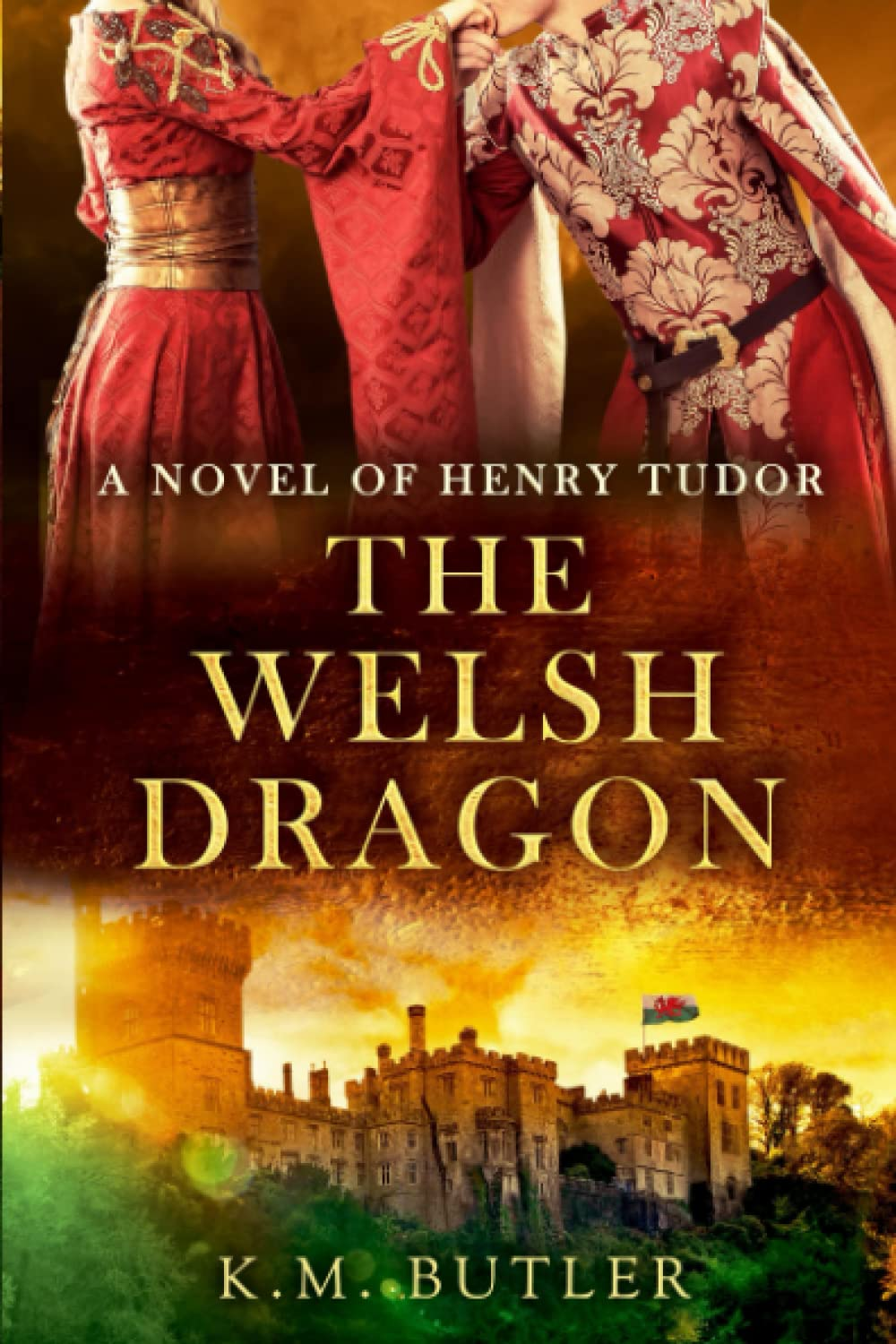
The Welsh Dragon, by K.M.Butler

A Review

Henry Tudor—the victor of Bosworth who defeated Richard III to claim the crown and become Henry VII of England, beginning the Tudor dynasty – had a weak claim to the throne. Descended on his mother’s side from the royal prince John of Gaunt and his mistress Katherine Swynford, Henry was barred from the line of succession by this illegitimacy. But Henry’s father Edmund Tudor was half-brother to the king, through his mother’s second marriage to Owen Tudor, and this too brought a potential claim.

When Edward IV took the throne from Henry VI in 1461, amidst the complex politics and battles of The Wars of the Roses, Henry Tudor and his uncle Jasper fled to Brittany. It is the fourteen years that Henry spent in exile that is the focus of nearly the first half of The Welsh Dragon – a period of which little historical fact is known. Author K.M Butler therefore had a fairly free hand to imagine this time in Henry’s life.

Butler shows us a young man attempting to live a life free of the politics of court and crown, in love with a commoner, the competent merchant Jehane, and learning to be useful and skilled in trade. A small life, perhaps, but a free one. But his mother’s (and others’) letters from England, the emissaries who come, and his own sense of duty can’t let him forget who he is. Nor can his enemies: Henry’s life is frequently in danger.

History takes its course, and Henry accepts his role. Butler handles the complexities of factions, allegiances and intrigue well (a small caveat here: I am familiar with this period and the historical people portrayed here – for someone new to it, it might still be a touch confusing) and does not, thankfully, underrepresent the role of the powerful and politically astute women on both sides.

One of the enduring mysteries of this time is the fate of the Princes in the Tower, Edward IV’s last two legitimate sons, imprisoned by Richard in the Tower of London. While generally considered to have been murdered by Richard’s orders, there are other theories. The one proposed by Butler was new to me – but plausible.

Henry may have been reluctant, but his acceptance of the expectations of his birth and upbringing rings true; Butler portrays him as a sympathetic character who grows into maturity and what he sees as his duty, accepting his role in the larger tapestry of politics and history, rather than his personal desires. The book ends with the victory at Bosworth: it is the making of a king, rather than his reign, that is brought to vivid life in The Welsh Dragon.

Writing for Effect: A Dialogue with Jamie Tremain

Jamie Tremain: aka Liz Lindsay and Pam Blance

Currently, Jamie Tremain has two series. The Dorothy Dennehy Mystery series is in the mystery/crime genre revolving around a female private investigator, Dorothy Dennehy.  The story is set in Portland, Oregon. Her office is aboard a houseboat, ‘The Private, Aye?’, moored in the Willamette River. She has a solid circle of family and friends who assist in her cases.  By the time we’d written the second book, we realized what we seemed to enjoy from writing this series, and Grant’s Crossing, is the building of character dynamics and relationships with one another.

Grant’s Crossing is our second series and is a mystery/amateur sleuth series. It might have cozy ‘overtones’ but doesn’t classify as a cozy.

It’s set in rural Ontario. We have two main characters, Alysha – owner of the home, and Dianne – a resident, and the story is told from each of their POV in first person. The setting is an old farmhouse converted to house 8 retired seniors in a guest-home type environment. 

As mentioned above, we feel our strength, and passion, in these stories has evolved to focus on character relationships, to show what life can do to all of us and how we cope or carry on. We’ve been successful based on comments and feedback received from readers.


Emotion of Characters, Witty Dialogue, and Diversity are the three topics we’ve chosen. They dovetail into each other as we build stories that portray life experiences on different levels a reader can relate to, while still providing a crime or mystery to solve.


Emotions of Characters – The Goal to build relationships built on human experiences common to readers.

These are two scenes from Lightning Strike, the second book in our Dorothy Dennehy Mystery series. Our protagonist, P.I. Dorothy Dennehy has learned her fiancé, Paul, has been murdered.  The first scene is her father, Max, trying to comfort her, and the second scene is Dorothy waking up from a dream the day of Paul’s funeral.

“Why did you change your clothes? she asked, wondering why his casual jeans and sneakers had disappeared. Now he wore his best corporate attire. Perfect tie and polished shoes.

“I had to change, Dee. You know what today is. Have to look my best.”

She awoke with a cry on her lips and a breaking heart. As the dream’s images fluttered away, she sighed. “You always looked your best, my love. I miss you so much and today will be the hardest day I’ve lived through.”

Marian’s thoughts:

Dreaming of lost loved ones is a common human experience. Dreams, too, often have hidden meanings. If I read into the scene that Paul’s message to Dee is that she must put on her ‘best’ today: best clothes, best front, best control – to change her real feelings to get her through this hardest day – would I be reading something into it you didn’t mean?

Jamie Tremain:

We think you’ve reacted as we intended. And without “knowing” our character Dorothy, this is even more true because she is a strong and independent woman, but the death of Paul has knocked her off her feet, and in addition to his funeral she knows that she, as a private investigator, is going to do her best to solve his murder. So, control of her emotions is paramount to her staying level-headed. Her grief will be put on hold. And Paul would have known that, as well.


Dialogue – The Goal to bring humour at times, but to always show that our characters are “human”, subject, for example, to petty backbiting, or one-upping.

We have fun with some characters’ dialogue scenes. This is from Resort to Murder, the second book in our Grant’s Crossing series. Our characters, most retired, live together in a small retirement “guest” home – Leven Lodge. Mealtimes can be lively due to their various personalities.

Rose changed the subject. “Anyway, I hope the investigation wraps up soon so the spa can reopen. I’m anxious to try out some of the services they offer.”

“Maybe they can do something about those wrinkles,” sniped Minnie.

“At least I know what a spa is for,” retorted Rose.

I settled back to watch the show, but Nina broke things up. “Now ladies. Let’s not bicker. Life’s too short. I’d hoped to make use of the spa while I’m here as well, but if it doesn’t work out, c’est la vie. That’s French you know.” The barb hit its mark with Minnie.

“Well kiss my derriere. That’s French too.” Minnie smirked. Then she exited the room. I noticed Lily’s small grin as she watched our wicked witch’s departure.

I had a feeling breakfast congeniality was done.

Marian’s response: 

Writing ‘gurus’ often say that no dialogue tags other than ‘said’ and ‘asked’ should be used. (Not that I agree with it!) Here you’ve used a variety of other tags and descriptors. Can you expand on why you chose them?

Jamie Tremain:

When we were traditionally published with our first 2 books, we had an amazing editor. Her opinion favoured avoiding the overuse of ‘said’ and it stuck with us. Not that there is anything wrong with ‘said’, but I (Liz) recently read a book, where about ten consecutive pieces of dialogue were tagged with ‘said’, and I found it boring, as if the writer couldn’t find something more descriptive to use. Balance is key, because to overuse any tag runs the risk of reader turn-off.

The narrator and Lily both seem a little detached from the bickering. You convey this both through the use of ‘watch’ and the fact that neither speaks. Were those conscious choices?

Jamie Tremain:

Definitely on Lily’s part, yes. She is an introvert, overshadowed by her extroverted twin sister. As for the narrator, yes as well. She enjoys being a bystander during these exchanges, although she has been known to stir the pot when it suits her.


Diversity – The Goal to have diversity in various forms, woven into a story so that it’s done in a way to make it seem natural and not because we have to tick boxes.

Without really intending to, we find our Grant’s Crossing series has touched on several areas of diversity, most done in subtle ways, to hopefully show diversity is taken for granted, and not a big deal to be fussed about. We’ve touched on Aboriginal issues, mental health, have had a gay character, and, aging is a general theme throughout. We, as writers, hope it’s a reflection of ourselves, that diversity is, and should be, a natural part of life’s fabric.

The example concerns a new couple, Sasitha and Bachan Patel, who have taken up residence in Leven Lodge – from the third book in the series, Acting Off-Script. It’s a small town in rural Ontario, with little familiarity of East Indian customs.

I decided to ask about a question I had. “I noticed you’ve placed some beautiful small candles in the front room. Are they for a special occasion?”

Sasitha beamed. “Oh yes, my friend. These are for celebrating Diwali. So important for us.”

“Festival of Lights,” interjected Bashan. “Lighting these candles, for us, means we are getting rid of the darkness. The darkness can be meaning bad vices, such as greed.”

From what I knew of the Patels, greed was a foreign concept to this generous and kind-hearted couple.

Marian’s thoughts:

You have subtly captured the rhythmic speech patterns of West Asian immigrants speaking English. Did you worry about being accused of stereotyping in the name of diversity?

Jamie Tremain:

The Patels are my (Liz) characters and have been modelled after a former co-worker, whom I am very fond of.  The speech patterns were part of everyday work life. Honestly, if a reader feels this is stereotyping, then, with respect, that would be an inaccurate assumption.  Earlier in the book, the Patels give an account of how they came from India, lived in Scarborough, and ended up in Grant’s Crossing. We thought having a retired married couple, who happened to be East Indian, would be an interesting dynamic to add to the mix of characters living at Leven Lodge.

Was the use of ‘foreign’ in the last line purposeful? To me it creates an effective dissonance between the idea of ‘foreigner’ and how we all share universal human attributes and concepts.

Jamie Tremain:

That’s an interesting observation, Marian. It wasn’t intentional, but we agree with your assessment of its use.


One final question from Marian:

You strive to show character relationships, ‘to show what life can do to all of us and how we cope or carry on’. Author intent and reader interpretation can be very close, or it can be very far apart. Art is a tension between the creator(s) and the ‘consumer’, the person experiencing it. Have you had feedback from people whose interpretation was far from what you intended?  If so, how did you handle it? (And if not, how would you handle it?)

Jamie Tremain:

We’ve been told our character relationships are a focal point of both series, and so we now make a conscious effort to create life situations for our characters that most people could relate to at various times in their lives – aside from finding murdered bodies, of course!

The most feedback we received was when we “killed” Paul in the second book of our Dorothy Dennehy Mystery series. Readers who had enjoyed the first book were dismayed, and even a little angry, that we’d dispatched him. We didn’t expect the level of disappointment but were gratified in a way because it showed readers connected with the character. And it made us realize that a mystery is not just about the crime to be solved, but it’s about the characters. So having the strong feedback about killing Paul was valuable.

Every reader has their own viewpoint and interpretation on what they read. We’ll continue to create scenarios we hope are relatable and always welcome feedback, be it positive or not, on how we’ve tried to portray relationship dynamics. We may be the author, but we can always learn from our readers, as well.


Links:

Web: http://www.jamietremain.ca/   

Blog : https://jamietremain.blogspot.com/

Amazon Author Page: https://www.amazon.ca/Jamie-Tremain/e/B06X1FFCCF/ref=dp_byline_cont_pop_ebooks_1

Books2Read :  https://books2read.com/ap/nObabJ/Jamie-Tremain

Facebook:   https://www.facebook.com/jamietremainwrites

Email: jamietremainjt@yahoo.com


Would you like to be part of this series? Authors published or unpublished are welcome – leave a comment and I’ll get back to you.
I Began with a Landscape

Thoughts on Worldbuilding, Part I

“Observing the interplay of minute details…within the larger, overall picture, sensing the tension between the revelatory particular and the general condition…the written stories we most trust about life begin to take shape.” 

Barry Lopez

Worldbuilding. There are a thousand blogs and articles and books on how to worldbuild in fiction. I wouldn’t be adding to them, except I was asked to. For years, my response to the readers and authors who ask me how I created the (apparently) immersive, believable, world of my books has simply (and honestly) been, “I don’t know. I just write.” 

But being asked to share my ‘wisdom’ on this subject made me analyse it – or try to. With the serendipity or synchronicity that often, I find, happens, I had started to read Barry Lopez’s last book, Embrace Fearlessly the Burning World, a collection of essays. Lopez is a writer I have returned to over and over; like Annie Dillard and Robert MacFarlane, his relationship with the natural world goes far beyond empiricism. And from the quote above, I began to see a way to explain how my fictional world came into being. At the heart of that creation is the often-given advice: write what you know.

Earlier in the summer I’d begun a stop/start/continue exercise to combat a growing sense of irritation and dissatisfaction with my life. Part of the exercise is to define what is important to you; what you truly care about. I knew that during the pandemic years, I’d lost sight of some of it.             

Here’s what that analysis showed me:

As I studied this result, I realized that these are not just the things I care about deeply. These are the things I know and have spent my days on. And as Annie Dillard wrote: “How we spend our days is, of course, how we spend our lives.”

Write what you know. What do we know better than how we spend our days and our lives?

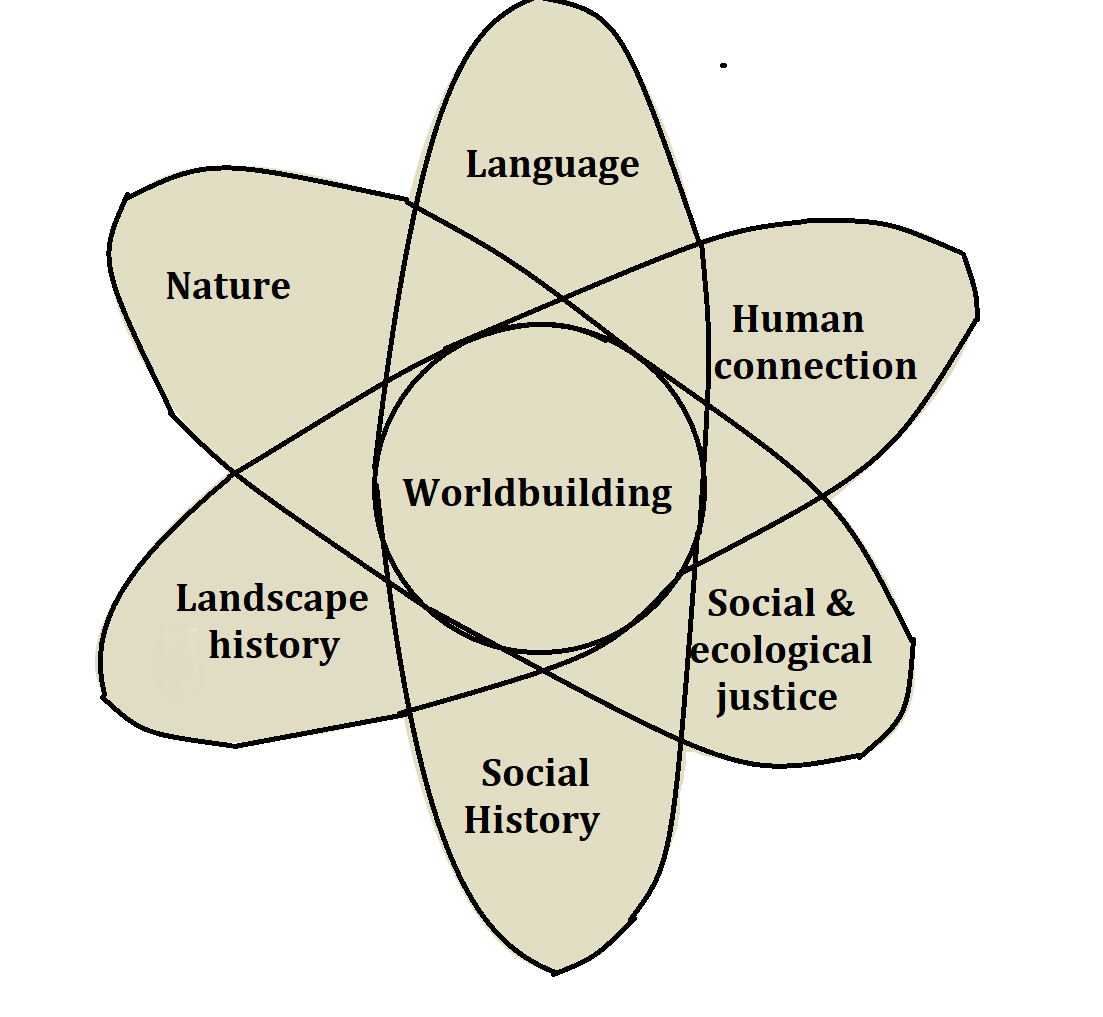
I took those eight identified foundations of my life, simplified it a bit, and created this slightly wonky Venn diagram:

At the intersection of these six passions, where their interplay of both detail and general weave together, is where, for me, worldbuilding occurs.  The world of my books – its ecology, geography, history; even its languages, arose from what I have spent a large part of my time on for over fifty years. Tolkien, the philologist, began with languages and built a world around them. I began with a landscape.

And I always did. Right from my first ‘apprentice novel’, begun when I was seventeen, the major theme of all my work has remained the same: the interrelationship between place and identity: what keeps us there, what drives us—or calls us—from it, how it shapes who we are both in its presence and its absence. In Empire’s Reckoning, the young Gwenna, visiting her mentor Sorley’s boyhood home with him, asks him about what it means to him. (The first-person speaker here is Sorley.)

“This all should have been yours.”
“I gave it to my brother,” I said.
“But you still love it here.” She shook her head in frustration. “That’s not right. More than love, but I don’t know how to say it.”
“Dùthcas.” She looked up at me quizzically. “I can’t translate it,” I said. “Belonging is close. It’s as if I carry this place deep inside me, and I hear it calling to me, always.”

This is the basis, the core of creation of a world for me. The bedrock. Place and culture are—or were—inextricably linked. The knowledge held and expressed in the tundra and taiga of northern Canada and the vast expanse of Australia are not the same, nor is the knowledge needed to navigate life in a big city the same as that needed to live on a ranch fifty miles from the next one. The next step in worldbuilding is showing that knowledge and its attendant skills in context, whether the world in question is real, quasi-real, or entirely fictional.

To be continued….

How Has Writing Changed Me?

A guest post by J.C. Paulson

On following your muse: it might just save your life, and other benefits.

When I awakened at three one morning a few years ago, as I had for months after a traumatic career ending moment, I was, for a change, not in tears.

I saw a (beautiful) reporter, a (stunningly handsome) cop, a (stupid homophobic) decision made by a church and a (dead) bishop. Where did that come from? Would I remember it all at a more reasonable hour of the morning?

Didn’t think so. But I did.

It became Adam’s Witness, a novel I never thought I’d write. Nor any novel, really.

I’m not much of a believer in intervention, divine or otherwise. Neither do I believe in astrology, but I am a perfect Virgo: analytical, critical, loyal to a fault . . . and very much with my feet planted on the hard unforgiving ground. Lightning bolts from heaven or any other mystical place do not, in my view, occur. At least, not to me.

But something happened. Somehow, my brain was trying to save my sanity, or perhaps myself. The mood did not actually improve much for a long time, in the overall; my father became desperately ill and eventually died, among other rather traumatic life events.

Even so, the creative muse eventually took hold and if nothing else served as a distraction. There’s nothing like diving into someone else’s life.

Even someone fictional.

And now, I am powerfully inclined to pitch my method of mind-bending to others. Simply, it is this: If a creative or athletic or other positive new thing is calling you, I advise answering the mental phone. Even if it’s hard.

Obvious by now is that my own escape from hell came via my creative cells, and I believe that most of us have those. Sometimes we have to go looking for them, but they are there; and in my view, they represent the best of ourselves.

Learning that I could actually sit down for longer than a few minutes, focus, type, research and write a book was an epiphany.

I am also here to tell you that publishing a book online and in print by yourself is not the easiest thing you’ll ever try, creatively or technically. Nor is trying to disseminate your new invention.

(I’m sure similar difficulties apply to all other pursuits.)

But I did it.

It boosted my self-confidence that I could learn something new — actually, several somethings. It cleared my mind of everything but my plot, characters, and message. Then it forced me to think, as they say, outside the box: how do you format a book on Amazon?

It also allowed me to blurt many of my strongly held beliefs (for example, why in the name of all that’s sane would some discriminate against or loathe LGBTQ people? Or any people?) when I had no other outlet.

To this day, I haven’t entirely sorted out why or how walking a new creative path changed my mind. Altered my brain, really. But it absolutely did. I’m quite sure it forged new synaptic pathways, and no kidding.

As to other benefits, there’s always a chance someone else might like, or even love, what you have made. Your book. Your painting. Your photograph. Your song.

You might make someone’s day. You might change their outlook for the better. You might entertain, or elevate, or excite.

But this is for certain. You have created something new and unique that did not exist before. And for that, my heartfelt congratulations.


Joanne (J.C.) Paulson, a long-time Saskatoon journalist, has been published in newspapers including The StarPhoenix, The Western Producer, the Saskatoon Express, allSaskatchewan and a variety of magazines.

She is the author of a mystery series including the novels Adam’s Witness, Broken Through, Fire Lake, Griffin’s Cure, and Two Hundred Bones, a novella. Her most recent works are a historical fiction/western novel entitled Blood and Dust, published by Black Rose Writing, and a wee children’s book, Magic Mack and The Mischief-Makers. Find her books via her website or on Amazon.


Are you a writer who’d like to contribute to this series? Leave a comment below and I’ll get back to you!

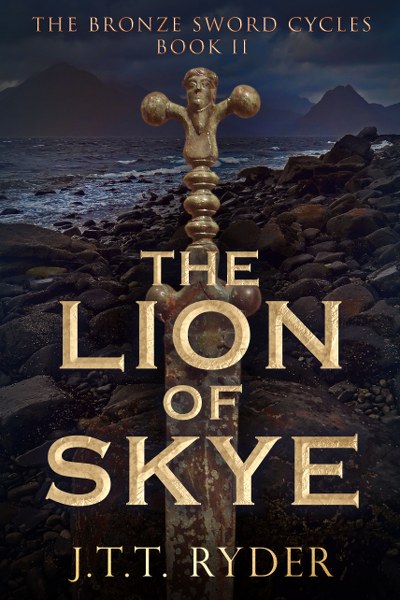
The Lion of Skye, by J.T.T. Ryder

’Celtic’ is a magic bag, into which anything may be put, and out of which almost anything may come … Anything is possible in the fabulous Celtic twilight, which is not so much a twilight of the gods as of the reason.

This J.R.R. Tolkien quote would be an apt epigram for The Lion of Skye. Not in a derogatory way, but an introductory one, a warning to the reader not to expect the world of Skye in 200BC to behave in a way consistent with the modern world of reason and causality.

The Lion of Skye picks up immediately after the end of Hag of the Hills, and it picks up running and doesn’t stop for a breath for many chapters. Brennus, now renamed Vidav after the sword he found (or was given) continues in his sworn purpose to rid Skye of the Hillmen and their queen, Slighan. Over the course of the story he will make and break alliances, battle human and the sidhe, but his oath to protect the maiden Myrnna is still a driving force.

In my review of the first of this duology, Hag of the Hills, I categorized the books as more magic realism than fantasy, because this is a world imagined through eyes and minds whose concept of reality differs from ours. Gods and monsters walk the land, and perspective swirls and shatters like the shards of a kaleidoscope. Author J.T.T. Ryder’s style reflects this; the view never stands still. Characters move from friend to foe in a few brief strokes of a sword; brothers are sworn allies and then enemies. Nothing is quite what it seems in this violent world of sworn oaths and ritual battles.

Vidav’s companions are men, but it is women who drive him forward: his hatred for Slighan, his oath to keep Myrnna safe.  His ability to see into the otherworld is a gift from the Cailleach, the hag of the hills.  He both is drawn to and repulsed by the women whose fates drive his own, whether human or something else. But they wield power, both that of sexual attraction and that of judgement, and he cannot escape that, even when he believes he has.

Ryder pulls on many sources and many legends: the Wild Hunt chases through the sky; the Blue Men of Minch, selkies, Amazons all make an appearance. They fit into Vidav’s concepts of his world; while he may be surprised they have manifested, he’s not surprised they exist. Echoes of Cuchulainn – a hero to Vidav—resonate in his worldview: death matters little, fame does.

The Lion of Skye should be read after Hag of the Hills for a full appreciation of the world and characters Ryder envisions; it lacks the worldbuilding of the first book which is necessary to understanding Brennus/Vidav and what drives him. Together they make up an unusual story steeped in mythology; an envisioning of a culture inseparable from the mountains and rivers and oceans in which it developed, and whose spirits of those places are as real to its inhabitants as the birds of the air or the fish of the sea, but with behaviour far less predictable.

Absolute Eden

Just about every September since 1989, the second Sunday of the month finds me at the Eden Mills Writers’ Festival. Begun that year by author Leon Rooke and his wife Constance (also an author) as a small gathering of Canadian writers sharing an outdoor book launch, it’s grown over the years to one of Canada’s premier writers’ festivals.

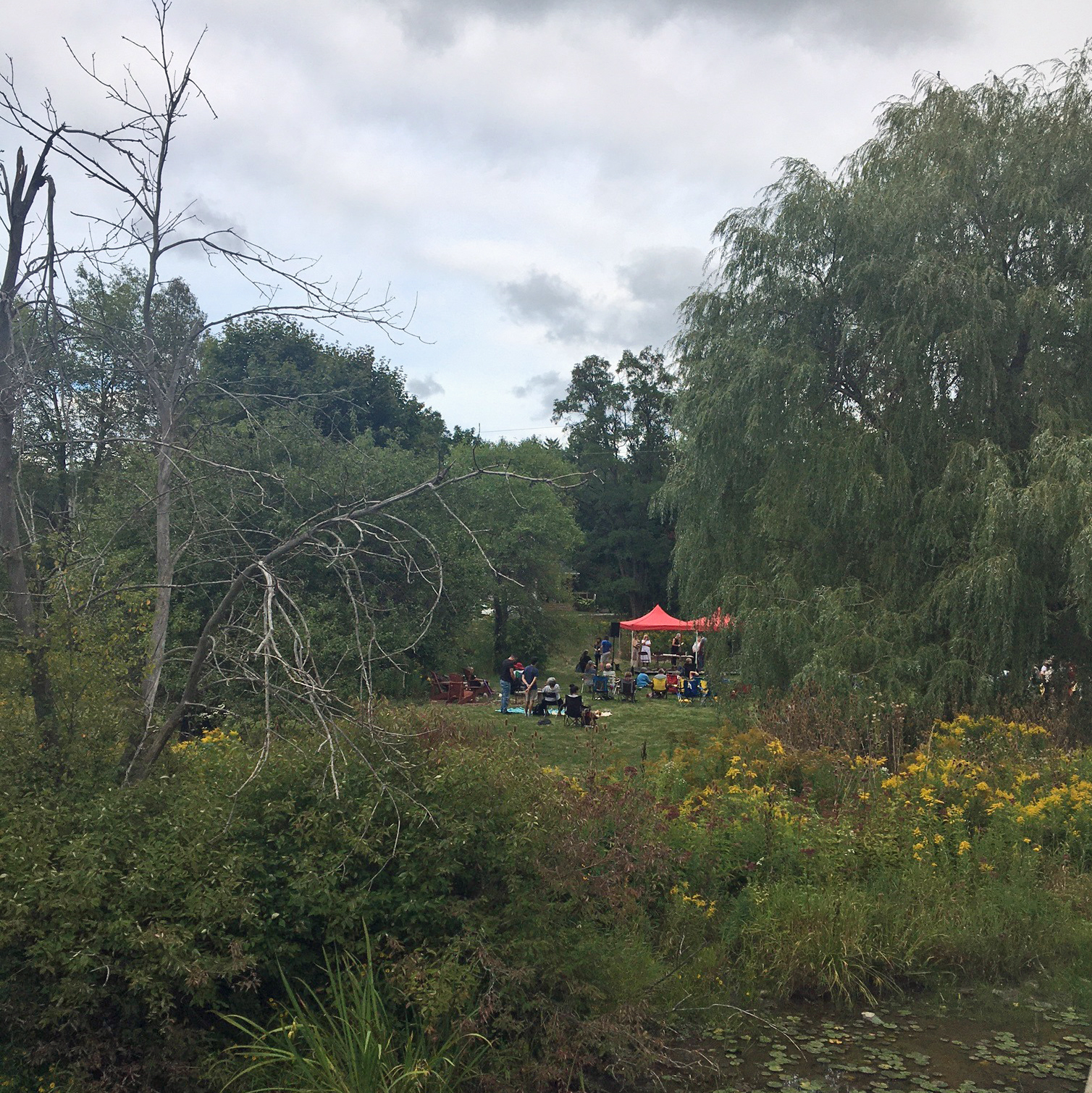
Eden Mills is a tiny village about an hour west of Toronto, on the banks of the Eramosa River. 19th century stone houses are scattered among later houses on a very few streets, many with gardens running down to the river. On Festival Sunday, some of these gardens provide the venues for the authors, with the audience sitting in lawn chairs, on blankets, or just on the grass, listening.

Over the years, I’ve heard such Canadian greats as Margaret Atwood, Alistair MacLeod, and Peter Gzowski read here. There is fiction and non-fiction, poetry, essays, prose. Writers to make you laugh, cry, think. There is a children’s author venue, to foster a love of words and books among young people. Our local Guelph indie bookstore, The Bookshelf, is there with piles and piles of the featured authors’ books, and a venue to get them signed. There is local organic ice cream and locally-roasted coffee, and a variety of food trucks, and no venue is more than 500 m from another, an easy walk on the quiet streets closed to cars for the day.

And it never seems to rain.

Back when I was still writing apprenticeship novels no one will ever see, I would sit on the grass and listen, and dream of reading at Eden Mills. To do so (in the Fringe venue, for unpublished or limited-published authors, as I was in 2016) was both terrifying and exhilarating. I had won places in both the prose and poetry competitions, so I was reading twice. I stood under a canopy, the Eramosa flowing in the background, 50 or 60 people scattered over the sloping lawn, waiting to hear my words. I did it; people applauded, and by the end of that day, after mixing with other authors both in the readings, the authors’ lounge, and the amazing authors’ dinner given at the end of the day, my perception of myself had changed. I wasn’t ‘an aspiring writer’ any longer. I was, simply, a writer.

(Oh, that dinner. The food was excellent, as I remember, but the crowning glory was the dessert: a selection of pies baked by the residents of Eden Mills and environs, pastry as flaky as you could want, bursting with fruit, and so good.)

For the last few years, I’ve been at Eden Mills in the Publishers’ Way, with one or the other of the small presses that publish my work. It’s a different view, a chance to chat with book lovers of all ages and interests, meet other publishers, do some networking. But I still sneak off to sit by the river and listen to an author or two, buy some books, say hi to old friends, and revel in the beauty of the village and the energy and commitment and vision that has kept this festival going for thirty-three years.

I plan to be back next year, the second Sunday in September. See you there?

Writing for Effect: A dialogue with Bryn Hammond

This is the first in a blog series, the purpose of which is not only to spotlight an author’s work, but, in a dialogue between myself and the author, to illustrate the variety of ways the techniques of writing can be used, and how styles differ. My first guest is Bryn Hammond, author of Amgalant, historical fiction based on the Secret History of the Mongols, which is is the oldest surviving literary work in the Mongolian language. It was written for the Mongol royal family some time after the 1227 death of Tchingis Khan (Temujin). Bryn has chosen to discuss how she used poetic speech, homely metaphor, and lively conversation in her work.

Bryn

This is going to be about Amgalant, my main work – my life’s work, though I potter with other things.

I call my historical fiction a ‘close reading’ of the Secret History of the Mongols. More than a source, the Secret History is my original, and I want to imitate its features – not merely its content. Early on, I confronted the fact that I had one major difference from most historical fiction: that I am text-based, text-to-text, not trying to re-create history as such but to give a version of a story already told. In search of a model or template, I looked to T.H. White and Malory. White’s Once and Future King riffs on Malory’s Morte d’Arthur, quotes Malory, talks to him and about him. That was me and my text. I was after a deep fidelity, and yet room to be myself – as T.H. White does not shy from idiosyncrasy of style or interpretations that are meaningful to him. My aims often felt like a contradiction, but as my Temujin says once, ‘Contradictions, when they work, generate much heat and light, or else they blow up in your face.’

Topic: poetic speech

In my first excerpt, young Temujin composes a message to his anda – a friend with whom he has exchanged blood, where resides the soul. His anda too has suffered at the hands of the king who has stolen Temujin’s wife. This is Temujin’s request for Jamuqa to join him in a war of rescue.

Simplest leaves least to go wrong, he thought, and he stitched together a few simple verses. Verses, for formal wear. And when underway he found that verses gave him a truer language, truer to his emotion, that was only flagrant in daily felts and furs.

They have cut the liver from my side.
How our fates, my anda, coincide.
Can we right the wrong?
We feel each other’s injury:
Your wound bleeds my blood and mine bleeds yours.
My other self, can I avenge you?
Can you comfort me?

It was his first draft, but he didn’t fiddle.


I feel strongly that I have to use as much poetic speech as does the Secret History, or else I belie the rich oral culture of the Mongols as well as the techniques of my original. The Secret History itself gives much weight and space to the spoken word. I am dialogue-heavy, but only in equivalence to my original. The Secret History marks significance by turning a speech into poetry, but it also reports people’s own poetic speech. People use this particularly when they need to be ceremonious, or courteous, or emphatic, or heartfelt.
Now, Temujin grows into a great ability with words. Here he is young and gauche and not used to formal communications. It is his first go at a message in verse. I had to make him heartfelt, I had to make him sound first-drafty, spontaneous, yet suggest he has a knack for this.
I took the opportunity to explain, through his experience, the value of talking in verse from time to time. Of course, the challenge is not to be off-putting to a readership who doesn’t burst out into verse, who might tend to see verse as stilted, as the opposite of spontaneous and heartfelt. I have to convince readers that the Mongols, in a culture of oral poetry, could slip into poetic speech with facility and no loss of genuine feeling.

Marian

“No loss of genuine feeling.” – or maybe a way to express deeper feelings, or perhaps more subtle ones? The use of ‘flagrant’ in verses gave him a truer language, truer to his emotion, that was only flagrant in daily felts and furs is an interesting choice – I think of ‘flagrant’ as meaning ‘blatant’, or even ‘over-the-top’, so I read this as an indication that verse allows him to convey a more nuanced, truer emotion.

The use of avenge/comfort in juxtaposition – I think Western perceptions of Mongol culture (as a warrior society) would expect ‘avenge’ but not ‘comfort’. The cognitive dissonance for the Western reader here speaks to our own preconceptions, but what does it reveal about Mongol society?

My last comment on this section is that the use of verse here in formal (courteous, ceremonial) context is reminiscent of Shakespeare, where nobles speak in verse but commoners do not. Did you consider that at all?

Bryn

With ‘flagrant’ I wanted to suggest an extravagance of emotion, that might have seemed too much to talk about. Verse gives him permission to feel as much as he feels, and say so. ‘Comfort’ I chose with great care, aware that it subtly undercuts preconceptions about the Mongols. I can say the same of hundreds of other choices I made.
There’s a word, ‘hachi’, important to the story from the start, because a khan before Tchingis, captured and tortured by China, sends a message back to his people in which he asks for ‘hachi’ – a message Tchingis cites as motivation when he strikes at China over thirty years later. If you’ve read a history on the Mongols you’ve probably seen ‘give me my hachi’ translated simply as ‘avenge me’. Now, my interest in revenge as a motive, whether I’m reading or writing, hovers around zero. So I’m going to look closely at that word, and I’m going to give you more shades to its meaning. I have Temujin’s grandfather think about the word when he hears the captured khan’s message:

Hachi means that which is owed, or felt due. It can mean an act of humanity. It can mean vengeance. It meant justice.

The word occurs in the Secret History for both gratitude and revenge. That’s nothing if not juxtaposition. ‘Hachi’ became one of my most beloved words to use – one I leave untranslated, because my reader has grown familiar with its cluster of meanings.
There is a strong tendency to translate things, understand things, believe things as per our preconceptions. When I began to write about the 13th-century Mongols, back in 2003, I had to dismantle the preconceptions in my own head. That wasn’t a short or easy process – it took real vigilance, self-examination, again and again stepping back to question.

On Shakespeare – I am a Shakespeare-head. I am certain he helped teach me how one talks in verse, or how verse can be a cadence in more ordinary speech, when the culture is steeped in it. The noble/commoner split doesn’t map onto the Mongol situation, at least in my telling (everything about the Mongols is contested, everything).

Topic: homely metaphor

My next excerpt is Temujin as Tchingis Khan, a king, fifteen years later. He has been caught listening to what his companions are saying about him.

Laughingly he called across to him, “Ile Ahai, you have your hare by the ears. I listen to learn, to learn what you make of me, for you are one of my principal makers. You make very much, but I shan’t be cowed, neither embarrassed. For my task is a joint labour and whereas Temujin is me, Tchingis is us. Mine is the sack, yours is the milk poured in; Tchingis is stood by the door with the churn in his neck and together we try to beat him a thousand times a day, and whenever we step in or out we lend a hand.”


To help write Temujin’s turn for homely metaphor, I admit I thought of Jesus’ parables in the Bible, that use a humble subject matter. Temujin’s style as a king is humble and common, but a gift for speech is among his greatest assets. So this is one of Temujin’s little parables, based on a homely subject: the process of churning milk into the fermented drink ayrag. It is spoken to his inner circle, and involves them in the Tchingis project, in his kingship.
Metaphor is much used in speech acts recorded by the Secret History – and other Mongol histories. Sometimes, at a critical moment, people have expressed themselves by a metaphor whose context is lost to us, and we can’t make sense of what they say. My challenge is to keep my English-language readers familiar enough with Mongol daily life that I can use those metaphors drawn from humble things, without the clunk of an explanation in (figurative) brackets. To work, this piece of speech has to have the casual references to ayrag-making and -drinking through the few hundred pages before it.

Marian

The concept of the separation of Temujin from Tchingis – the individual vs. the role really struck me (perhaps because I am writing a character in a similar situation.) The ‘homely metaphor’ works really well here to delineate this separation of person from position, and using the Mongol analogy brings it into its context beautifully. Which came first, the references to ayrag-making and -drinking in the previous pages, or the metaphor?

The lost metaphors: I couldn’t help but be reminded of the Star Trek: The Next Generation episode Darnok, where Picard is trapped on a planet with an alien captain who speaks a metaphorical language (from his own culture) incompatible with the universal translator. I don’t know if that means anything to you, but while (of course) it was easily solved, there are other examples in the Scandinavian sagas and perhaps even in Old English where we don’t understand the metaphors, concepts lost to time and change. It also brings to mind Robert MacFarlane’s book The Lost Words, which came about because of the loss of words related to nature in the 2007 edition of The Oxford Junior Dictionary. How much, do you think, are the lost metaphors due to cultural change separate from the evolution of language?

Bryn

Which came first? Daily life, always. Then it is there when you need it – waiting to be picked up in a metaphor.

I loved that Star Trek episode – particularly because those metaphors were drawn from a body of epic story. And then Picard recites from Gilgamesh to the alien! – my heart.
So yes, I think a lot of the loss is down to lost story, lost anecdotes. Most unfortunately, the only survivals of the oral story-world that Temujin lived in, pre-writing, are snippets extracted for use in other contexts. We know there was a wealth because of the Secret History’s ease of reference, as well as by analogy to the vast and wondrous world of Turkic epic, that began to be recorded from medieval times on because of its proximity to writing cultures.

Topic: lively conversation

Back to young Temujin for my third excerpt. He faces a circle of experienced companions-in-arms, who laugh – or try not to laugh – at Temujin’s naivety over the size of armies mentioned by his patron the khan of Hirai.

Grey-tailed Jungso of Noyojin started to effervesce silently and couldn’t stop. Others, two or three of them, told him, “Jungso. Jungso, don’t be uncouth.”
“I’m not,” he effervesced. Then he claimed, “I’m laughing at the khan of Hirai.”
“Fair enough, too,” declared Jirqoan of Oronar. “It helps when people are precise in military matters. Tumens,” he addressed to Temujin, “you can bet your bottom goat, is here imprecisely used.”
Temujin turned student-like to him. “A tumen doesn’t mean ten thousand?”
Bisugat, next to Jirqoan, answered. “In a fat year, like a cheese. Cheeses shrink in a lean year, but we still call them a cheese.”

It is an often-acknowledged truth that the real hero of the Secret History of the Mongols isn’t Tchingis Khan but his companions. I do a lot of group conversations to convey the input of the group. This means I have cast members who have one line, but I still want them to feel alive, like individuals.
One reason I chose the Secret History of the Mongols is its wonderful exchanges of speech. That suited the writer that I am. In historical fiction, the danger is that speech becomes stiff and stilted, in part because our slang isn’t theirs, in part because we often hear them through paperwork and not everyday speech at all.

Marian

The group conversations convey the richness of the oral culture and the importance of individuals within it.

I loved ‘bet your bottom goat’ because I as an English-speaker of a certain age and time expected ‘bet your bottom dollar’ and that it wasn’t that familiar phrase reminded me very sharply that this was a different time/place/culture. Was that your intent?

The flexibility of the measure of a tumen is superb, so easily understood. Is this your invention, or something shown in the Secret History of the Mongols?

Bryn

I do like to merge English-language slang with Mongol slang. This one was an easy example. I use whatever Mongol slang and figures of speech I can convey sense in, but where I need to amalgamate them with English idiom for explanatory value, I don’t scruple to do that.
Sometimes there’s a clash that’s fun to work with. Milk is a substance for infinite idioms in Mongol, which often come straight across in English. But if Westerners hear ‘he has milk in his veins’, they might well assume that’s an insult. In Mongol idiom, milk is pretty much always positive, and this isn’t said negatively, although it does tie in nicely with the English – and Shakespearean – ‘milk of human kindness’.

Tumens: This explainer was me.

You can find more information on Bryn and her books at

https://amgalant.com/

or purchase her books here

https://payhip.com/b/2ERGv or https://books2read.com/ap/xK6AY8/Bryn-Hammond


Would you like to be part of this series? Authors published or unpublished are welcome – leave a comment and I’ll get back to you.