I need a name for a fairly major character in my in-progress young adult adventure novel, Empire’s Hostage, the second in the Empire’s Legacy series. Empire’s Legacy is set in a world not quite our own, but that is based on Britain/Northern Europe in the years after the fall of Rome. The character I need to name is the “Viking” heir-apparent to the king of the islands of the north coast, more or less equivalent to the Hebrides.
He’s not a terribly nice character, so might not want to suggest your best friend’s name! The name also needs to sound vaguely Scandanavian/Icelandic/Gaelic to fit in with the rest of the names in the story.
What do you win? A mention in the acknowledgments in the book, when it sees the light of electronic day sometime next year; a free copy of it and its predecessor, Empire’s Daughter, and, if you wish, either a review of a book of your own on this website, or a beta-read of work-in-progress.
The contest remains open until I have twenty names to choose from, or to December 31. Respond in the comments section or to marianlthorpe at gmail.com
If you’ve read my profile on this or other sites, (or if you read the post called Landscape and Story I posted a few days ago) you will know that I describe myself as (among other things) a part-time student of archaeology. Currently I’m in the middle of an on-line course from the University of Exeter called “Landscape Archeology I”. This week’s assignment was to look at what types of environmental archaeological evidence – things like animal bones, soil and water micro-organisms, wood – can be used to interpret either a castle or monastery site.
My response to the assignment was to write a brief story about a fictional monastery and point out all the things we knew about this monastery because of the archaeological evidence, which was fun and more interesting for me than just making a chart or list. However…now this fictional monastery has a life of its own in my writer’s brain, and doesn’t want to go away. It wants to tell its story more fully.
It doesn’t fit into the series I’m writing right now, but it may just fit into another planned novel/novel series. Or maybe it will be something completely new. I don’t know yet. I’m hoping I can use it for further assignments for the course, but regardless, it is now a real, dynamic place inside my mind, and another dimension of my created landscape(s) has made itself evident. Now I have to see where it takes me.
The door into another world is as old as Alice in Wonderland and as new as Neil Gaiman’s Coraline, with many many interpretations and reiterations in between (and since). In The Quantum Door, Jonathan Ballagh’s debut novel, it is given a familiar yet fresh treatment in this middle-grades science fiction story set a very few years in the future.
Brothers Brady and Felix are attracted by a faint light in the forest behind their Vermont home, a forest that has recently been purchased and fenced with No Trespassing signs. Felix, the younger and more technologically-oriented brother, attempts to investigate with a drone, leading to the discovery of the quantum door, a door into a parallel universe fraught with menace and danger.
The door has been constructed by Nova, a strong, resourceful female character who appears to be roughly the same age as the boys. With her robotic, AI dog – a canidroid? – Achilles, she is attempting to find a safe place away from the Elder Minds, the artificial, evolving intelligences that now rule her world.
The Quantum Door is imaginative and fast-paced, introducing young readers to many of the classic science fiction themes. The science and the technology is realistic and feasible, building on current knowledge, devices and systems. The scenes of the underworld where the Neurogeists, constructed creatures that house the reprogrammed minds of transgressors of the Elder Minds’ rules, are resonant of many dystopias portrayed in text and film, and yet manage to be fresh horror.
A mention must be given to the outstanding illustrations by Ben J. Adams. Dark and fractured, they convey the dystopian side of this novel perfectly.
The reading level and story complexity are also worthy of mention: they are appropriate to the age group to which this book is aimed, without talking down in any way. This is a book that in my previous career in education I would have been recommending to middle-grade teachers without hesitation. Five stars to this outstanding debut novel, and here’s hoping for a sequel.
This is an independent review of copy of the book provided by the author. The opinions stated here are mine alone.
If you’re publishing your book in installments on WordPress, like I do at empireshostage.com, here’s a question – or rather a two part question – for you:
Is there a blog where such serializations can be listed, so they can be fairly easily found?
If there isn’t, is it something that would be useful?
This question comes out of a on-line discussion I was having with a couple of other bloggers. I was thinking of something that was limited to blogs, rather than work on Wattpad or Inkitt or other sites…they have their own ways of promoting and advertising.
Anyhow…this is a serious question, and I’d appreciate serious answers, and re-blogs if possible. My goals, as many of you know, are to assist in the promotion and dissemination of indie writing, and I’d be willing to get something started if there is a need or an interest. I’m not looking to make money; thankfully, I don’t need to.
Currently I am using two covers for Empire’s Daughter…one is the professionally-done cover that I use on the commercial (paid) version of the novel, and one is my own work that I use for the Wattpad version (for copyright reasons). I’d like to ask you…which do you prefer? It will let me know whether or not to buy a cover for Empire’s Hostage when it comes out. Here are my two covers – with the peregrine falcon theme – and the professional cover of Empire’s Hostage. Please let me know what you think!
Once a year, my alma mater, the University of Guelph, honours its faculty, staff and alumnae who have published, edited, or illustrated a book in the last year. This year’s honourees included winners of and nominees for some of Canada’s most prestigious literary awards, including Thomas King, Dionne Brand and Alison Pick…and alongside those well-known names was me.
Which was a humbling experience, let me tell you. There I was, author of a self-published, moderately successful e-book for young adults, being feted in exactly the same way as these major authors, whose books are taught and read in schools and universities, who have won major prizes….I felt a little bit like a fraud, to be honest. But, on the other hand, the University knew exactly what I had written and published, and they chose to include me (and others like me). I thought that was wonderfully democratic and non-hierarchical….and also typical of my university and its community.
My plaque has pride of place on my office wall. I will admit that I do keep looking at it.
Thank you, alma mater. May you never change your attitudes and beliefs.
I’m about a third of the way through the next book in the Empire’s Legacy series. It’s going a bit more slowly than I hoped but that’s my own fault; I signed up for an on-line university course that’s taking quite a bit of my time, but then again I find I’m more creative and focused when my time to work on Empire’s Hostage is limited. It’s a balance. My goal is to finish the first draft by the spring!
Beyond the village, west towards the Wash, flat fields of barley and wheat, latticed with ditches, lie on either side of the paved right-of-way out to the water. Once this was marsh, and from the satellite images on Google Earth, the patterns of waterflow can still be seen, like a ghost, or a memory, held in the soil.
Around the village, around its bungalows and houses, shops and pubs, church and hall, people going about their lives shopping, walking dogs, gardening, working, I see other ghosts, memories not my own underlying the quotidian. My father’s memories, and his parents, and beyond that for unknown years. Memories now at their newest eighty-seven years past, and going back for generations.
I would like to know this place intimately, to understand its ecology and geology, its weather, its landscape, its history. I want to watch the seasons here, the ebb and flow of waders on the Wash, feel the wind off the North Sea in the winter, bringing hard frost and snow; hear the nightjars churring on the Fen at a summer’s dusk; see the hordes of geese returning, and leaving, autumn and spring. I would like, as much as can be in a changed world, to know this place as my forebearers did, the knowledge of foot and sight and smell and feel. I have been making small beginnings, over the last thirty years, coming closer together over these last ten. What can I learn, this time, in a month in spring?
I am walking in what I am arbitrarily determining as the boundaries: the old marshes west of the A149; the three commons of Dersingham; the footpath on the old railway line as far north as Ingoldisthorpe; Sandringham Park and Dersingham Bog NNR. The first walk was to and from the Wash.
A century ago my great-grandfather built a tiny wooden bungalow, a beach cottage, on the shingle beyond the marshes. I do not know exactly where. Between Dersingham and the Wash were the marshes, and, the first part of the lane which is now the bridleway from Station Road, which is recorded on Faden’s 1797 map of Norfolk. There was (and is) also the Drift, a droveway to move sheep on and off the marshes.
The Wash
What lay between the edge of the village and the Wash I imagine to be much like the shooting marsh beside Titchwell: a mix of rush and sedge and ling, cut with hundreds of channels and small ponds, rich with wildfowl, water vole and waders. Perhaps not, though; perhaps it was grazing marsh, diked and drained, wet meadow. And perhaps it was a mix of the two; I suspect this is the most likely. Some of the drains, or sluices, are on Faden’s map, so drainage had begun in at least the 1700s. At some point in the 1920’s, my grandfather, Percy, and one of his brothers-in-law, Sid or Eph, walked out from the Drift to the bungalow, across the wet land and the unbridged waterways. Because this story was still being told eighty years later, I think they arrived very wet, very muddy, and to a good telling off from the women.
Now the bridleway and some of the side lanes are paved, huge, tilting slabs of concrete pavement. I am not sure when this was done: either before the war, when the shingle from the pits at the Wash’s edge was being removed, or after the floods of 1953. To the south of the bridleway, the land belongs to the Sandringham estate; to the north, to (mostly) another landowner. The land is arable, planted to cereals for the most part, but also managed for wildlife, or at least for shooting. Weedy headlands, broad buffer strips on either side of the waterways and around each field, some fields left to grass fallow, strips and clumps of trees: all give shelter not only to the pheasant and red-legged grouse, but to other wildlife. The first morning we walked out there were hares everywhere. Marsh harriers hunted over the fields and the marshes; whitethroat, dunnock, robins, blackcaps, and reed and sedge warblers sang, along with finches, green and gold, and linnets. Songs I do not know, songs to learn, to become part of the tapestry.
A few greylag geese are raising goslings in the fields near the Wash, along with several Egyptian geese. Oystercatchers and ringed plover nest on the beach. Goldfinches twitter from the tops of the blackthorn. Cuckoos call from the woodlands. A whitethroat sings from every bush or tall reed along the ditches, it seems; some will be raising cuckoo chicks, unwittingly.
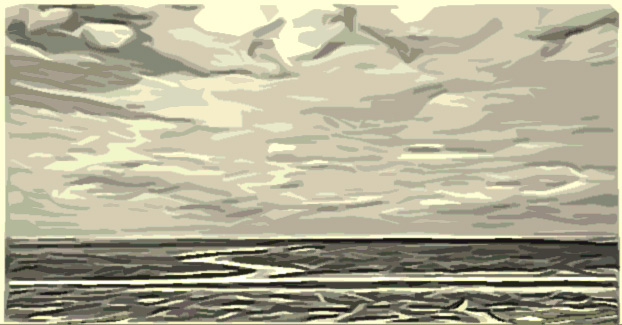
But while the land has changed, two things have not: the sky and the sea. The vast Norfolk skies, the ebb and flow of the tide over Ferrier and Peter Black Sands, and the birds that belong to both: in May, oystercatchers, dunlin, knot and grey plover, feeding at the edge of the sands, moving with the tide, or taking to the skies in huge wheeling flocks, sometimes put up by a peregrine, sometimes by seemingly nothing. And along with waders, black-headed gulls, nesting on the rocks and islands of the pits, or out on the remnants of the shingle gantry, a structure that was built in the 1930s to load the beach pebbles onto boats, and has withstood the storms of 1953 and 2013.
I am drawn to this flat and open land. There are several walks through woodland available to me, but my instinct is to go west, out into the fields, or the fen. I explore different routes: there is a permissive path that runs north from the Station Road bridleway, over to the edge of Ingoldisthorpe Common: I try that. It loops around two fields: the part that parallels the A149 is loud with road noise, and a few birdsongs from the belt of woodland between the road and the fields, but the western side is quiet. I watch buzzards hunting, one coming down repeatedly into the uncut hayfield beside me, but I see no evidence of success. But it’s an adult bird, so it knows what it’s doing. A kestrel hovers over the same grasses but does not dive. In the distance a cuckoo calls, and the ubiquitous wood pigeons beat across the fields.
Norfolk fields and sky
Another time I access the fields a bit further south, from the Drift. The Drift runs, for much of its length, between a thick hedge or woodland on the south and a ditch on the north, edged first with houses and then with fields. West of the A149 the southern side is a mix of field and woodland, but the boundary is still treed. Good songbird habitat; lots of blue tits, robins, dunnocks. Wildflowers grow on both sides: yellow flag iris in the ditch, kingscup and buttercup, all yellow. On the woods’ side a creeping purple mint – heal all? – and a starry white flower colour the grasses. I need a book. Or an app.
Where the Drift ends at a cross lane – a Sandringham estate farm lane, and at least to the north open to walkers to make a connection with the bridleway to the Wash – I stop, and look west, thinking of my grandfather’s walk. To do that walk today, were it possible, there are at least three waterways to be crossed: Boathouse Creek, a drain, and the River Ingol, challenges in themselves. What is gone is the vast web of minor channels between them, and the right to access.
I watch the fields for a while. Gulls circle and scream at the edge of the Wash, a kilometer or so distant. Pheasants call. To the south, in the woodland called Gogg’s Whins and firmly signed as to no public access, there are feeding stations for the gamebirds: these are birds for the shooting.
A gamekeeper and his black lab begin to walk a field north of me, paralleling the Drift. As I turn and walk east again, we keep pace with each other. When he reaches a small woodland, I hear the shotgun. I can’t determine what he’s after – possibly wood pigeon, more likely one of the Corvidae – crow or magpie. I hear half a dozen shots as I continue east.
Back within the village boundaries a gate opens off the Drift and into a woodland marked on the maps as Bypass Wood. (Unless a woodland or other landscape feature is very old, it will tend to have a practical name: Bypass Wood edges the A149 bypass of the villages of Dersingham, Ingoldisthorpe and Snettisham, and does not appear on the 1992 Ordnance Survey map.) I follow the path round and through the woodland, hearing long-tailed tit, and enter the village fen at its western end. The village fen (once known as Bog Common) is one of the three commons of Dersingham, and would have once been grazed, the reeds gathered and the birches cut for fuel and peasticks; now it is managed as a nature reserve.
I watch a family of robins in one clump of birches, and a single female blackcap. The path branches and I cross the Lynn Road and enter Sandringham Woods, immediately turning left and back up the hill (well, small rise, but this is Norfolk, so it’s a hill), crossing at some point onto Shut-Up Common. More long-tailed tits chatter from the birches which dominate the common now: once it was open heath and bracken, kept that way by the large population of rabbits, and the commoner’s right of wood gathering. Myxomatosis reduced the rabbit population, and most villagers don’t gather wood now. I follow the track across to Heath Road and onto Open Common, and come out on the Lynn Road. From here it’s a ten minute walk back to the cottage.
Had I chosen to walk up Heath Road, I would have passed the house my great-grandfather had built, known then as The Retreat. From this house, it’s a twenty-minute or so walk through Shut-Up Common and across what is now Sandringham Country Park to Sandringham House itself, a walk (or perhaps a boy’s run) my father did frequently in the years he lived here, sent to Sandringham with a message for his grandfather. When he and I and my sister came back, he was in his early 80s and had not made that walk in seventy years, but he unerringly took us across the overgrown common with its branching paths, and onto the estate, the memory of the landscape lying deep within the hidden neural networks of his mind.



 marianlthorpe.com
You must be logged in to post a comment.