A boy of the night-time streets; a girl of libraries and learning.
Druisius, the son of a merchant, is sixteen when an order from his father that he can neither forgive nor forget drives him from home and into the danger and intrigue of the military.
Eudekia, a scholar’s daughter, educated and dutiful, is not meant to be a prince’s bride. In a empire at war, and in a city beset by famine and unrest, she must prove herself worthy of its throne.
A decade after a first, brief meeting, their lives intersect again. When a delegation arrives from the lost West, asking Eudekia for sanctuary for a princess and support for a desperate war, Druisius is assigned to guard them. In the span of a few weeks, a young captain will capture the hearts of both Empress and soldier in very different ways, offering a future neither could have foreseen.
A stand-alone novel that can also serve as a second entry point into the Empire series. No previous knowledge of my fictional world is needed.
Electronic ARCs available after November 15, 2022. Email request to arboretumpress (at) gmail.com
Just about every September since 1989, the second Sunday of the month finds me at the Eden Mills Writers’ Festival. Begun that year by author Leon Rooke and his wife Constance (also an author) as a small gathering of Canadian writers sharing an outdoor book launch, it’s grown over the years to one of Canada’s premier writers’ festivals.
Eden Mills is a tiny village about an hour west of Toronto, on the banks of the Eramosa River. 19th century stone houses are scattered among later houses on a very few streets, many with gardens running down to the river. On Festival Sunday, some of these gardens provide the venues for the authors, with the audience sitting in lawn chairs, on blankets, or just on the grass, listening.
Over the years, I’ve heard such Canadian greats as Margaret Atwood, Alistair MacLeod, and Peter Gzowski read here. There is fiction and non-fiction, poetry, essays, prose. Writers to make you laugh, cry, think. There is a children’s author venue, to foster a love of words and books among young people. Our local Guelph indie bookstore, The Bookshelf, is there with piles and piles of the featured authors’ books, and a venue to get them signed. There is local organic ice cream and locally-roasted coffee, and a variety of food trucks, and no venue is more than 500 m from another, an easy walk on the quiet streets closed to cars for the day.
And it never seems to rain.
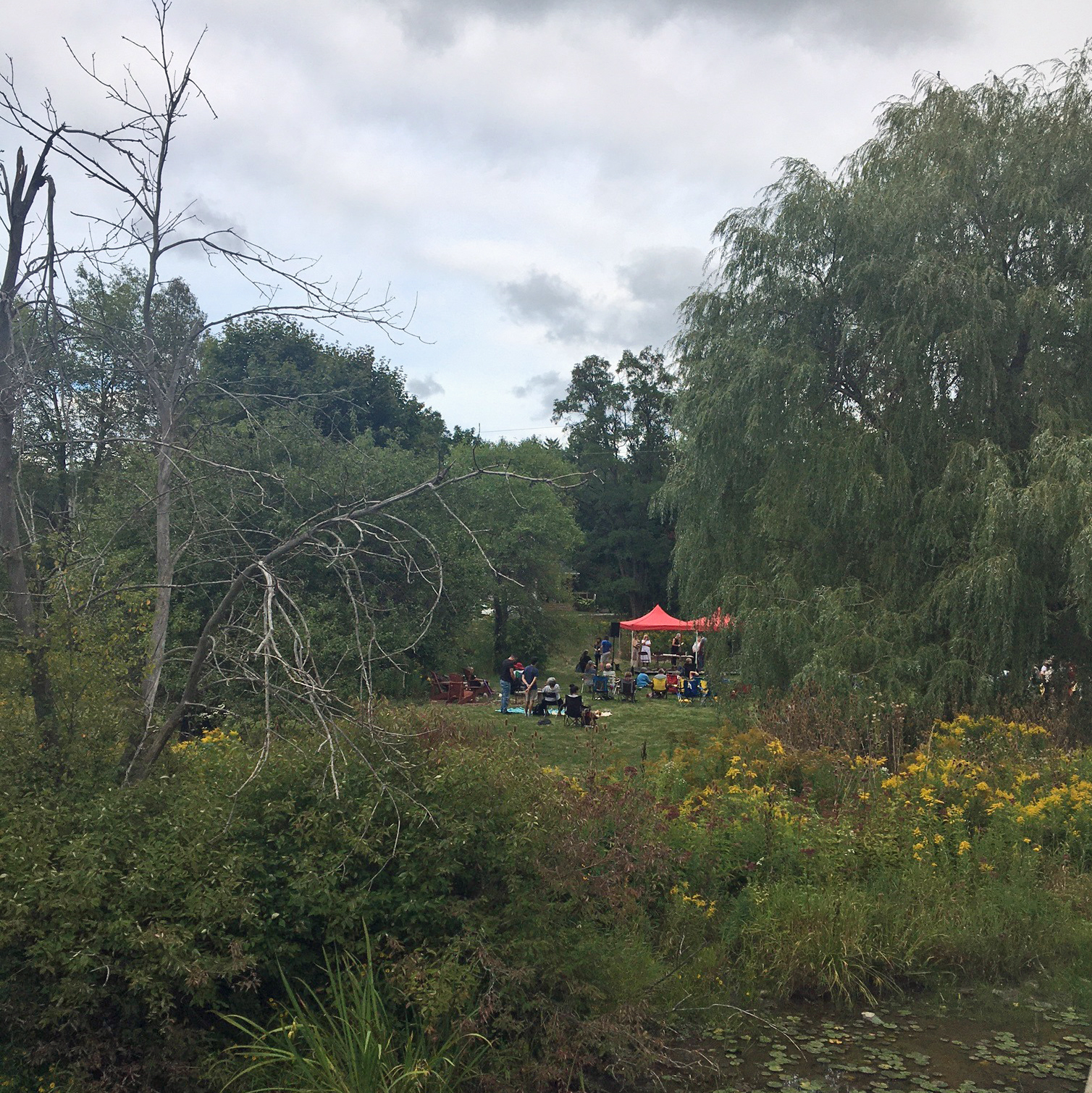
Back when I was still writing apprenticeship novels no one will ever see, I would sit on the grass and listen, and dream of reading at Eden Mills. To do so (in the Fringe venue, for unpublished or limited-published authors, as I was in 2016) was both terrifying and exhilarating. I had won places in both the prose and poetry competitions, so I was reading twice. I stood under a canopy, the Eramosa flowing in the background, 50 or 60 people scattered over the sloping lawn, waiting to hear my words. I did it; people applauded, and by the end of that day, after mixing with other authors both in the readings, the authors’ lounge, and the amazing authors’ dinner given at the end of the day, my perception of myself had changed. I wasn’t ‘an aspiring writer’ any longer. I was, simply, a writer.
(Oh, that dinner. The food was excellent, as I remember, but the crowning glory was the dessert: a selection of pies baked by the residents of Eden Mills and environs, pastry as flaky as you could want, bursting with fruit, and so good.)
For the last few years, I’ve been at Eden Mills in the Publishers’ Way, with one or the other of the small presses that publish my work. It’s a different view, a chance to chat with book lovers of all ages and interests, meet other publishers, do some networking. But I still sneak off to sit by the river and listen to an author or two, buy some books, say hi to old friends, and revel in the beauty of the village and the energy and commitment and vision that has kept this festival going for thirty-three years.
I plan to be back next year, the second Sunday in September. See you there?
This is the first in a blog series, the purpose of which is not only to spotlight an author’s work, but, in a dialogue between myself and the author, to illustrate the variety of ways the techniques of writing can be used, and how styles differ. My first guest is Bryn Hammond, author of Amgalant, historical fiction based on the Secret History of the Mongols, which is is the oldest surviving literary work in the Mongolian language. It was written for the Mongol royal family some time after the 1227 death of Tchingis Khan (Temujin). Bryn has chosen to discuss how she used poetic speech, homely metaphor, and lively conversation in her work.
Bryn
This is going to be about Amgalant, my main work – my life’s work, though I potter with other things.
I call my historical fiction a ‘close reading’ of the Secret History of the Mongols. More than a source, the Secret History is my original, and I want to imitate its features – not merely its content. Early on, I confronted the fact that I had one major difference from most historical fiction: that I am text-based, text-to-text, not trying to re-create history as such but to give a version of a story already told. In search of a model or template, I looked to T.H. White and Malory. White’s Once and Future King riffs on Malory’s Morte d’Arthur, quotes Malory, talks to him and about him. That was me and my text. I was after a deep fidelity, and yet room to be myself – as T.H. White does not shy from idiosyncrasy of style or interpretations that are meaningful to him. My aims often felt like a contradiction, but as my Temujin says once, ‘Contradictions, when they work, generate much heat and light, or else they blow up in your face.’
Topic: poetic speech
In my first excerpt, young Temujin composes a message to his anda – a friend with whom he has exchanged blood, where resides the soul. His anda too has suffered at the hands of the king who has stolen Temujin’s wife. This is Temujin’s request for Jamuqa to join him in a war of rescue.
Simplest leaves least to go wrong, he thought, and he stitched together a few simple verses. Verses, for formal wear. And when underway he found that verses gave him a truer language, truer to his emotion, that was only flagrant in daily felts and furs.
They have cut the liver from my side.
How our fates, my anda, coincide.
Can we right the wrong?
We feel each other’s injury:
Your wound bleeds my blood and mine bleeds yours.
My other self, can I avenge you?
Can you comfort me?
It was his first draft, but he didn’t fiddle.
I feel strongly that I have to use as much poetic speech as does the Secret History, or else I belie the rich oral culture of the Mongols as well as the techniques of my original. The Secret History itself gives much weight and space to the spoken word. I am dialogue-heavy, but only in equivalence to my original. The Secret History marks significance by turning a speech into poetry, but it also reports people’s own poetic speech. People use this particularly when they need to be ceremonious, or courteous, or emphatic, or heartfelt. Now, Temujin grows into a great ability with words. Here he is young and gauche and not used to formal communications. It is his first go at a message in verse. I had to make him heartfelt, I had to make him sound first-drafty, spontaneous, yet suggest he has a knack for this. I took the opportunity to explain, through his experience, the value of talking in verse from time to time. Of course, the challenge is not to be off-putting to a readership who doesn’t burst out into verse, who might tend to see verse as stilted, as the opposite of spontaneous and heartfelt. I have to convince readers that the Mongols, in a culture of oral poetry, could slip into poetic speech with facility and no loss of genuine feeling.
Marian
“No loss of genuine feeling.” – or maybe a way to express deeper feelings, or perhaps more subtle ones? The use of ‘flagrant’ in verses gave him a truer language, truer to his emotion, that was only flagrant in daily felts and furs is an interesting choice – I think of ‘flagrant’ as meaning ‘blatant’, or even ‘over-the-top’, so I read this as an indication that verse allows him to convey a more nuanced, truer emotion.
The use of avenge/comfort in juxtaposition – I think Western perceptions of Mongol culture (as a warrior society) would expect ‘avenge’ but not ‘comfort’. The cognitive dissonance for the Western reader here speaks to our own preconceptions, but what does it reveal about Mongol society?
My last comment on this section is that the use of verse here in formal (courteous, ceremonial) context is reminiscent of Shakespeare, where nobles speak in verse but commoners do not. Did you consider that at all?
Bryn
With ‘flagrant’ I wanted to suggest an extravagance of emotion, that might have seemed too much to talk about. Verse gives him permission to feel as much as he feels, and say so. ‘Comfort’ I chose with great care, aware that it subtly undercuts preconceptions about the Mongols. I can say the same of hundreds of other choices I made. There’s a word, ‘hachi’, important to the story from the start, because a khan before Tchingis, captured and tortured by China, sends a message back to his people in which he asks for ‘hachi’ – a message Tchingis cites as motivation when he strikes at China over thirty years later. If you’ve read a history on the Mongols you’ve probably seen ‘give me my hachi’ translated simply as ‘avenge me’. Now, my interest in revenge as a motive, whether I’m reading or writing, hovers around zero. So I’m going to look closely at that word, and I’m going to give you more shades to its meaning. I have Temujin’s grandfather think about the word when he hears the captured khan’s message:
Hachi means that which is owed, or felt due. It can mean an act of humanity. It can mean vengeance. It meant justice.
The word occurs in the Secret History for both gratitude and revenge. That’s nothing if not juxtaposition. ‘Hachi’ became one of my most beloved words to use – one I leave untranslated, because my reader has grown familiar with its cluster of meanings. There is a strong tendency to translate things, understand things, believe things as per our preconceptions. When I began to write about the 13th-century Mongols, back in 2003, I had to dismantle the preconceptions in my own head. That wasn’t a short or easy process – it took real vigilance, self-examination, again and again stepping back to question.
On Shakespeare – I am a Shakespeare-head. I am certain he helped teach me how one talks in verse, or how verse can be a cadence in more ordinary speech, when the culture is steeped in it. The noble/commoner split doesn’t map onto the Mongol situation, at least in my telling (everything about the Mongols is contested, everything).
Topic: homely metaphor
My next excerpt is Temujin as Tchingis Khan, a king, fifteen years later. He has been caught listening to what his companions are saying about him.
Laughingly he called across to him, “Ile Ahai, you have your hare by the ears. I listen to learn, to learn what you make of me, for you are one of my principal makers. You make very much, but I shan’t be cowed, neither embarrassed. For my task is a joint labour and whereas Temujin is me, Tchingis is us. Mine is the sack, yours is the milk poured in; Tchingis is stood by the door with the churn in his neck and together we try to beat him a thousand times a day, and whenever we step in or out we lend a hand.”
To help write Temujin’s turn for homely metaphor, I admit I thought of Jesus’ parables in the Bible, that use a humble subject matter. Temujin’s style as a king is humble and common, but a gift for speech is among his greatest assets. So this is one of Temujin’s little parables, based on a homely subject: the process of churning milk into the fermented drink ayrag. It is spoken to his inner circle, and involves them in the Tchingis project, in his kingship. Metaphor is much used in speech acts recorded by the Secret History – and other Mongol histories. Sometimes, at a critical moment, people have expressed themselves by a metaphor whose context is lost to us, and we can’t make sense of what they say. My challenge is to keep my English-language readers familiar enough with Mongol daily life that I can use those metaphors drawn from humble things, without the clunk of an explanation in (figurative) brackets. To work, this piece of speech has to have the casual references to ayrag-making and -drinking through the few hundred pages before it.
Marian
The concept of the separation of Temujin from Tchingis – the individual vs. the role really struck me (perhaps because I am writing a character in a similar situation.) The ‘homely metaphor’ works really well here to delineate this separation of person from position, and using the Mongol analogy brings it into its context beautifully. Which came first, the references to ayrag-making and -drinking in the previous pages, or the metaphor?
The lost metaphors: I couldn’t help but be reminded of theStar Trek: The Next Generation episode Darnok, where Picard is trapped on a planet with an alien captain who speaks a metaphorical language (from his own culture) incompatible with the universal translator. I don’t know if that means anything to you, but while (of course) it was easily solved, there are other examples in the Scandinavian sagas and perhaps even in Old English where we don’t understand the metaphors, concepts lost to time and change. It also brings to mind Robert MacFarlane’s book The Lost Words, which came about because of the loss of words related to nature in the 2007 edition of The Oxford Junior Dictionary. How much, do you think, are the lost metaphors due to cultural change separate from the evolution of language?
Bryn
Which came first? Daily life, always. Then it is there when you need it – waiting to be picked up in a metaphor.
I loved that Star Trek episode – particularly because those metaphors were drawn from a body of epic story. And then Picard recites from Gilgamesh to the alien! – my heart. So yes, I think a lot of the loss is down to lost story, lost anecdotes. Most unfortunately, the only survivals of the oral story-world that Temujin lived in, pre-writing, are snippets extracted for use in other contexts. We know there was a wealth because of the Secret History’s ease of reference, as well as by analogy to the vast and wondrous world of Turkic epic, that began to be recorded from medieval times on because of its proximity to writing cultures.
Topic: lively conversation
Back to young Temujin for my third excerpt. He faces a circle of experienced companions-in-arms, who laugh – or try not to laugh – at Temujin’s naivety over the size of armies mentioned by his patron the khan of Hirai.
Grey-tailed Jungso of Noyojin started to effervesce silently and couldn’t stop. Others, two or three of them, told him, “Jungso. Jungso, don’t be uncouth.” “I’m not,” he effervesced. Then he claimed, “I’m laughing at the khan of Hirai.” “Fair enough, too,” declared Jirqoan of Oronar. “It helps when people are precise in military matters. Tumens,” he addressed to Temujin, “you can bet your bottom goat, is here imprecisely used.” Temujin turned student-like to him. “A tumen doesn’t mean ten thousand?” Bisugat, next to Jirqoan, answered. “In a fat year, like a cheese. Cheeses shrink in a lean year, but we still call them a cheese.”
It is an often-acknowledged truth that the real hero of the Secret History of the Mongols isn’t Tchingis Khan but his companions. I do a lot of group conversations to convey the input of the group. This means I have cast members who have one line, but I still want them to feel alive, like individuals. One reason I chose the Secret History of the Mongols is its wonderful exchanges of speech. That suited the writer that I am. In historical fiction, the danger is that speech becomes stiff and stilted, in part because our slang isn’t theirs, in part because we often hear them through paperwork and not everyday speech at all.
Marian
The group conversations convey the richness of the oral culture and the importance of individuals within it.
I loved ‘bet your bottom goat’ because I as an English-speaker of a certain age and time expected ‘bet your bottom dollar’ and that it wasn’t that familiar phrase reminded me very sharply that this was a different time/place/culture. Was that your intent?
The flexibility of the measure of a tumen is superb, so easily understood. Is this your invention, or something shown in the Secret History of the Mongols?
Bryn
I do like to merge English-language slang with Mongol slang. This one was an easy example. I use whatever Mongol slang and figures of speech I can convey sense in, but where I need to amalgamate them with English idiom for explanatory value, I don’t scruple to do that. Sometimes there’s a clash that’s fun to work with. Milk is a substance for infinite idioms in Mongol, which often come straight across in English. But if Westerners hear ‘he has milk in his veins’, they might well assume that’s an insult. In Mongol idiom, milk is pretty much always positive, and this isn’t said negatively, although it does tie in nicely with the English – and Shakespearean – ‘milk of human kindness’.
Tumens: This explainer was me.
You can find more information on Bryn and her books at
My city, 9 a.m., downtown. A grey and cool holiday Monday. Pigeons crowded on a mansard roof like commuters waiting for a train. Empty sidewalk patios. A few people, out for breakfast or coffee.
My destination is the usual: The Red Brick Café. I’m here to write, but also to meet two friends, fellow writers. We’ll write in more-or-less creative solitude for three hours, and then we’ll have lunch together. A pre-COVID ritual we’ve started again.
The Monday morning writing group began a number of years ago; I joined when we moved back to the city. Time and circumstances mean people come and go, and COVID shut it down completely. But it was a way to begin the week, to focus back on writing, and, at least as importantly, to be in the company of other writers.
We’ve always been an eclectic group, writing across genres; writing for publication, traditional or indie; writing for personal exploration or enjoyment. Not everyone came for lunch every week, but the conversation has always been wide-ranging: Aristotle’s Poetics, Lee Child, poetry, politics, film, television. What we’re reading. What we’re writing.
We are three quite different writers: one a thriller writer, wedded to the three-act structure, fast pacing, clear endings. One is a poet and mystery writer. I write – well, what I write, which is an ongoing saga of conflict and politics in an imagined world. It moves closer to literary fiction with each book. Sometimes we debate structure, style, various ‘rules’ for writing; we don’t always agree. The thriller writer wanted my latest published book to be far more of a classic thriller than it was, and to have a lot less introspection. Good discussion; it made me think about all the possible ways a story could be written, how changing the focus changes the story. But in the end, I left the book the way I wanted it. But it influenced the one I’ve just finished.
Our small Monday morning group is only one intersection in the network of writing supports in my city, and for the most part they flow out from one non-profit organization dedicated to supporting writers. There are a multitude of events, meetings, casual Sunday afternoon get-togethers in cafes, Saturday nights in pubs. I participate in some regularly, a few occasionally, and others not at all. The overall sense, though, is one of respect for each other. We’re all writers, regardless of where we are in our development or interests or route to publication. And we have great conversations.
The sort of conversation social media just doesn’t support. Reasoned, sometimes argumentative, teasing, wide-ranging, following tangents, circling back, but without the binaries and snap judgements that dominate on just about every platform. We listen: not just to words, but to expression and body language and tone, understanding when someone can’t find quite the right words to say what they’re thinking. Something largely missing, and missed, during the months of isolation.
So here I am, writing at The Red Brick. (Where I set a short story recently.) Around me are other writers, one whom I just met on the weekend on the patio here; some are my friends, some aren’t (yet?). Other people are just having coffee, breakfast, talking, reading, working. There’s a real sense of community, even when we don’t know each other’s names.
My coffee cup is empty. Time for another, and a few conversations, no doubt, as I move between my table and the serving bar. How’s the work going? I’ll ask, or be asked. Will you be at….? Have you seen….? And in about 90 minutes, it’ll be lunch time. What will it be today? Aristotle? The Rings of Power? Stephen King’s newest? Or a heated debate on whether a villain has to get their comeuppance at the end of a book? Whatever it is, I’m looking forward to it.
In both my next two novels, the work in progress, Empress & Soldier, and the planned last book of my series, Empire’s Passing, death and grief play an important role. In Empress & Soldier deaths transform my central characters in different ways. For both, deaths are the pivots that change the directions of their lives. One grieves in ways he cannot articulate (he may not even realize he is grieving); one is forced by circumstance to pick up the pieces of a shattered life far too soon.
The personal relationships of the characters of my Empire’s Legacy series have always been a metaphor, or a reflection, of the political relationships among their countries, their creation of an unusual ‘found family’ and the depth and expression of love among them echoes their work towards understanding and cooperation among their nations. The loss, in Empire’s Passing, of two of these central characters, deeply loved, deeply grieved, will also reflect the fragility of the political alliance; both families and political unions can be strengthened or destroyed by catastrophic events.
I am 64 years old. In my life death has, of course, touched mine. But not yet the deep, life-changing grief of losing life partners that my characters will experience. My parents died at 93 and 99: I mourned them, miss them still, but life didn’t change in any significant way. My brother’s too-early death came closer, hit harder, but I wasn’t left to find a way forward alone.
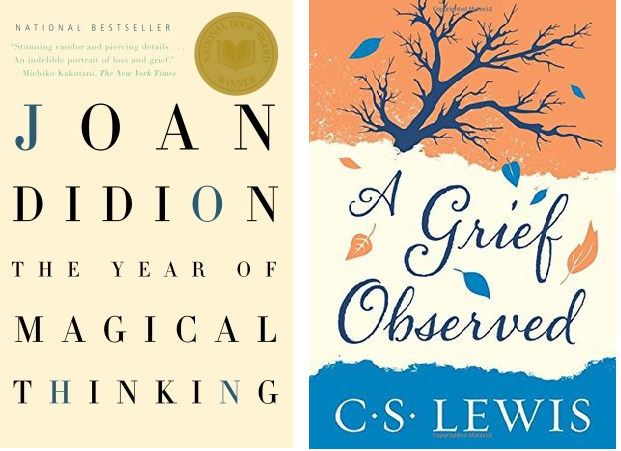
So I turned to others accounts: CS Lewis’s A Grief Observed, Joan Didion’s The Year of Magical Thinking. Personal accounts, too: friends, family – not interviews, but remembering what they said or described. Listening, squirreling away words and concepts, as writers do.
I know what my characters do, in response to their losses. The challenge is entwining the feelings, the mental response, the confusion and darkness and irrationality with their actions in a way that is plausible and to some extent explanatory. Grief is universal but intensely personal, and in what I am attempting I am conscious I am not writing from lived experience, but from research, imagination, and empathy. Will my characters, who live only on the page and in a world that has never existed, express their pain and grief and love in ways that speak to readers? I will find out in time, I suppose.
Featured Image: Stele of Titus Fuficius in Split Archaeological Museum, Split, Croatia
May is the month when my two avocations – writing and birding – compete for my time and attention. For most of the year (or at least my Canadian year – our English months had a different rhythm), I write in the mornings, and do everything else in my life in the afternoons. But birds – especially songbirds, migrate primarily at night, dropping down into woodland, hedgerow and grassland to feed in the early mornings. So morning, during migration, is when to be out.
I’ve been birding at some level for over fifty years. I’ve been writing for at least as long. Birding keeps me in touch with the rhythms of the earth, and the non-human lives that we share it with: I may be primarily looking for birds, but I’m also seeing and paying attention to reptiles, amphibians, mammals, insect life – and plants. Honing skills of observation, layering experiences of sight and sound and smell – and even feel and taste – into my day and my memory, often to reappear in my writing.
I’m always birding. If there’s light in the sky, whether outside or near a window, if a bird moves, I look at it. Reflexively. (Not always the best reflex, when you’re having a serious conversation with your boss in the parking lot, but, there it is. They were all remarkably forgiving.) I’m always writing, too. Words move in and out of my conscious mind: description, conversation, mood. Sometimes I even write about birding.
Regardless of my respectable list of birds seen, garnered over seven continents, I’m not a world-class birder, and I never was nor will be. I have no ear for song, a requirement to be really good, and, at sixty-four, my eyesight isn’t what it once was. The details are harder to distinguish now. But I was at my best a solidly good birder. But I didn’t get there overnight. It took a lot of work, birding with people who knew far more than I, studying books, making mistakes, learning from them: hours and hours in the field and analyzing that field work afterwards. A lot of work for a ‘hobby’? But a discipline that overlaps with that of writing. I’m not a world-class writer, either. I’m probably a solidly good one. But I didn’t get there overnight. It took all the same steps, the same discipline, the same willingness and drive to learn, and keep learning.
As I walked the familiar paths of my birding patch this morning, I thought about how these two parts of my life complement each other. Birding taught, and continues to teach, lessons far beyond that of identification: patience, for one. But more subtle ones, too: yesterday I watched a bluebird hunting insects. Except I didn’t have my binoculars, and the position of the sun meant the bluebird was only a silhouette. How did I know it was a bluebird, then? From all the things it showed me: its size and shape, how it flew, how it returned to the same branch over and over – all these things said ‘bluebird’, without me having to be told, by an in-your-face, look-at-me view, that it was a bluebird.
Birding taught me, too, about glimpses, how to construct a whole from pieces. Tapaculos are small birds of the undergrowth of central America. They are, most of them, very hard to see, because they skulk under thickets. But if you see enough pieces of a tapaculo: an eye, a beak, the tail feathers – they add up to a whole bird in your mind. Just like worlds and characters are best built in the mind of the reader from pieces, hints, brief views.
I could keep drawing parallels; I won’t. But this morning, as I left the coffee shop downtown where I’d had breakfast, still early, and stepped into St George’s Square, a raven flew low over the space, calling. Unexpected, delightful, (and perhaps portentous for some). I’m still thinking about it. A plot twist, if you like.
I love road trips, and over the years Brian and I have driven thousands upon thousands of kilometers across all North America and Great Britain, much of Australia and most of New Zealand, plus bits of more other countries than I can count. But I never stopped wanting to do one on my own.
I like my own company, and I like, perhaps need, space and silence to think. So when, in the summer of 2013, Brian went birding in Papua New Guinea – a place I had no interest in, having had enough of hills and humidity – I left the cats in the care of their usual sitter and drove west, out to the silence and space of the Great Plains and the Canadian prairies. A two week trip.
I’d originally planned to follow Highway 2, a non-interstate that runs not too far under the Canada/US border, but I soon learned it didn’t suit my needs: too many trucks, too few safe opportunities to pull of to look at birds. So I took myself up to the parallel county roads, where there was almost no traffic, and many opportunities to stop.
I’ve written before of the recurring dreams I’ve had since childhood: dreams of roads and paths, in cities but more often out of them. Some of these dreams involve water, paths crossing wetlands on causeways. They stay in my mind, holding their own authenticity overlaid on the real world. And on a county road in North Dakota, just west of the tiny hamlet of Whitman, I drove into one of those dreams. The road became a causeway, crossing a lake filled with birds. I pulled over, stopped, got out. Wonder coursed through me. I know I laughed aloud in recognition and delight.
Black terns hunted insects over the water; ducks of a half-dozen species swam and dabbled. I stayed maybe half an hour, the occasional pickup truck passing, but nothing else to interrupt, interfere. I got out the scope, looked at the birds, but it was almost an excuse to linger.
What has this got to do with my books? Just two lines. In Empire’s Exile, not too long after Lena and Cillian reach Casil, she asks:
“What did you think? It must be strange, to see these buildings you have read about.” “Like finding the landscape of a dream is real,” he answered.
Moby-Dick was the first assigned book I never finished. It was part of our American Literature focus in my last year of high school, back in the day when Canadian high schools were still ignoring Canadian literature. I was, and am, a voracious reader. But I just couldn’t read Moby-Dick. The prose was dense, meandering, sometimes unclear. And yet I kept thinking about it.
Fast-forward about thirty years, and a long-haul flight to New Zealand. Seventeen hours plus. I’d started listening to a lot of books: family circumstances meant I was driving eight hours every second or third weekend, and my job also entailed a lot of driving. Audiobooks helped pass the time. So, I decided to listen to Moby-Dick on that trip to New Zealand and Australia.
And fell in love with a magnificent book, a symphony of language and philosophy, of style and story. Whether it was my tendency to skim-read, or a symptom of my ADHD, or just maturity, I don’t know – but this book I couldn’t read is now one of my favourites: one I needed to hear to appreciate it.
Since then, I have learned that I appreciate almost all 18th and 19th century writers better when I listen rather than read. I wonder sometimes if it was that these books were expected to be read aloud, an on-going evening’s entertainment, or if a slower pace of life (for the privileged few, anyhow) meant reading was perhaps more leisurely. Regardless, when I want George Eliot or Tolstoy or Cervantes, I reach for my phone and earbuds, not a physical book.
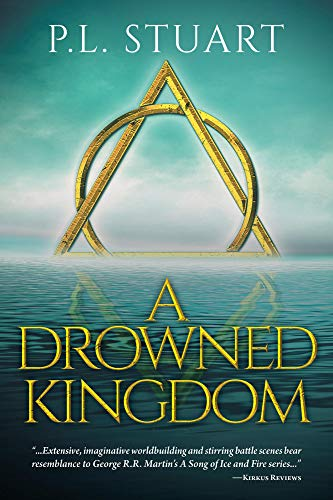
Which brings me to the actual subject of this ramble: a reconsideration of a recent review. A book I had difficulty reading: P.L. Stuart’s A Drowned Kingdom. It has, actually, a few things in common with Moby-Dick: a dislikable central character driven by hubris, and long expositions on the reasons for actions, to name a couple. I read it, wrote a neutral and unstarred review (some of you reading this will know I rarely star reviews, for reasons given here), and moved on. And yet I kept thinking about it.
Then one day I was listening to Thomas Hardy’s Return of the Native, which is slow, and definitely not cheery (well, it’s Hardy, what do I expect?) and something clicked. I should listen to A Drowned Kingdom (which coincidentally had just come out in audiobook format.) So I did.
And, as with Moby-Dick, I liked it a whole lot more. Listening doesn’t change the arrogant hubris of the MC, Othrun, but that was never an issue for me. I still believe Stuart is brave, both for creating a dislikable main character and for writing in a style somewhat at odds with much modern fantasy writing. But the lack of enjoyment in my first reading of the book wasn’t due to a fault in the writing, but my own limitations in interacting with the prose.
Story is at the heart of what we as writers do, and stories can be told – and absorbed – in many ways: through poetry, through prose, through oral storytelling, through plays, through visual media. Sometimes, as the audience, we need to find the form that is right for us. I’m glad I could for A Drowned Kingdom.
“History is lies agreed upon.” A sentiment attributed to both Voltaire and Napoleon Bonaparte, but likely first used by Bernard Le Bovier de Fontenelle in 1724. As I wrote Empress & Soldier, the 7th book in my fictional early-medieval world, this idea is never far from my mind. But not for the big events of the world, but for my characters’ personal histories, and the small events that shape their lives.
History is a matter of interpretation and memory. Oh, we know Bonaparte lost the Battle of Waterloo, but if you asked a dozen people who fought in that battle, they’d all have different memories. Not only would those memories conflict, they’d change over time. Even what we remember immediately after an event isn’t necessarily what actually happened, and memory is malleable, easily reshaped.
Some of what happens in Empress & Soldier has been told before, in Empire’s Exile, although from different points of view, and some of character Druisius’s past history has been told in bits and pieces in all the books after Exile. There are discrepancies. They are, largely, purposeful on my, the author’s, part. Are the characters also purposely misleading? (Bear with me. I know I create these characters, and their thoughts. I will explain.)
Often, yes. My characters lie for all the reasons humans do: to protect another from hurt; to protect themselves from judgement, to hide their wrongdoing, or the actions of someone they care about, to avoid an argument. They lie for diplomatic purposes, for reasons of state security; they lie from love and fear and by the order of their superiors. Their lies are both of omission and commission, things left unsaid, things said.
In the latest-published book of my series, Empire’s Heir, my four main characters have been together for twenty years, give or take, as lovers, friends, parents. That’s a lot of shared history, and a lot of stories told. But in Empress & Soldier, which takes place in the decade before that foursome becomes a foursome, the history that unfolded for Druisius didn’t quite match his later stories.
I could, of course, have changed the unfolding story to match, or simply blamed it on faulty memories. But that would have been far too neat, too fictional, really. Life’s not like that. And then I began to think about the other stories told, and how they reflected a truth, but perhaps not all the truth.
The challenge is to find plausible reasons for the discrepancies in the stories, true to my characters but perhaps also revealing (or at least hinting at) things about them we didn’t know. Why would they have lied, whether directly or by never mentioning something? What purpose did it serve at the time – and will it come back to haunt them?
In the next and last book, Empire’s Passing, when my foursome has had nearly thirty years together, events will lead to questions. What do we know about the people we love? How do we react when we learn they withheld things from us for all that time? Do we know them, or only the person they have let us see? I’m setting up a lot of those withheld things now, in the current work.
It’s not a new theme for me: the idea of the mutability of history, both political and personal, is entwined in the stories, as well as the things left untold.
That the complex bonds among my parents and Druise and Sorley needed both deep trust and deeper love, I had understood. But I hadn’t thought then about the ways their lives were also delineated… Spaces in what they spoke of, too, even behind closed doors.
A price to be paid, for the love and the vision they shared.
Empire’s Heir
Truth is the first casualty of war, it is said. Is it also a casualty of love?
Slingers portrayed on Trajan’s Column. Public Domain via Wikimedia Commons
Smooth stones shot with a sling…are more dangerous than any arrows, since while leaving the limb intact they inflict a wound that is still lethal, and the enemy dies from the blow of the stone without loss of blood…This weapon should be learned by all recruits with frequent exercise, because it is no effort to carry a sling. It often happens too that warfare is carried on in stony places, that some mountain or hill has to be defended…
Vegetius: De Re Militari
Druisius, one of the main characters in my newest book, Empress & Soldier, is a new recruit facing his first battle, defending a mountain pass. In the vanguard of the troops facing the enemy are the slingers. (No, this isn’t historically correct: what I write isn’t. It’s a created world that looks a lot like ours, but I’m not bound by absolute accuracy.)
Slings are an ancient weapon, most likely in use long before any written record. The first written record in the western world is the story of David and Goliath in the Old Testament of the Bible (1st Samuel), thought to have been written about the 6th century BCE. Used across the world, the oldest-known slings are from coastal Peru, radio-carbon dated to c. 2500 BCE.
Roman slingers, which I am using as my model, used lead sling-bullets: the density of lead means that the mass of a sling-bullet made from the metal is much greater than one of stone. Lead sling-bullets could therefore be small, able to travel further than a stone of the same mass due to less resistance in the air, and difficult to see in flight. A painful projectile, with larger ones capable of speeds up to 160 kph. As archaeologist John Reid of the Trimontium Trust told Scientific American, it could take the top of a head off. Romans (and Greeks) literally added insult to injury: bullets were sometimes inscribed with images of snakes or scorpions, or inscriptions such as ‘catch!’.
Peter van der Sluijs, CC BY-SA 3.0 via Wikimedia Commons
Perhaps the most interesting of all the sling bullets found from the Roman period are those from Burnswark, or Birrenswark, Hill in southwestern Scotland. In the second century CE, troops under the command of Quintus Lollius Urbicus, the Roman governor of Britannia (himself following orders from Antonius Pius, the Roman Emperor) attacked the hillfort of the Caledonian people here. Archaeological investigations at the site discovered about twenty percent of the sling bullets were smaller than average, and had holes drilled into them. These bullets whistle as they fly. Their assumed purpose is to terrify the enemy: small, stinging, whistling projectiles, almost like a swarm of biting insects.
Druisius isn’t a slinger; he’s infantry, a foot soldier using shield and sword. But he sees the value of the sling in his first battle. Will he ever use it? You may have to read Empress & Soldier to find out!
References:
Translated Texts for Historians Volume 16: Vegetius: Epitome of Military Science. N.P. Milner, Translator. Liverpool University Press, 1996. pp 16-17









 marianlthorpe.com
You must be logged in to post a comment.