Finding Inspiration

Trying to maintain writing discipline while packing, arranging for (and checking on) tradespeople, and doing all the other things involved in moving house after twenty-two years, is, to put it mildly, difficult. I’ve done my best to keep up with my blogs (three of them now – one of which I started in the midst of all this, for some reason….) but work on Empire’s Hostage has been non-existent. That’s only in part due to the move, and in part due to, basically, writer’s block.

But this last week I’ve been reading – in small chunks, usually at lunch or when I really need a break from something – Malachy Tallach’s book 60 Degrees North: Around the World in Search of Home, a book I chose to read in part because, I thought, it might give me more insight into life ‘north of 60’, as we say here in Canada. I’ve been there, in Canada and the US, but not otherwise. As Empire’s Hostage takes place largely in what might be ‘north of 60’, in a land that more or less parallels northern Europe, it seemed a potentially useful book to read.

It was. Yes, I’ve learned some things that I may or may not use. But it was one passage – a descriptive one, not factual – that suddenly sparked a scene, a setting to begin the next section of Hostage, one accurate to the landscape and mood of the story. I can feel the relief, a lifting of the nagging tension that I wasn’t going to find a way forward. But now, of course, I have to find time to write….

Canadian indie writers – join me in supporting Fort McMurray fundraising!

All proceeds from the sale of my two e-books, Empire’s Daughter and Spinnings,in the month of May, will be donated to the Red Cross to aid Fort McMurray residents.  Canadian indie authors, join me in raising funds!

Fort McMurray

By DarrenRD – File:Landscape view of wildfire near Highway 63 in south Fort McMurray.jpg, CC BY-SA 4.0, https://commons.wikimedia.org/w/index.php?curid=48561288

Horrible Words?

A link to a timely article for all writers from the Guardian.  I admit to ‘alright’ being one of my pet peeves, but I’ve bowed to common usage in my reviewing and stopped commenting on it. I still wouldn’t write it, though….

http://www.theguardian.com/books/2016/mar/25/epic-fail-to-hotdesk-guesstimate-an-a-z-of-horrible-words?CMP=fb_gu

Short Fiction: In an Absent Dream

Some of you may remember this post from December….it’s been edited since then.

In an Absent Dream

Where I go in my dreams is real.

I wrote that ten minutes ago. I’ve been staring at it ever since: twice I’ve reached for the delete key. Acknowledgement is the first step in solving a problem, it’s said, and until I actually wrote it down, I was in denial. Who wouldn’t be? But please, keep reading…this is important.

Let me correct what I just said – no, I’m not back-pedalling, just being more precise in what I say. Most of my dreams are just dreams like everyone else’s, my brain processing bits and pieces of what I’ve seen and done and turning them into a film, sometimes straightforward, sometimes incomprehensible. Sometimes an image or even a whole series of scenes remains in my consciousness when I wake, for a little while, before they fade; I think that’s normal.

And then there are the other dreams.

Please bear with me, Wills. You’re the only person I could think of who might believe me, and I think even you will find it hard. I promise you, though, this is real: I’m not on drugs, or mentally ill – at least, I don’t think I am. You’ll have to decide that for yourself, I suppose.

I couldn’t have been more than five or six the first time my dreams took me to this other place. I don’t have a name for it – it’s just a different reality, overlaying the everyday. Maybe it’s faerie, for lack of another label, but it’s not the faerie from the children’s stories. It’s just this world, these streets, these fields…but it’s overlain with roads and paths and occasionally buildings that don’t exist in the world under the sun. It’s like they hover over (or under) the solidity of the everyday world, taking shape and substance only when someone – me – enters them.

So for much of my life I’ve held two realities in my mind: the world we all walk in, and the world I walk in my dreams. In my waking life, I’d walk or cycle or drive, on footpath and bridleways, lanes and roads, and see the dream-paths overlaying the everyday world. I could tell you – can tell you – exactly where an unseen path branched off from the one I’m on, and what’s down it, and how it connects with other paths, seen and unseen. I dreamt the same dreams, the same paths, over and over again, and I remembered all the details, every time. Sometimes the paths took me underground; sometimes up through staircases and connecting aerial pathways between buildings that cannot be seen in the light of day. Sometimes I walked rock-strewn tracks through fields and woodland, and sometimes I waded through shallow water. Paths took me north and east and south and west, and the direction I moved in was always clear. And every time I moved away, to university, to a new city to work, there were new paths to learn.

No, that’s not true. There weren’t always new paths. In all the years I worked in a small, new city, and drove its suburban streets, there was no hint of a faerie world beneath or above it. It was a city I felt no connection to; a place to work, no more. But this city – when I came here for uni, I felt connected to it almost immediately –in my dreams, it’s full of faerie paths, at least in the oldest parts. When I moved away from it, I felt bereft. I had to find reasons to return, to walk the old city, to keep the faerie paths clear, like a rambler who walks a footpath every few months to keep it open. I’d moved to my village, and I was learning its footpaths and lanes – in daylight and in dreams – but the city called me back every few weeks. When I was offered this job at the college, I jumped at it.

I know what you’re thinking. Recurring dreams aren’t uncommon, and this is just how my brain, which loves maps and paths, interprets new experiences. I told myself this for years. I’m a scientist, remember? Of course this wasn’t real. I’d been brought up on Alice, and Narnia, and Alan Garner and Lucy Boston and Puck of Pook’s Hill, and all those other children’s books where another reality can be reached through a rabbit-hole or a wardrobe or a door.

So what changed my mind?

It started with a photograph. I was walking in the old city, down some cobbled passage, looking up, at the gargoyles, at window-boxes planted with pansies gracing tiny windows on the top floors of ancient buildings, at the pigeons on the tiled roofs. I came out into a courtyard I knew, a place I hadn’t been for a while, in either world. Across the courtyard from where I stood, the passage continued, heading northeast towards the river; to its left a three storey building abutted a taller one, leaning into it in the way of old structures. On the flat roof of the shorter house, someone had built a garden, iron railings enclosing a couple of potted trees, planters bright with flowers, and two blue chairs.

I remember wondering, somewhat mocking myself, what this new garden had done to the faerie bridge that had run from this roof across the passage to the next building. I found my phone and took a picture of the roof garden: I liked the look of it, the blue of the chairs against the grey stone. And then I kept walking, down to the river and along the embankment, looping back the car-park.

That night I dreamt of the faerie path that parallels where I’d walked that morning. I followed the passage to the courtyard, and then slipped onto paths that existed only in the dreamworld, through an arched gate and up an external stair onto the roof where the garden had been built. The bridge still rose from the roof to a door in the building across the passage, just as I remembered it. The garden had been arranged, it seemed, to accommodate it. I walked across the bridge – in the dream I looked back at the roof garden, which remained unchanged – and then through the door that let me into the house, and down a hidden staircase and out to the river.

When I woke, the dream was still vivid. I lay contemplating it, thinking about how my question of yesterday morning had been answered so directly. I couldn’t remember that happening before. I got up and made coffee, wondering if the faerie bridge could indeed have risen still from the roof, now the garden was there. Ignoring the cat, who was demanding to be fed, I found my phone, and opened the photos.

The garden was a tiny part of the picture, as is the way with phone photos. I zoomed in on it: the angle wasn’t good, but I thought I could see that potted trees were standing on what would be either side of the faerie staircase, leaving a space between them. I smiled. No doubt I’d registered that yesterday, on some subconscious level, and the dream had just been confirmation. Just before I put my phone down, I glanced at the screen again. I was holding the phone slightly tilted. From between the potted trees, a shadow, a shimmer of what looked like a bridge caught and held my eyes.

I brought the phone closer, the screen flat. Nothing. I tilted it again, and the same shimmer appeared, the faint hint of a shape, a structure. A reflection, I told myself. I put the phone away, fed the cat, drank some more coffee, made toast. I even took a bite or two, before I retrieved the phone and uploaded the picture to my laptop.

I worked on the picture all morning, adjusting lighting and contrast, playing with equalization and sharpness and every other filter and enhancement Photoshop offered me. By noon, my shoulders aching and the coffee and toast stone cold beside me, I had a picture in which something that could have been a set of steps and the deck of a bridge – or at least the outline of them – rising from the pavers of the roof garden.

I saved the file again and walked away from the table. I took a hot shower, letting the spray of water ease the tension in my neck and shoulders. I made fresh coffee, found eggs and cheese and cooked an omelette, ate an orange. I did all this methodically, focusing on the tasks and the food. Then I sat down and thought.

What had I done this morning? I had a picture that apparently showed the impossible, a bridge from my dreams visible in the light of day. But had I simply manipulated, pixel by pixel, an artefact on the screen into what I expected to see – what I wanted to see? I couldn’t rule out the possibility.

I needed someone else to enhance the picture, someone who had no preconceived idea of what the artefact was. In the spring, I’d taken a couple of sessions of an art class for a friend, teaching her evening group how to do what I do as a hobby: use Photoshop to manipulate their original works, watercolours and pencil drawings, into images more abstract and interpretive. One of the students had taken to the technique like the proverbial duck to water, sending me an e-mail later to say I’d changed her whole approach to art. I’d seen her at the Tuesday Market a time or two, selling greeting cards and prints of her work; she’d insisted on giving me a print, a slightly abstract view of the Minster. I thought she would do it, if I asked.

Hello, Abby, I wrote in the e-mail. I hope you’re well. I wonder if you’d do me a favour? I took this photo (attached) earlier in the week, and it’s got a reflection or some other artefact that you can barely see. I had an idea that I use that to make a more abstract image…but I’m not happy with my results. Would you play around with it for me? I think your abilities have outstripped mine long ago and I’d like to see what’s possible! Thanks, and let’s have coffee or lunch some day after the market, my treat. Claire.

I sent the e-mail. I closed the laptop, pulled on a coat and laced up my boots, and went out into the day. I walked a long loop west and south of the village, the wind off the North Sea brisk, ice still on puddles in shade. I had a biology class to teach Monday – the next day – and I’d barely thought about how to present it so my students would pay attention. I focused on my lecture, and on the play of sun and shade on the fields, as I walked through the March afternoon.

I heated soup and ate it with cheese and baguette and a glass of wine while I typed up my lecture notes, resolutely ignoring my e-mail. Only when my notes were complete and the summary posted to my website did I open Gmail, a new glass of wine in my hand. I scanned the new mail: a reply from Abby.

Hi, Claire, it read. Of course I will! I can’t do it today but I’ll see what I come up with as soon as I can. Lunch sounds great! Let me get the picture done and then we’ll set a date. Looking forward to seeing you! Abby.

Over the next few days I taught my classes, went to a film with friends – you were there – and enjoyed the spring sunshine whenever possible. It wasn’t till Thursday evening that the email from Abby arrived, with the little paperclip symbol that indicated an attachment. I opened the email.

Here it is! I had a lot of fun with it! It’s a really interesting picture – don’t know what was reflected there – maybe a builder’s ladder? Or some scaffolding? but it’s come out well. Let me know what you think! How’s this coming Tuesday for lunch, one o’clock, Florrie’s? Abby xo

I opened the attachment. Abby’s skill with Photoshop made my attempts look pathetic. Rising from the roof garden, shining in a sun I hadn’t remembered, was a bridge of finely-wrought metal, looking barely able to take a person’s weight, spanning the passage and ending at a arched doorway cut into the wall of the next house.

I typed a reply to Abby, words of thanks and a confirmation of lunch. Then I sat, staring at my computer screen, until my eyes itched with dryness. It couldn’t be. Eventually the persistent mewing of the cat brought me to myself. I got up, let her out, tidied away the remnants of supper and put the dishes in the dishwasher. By the time I’d done that, and used the loo, the cat was asking to come back in. I scooped her up, and went to bed.

Sleep was slow in coming. Part of my mind told me that Abby’s image just confirmed that there had been a reflection, somehow, of some builder’s gear; she had just artistically enhanced it to create that exquisite bridge. I’d buy her lunch to repay the time she’d spent on it, ask her if she wanted the picture for her cards. But another part of my mind told me a different story. As I drifted, finally, into sleep, I thought, at the edge of consciousness, bring something back, the next time you walk the faerie paths.

I’ve never been able to compel these dreams: they come as they want. But late that night – or more accurately, in the early hours of the next morning – I found myself again walking the cobbled passage and taking the stair to the roof garden. In the dream, I stood on the roof, looking at the plants, and at the bridge before me. I crouched, and from the planter box in front of me, I picked three pansies – two yellow, one deep purple – tucking them deep into the pocket of my jacket. Then I crossed the bridge, feeling its structure vibrate underfoot, and followed the faerie path away.

And woke, disoriented. I lay still. The familiar weight of the cat at the foot of my bed, and the soft hum of the boiler reheating grounded me, brought me back to the real world. I rolled over, and returned to sleep, deep and dreamless.

I had an early class the next morning. The bright smiling chatter of the morning weather girl told me the day would be warm and sunny; it was already ten degrees at seven a.m. I left the house without my jacket, simply throwing my favourite scarf, bright with poppies, around my throat against any chill.

The day passed as every last Friday of the month does: my morning classes, the staff meeting after lunch. Budget and curriculum, new regulations from the government, enrolment figures. Late in the afternoon we moved to the pub, but the conversation didn’t change much, as you know. It was dark by the time I left, and the temperature had dropped considerably. I wound my scarf more snugly around my throat, and walked quickly to the car-park. The car barely warmed in the ten-minute drive home, and I was shivering slightly as I unlocked my front door.

A jumper and a cup of tea helped warm me. After a short while I unwound the scarf and hung it on the coat stand in the hall, beside the jacket I should have taken that morning, regardless of what the weather girl had promised. And then I stopped. Slowly, I reached into the left-hand jacket pocket. Nothing but a pound coin. I put my hand in the other pocket. Again, nothing. I felt my shoulders relax…and then my fingers found something dry and crumbly. I caught a piece between my finger and thumb.

In the poor light of the hall it looked like a bit of dry leaf, something that could have been there since the autumn, picked up and forgotten. I walked slowly to the kitchen and its brighter light, laying the shred of dry material on the white counter. I stared at the counter. The scrap was brown and dry, but along its crumbling veins a hint of purple ran, rich and deep.

It’s just a piece of copper beech.” I said to the empty room. The cat mewed inquisitively. “It probably stuck to my glove the day I was picking up conkers along the river.” I told her. She wound around my ankles, wanting her dinner. I fed her, and me, and poured myself wine, flipping through channels to find something half worth watching. I settled on a film, a sci-fi thriller set on a space station, good enough to keep my attention to bedtime. I took the last glass of wine to bed with me, and while I dreamt that night, confused, alcohol-induced images flashing across my eyes, I did not visit the faerie paths.

I didn’t make it to the Saturday Market until nearly noon, my pounding headache eased by then by water, strong coffee, and paracetamol. The day was dull, low clouds hanging over the town, for which I was glad. I bought bread and oranges, cheese and a bunch of daffodils, and a book I’d been wanting at Waterstone’s. The first chapter occupied me through lunch: another cup of coffee and a sandwich I couldn’t finish. But regardless of how good the writing was, I kept looking up, east, to where the cobbled passage ran out of the market square and towards the river. When I finished my lunch I closed my book, gathered my bags and very firmly walked west to the car-park.

I’m telling you this so you know how reluctant I was to go any further with these wild imaginings, and yet how drawn I was to the thought of that faerie bridge. I kept myself occupied all day Saturday – yesterday – cleaning, laundry, a trip to Tesco’s. In the evening I drank water and tea with my supper, and marked papers until past eleven, and then took my book to bed.

My bedroom was cool, so I got up again to get my poppy scarf, draping it around my shoulders like a shawl while I sat up to read. At some point, half-way through a chapter, I fell asleep. The dream started as it always does: I’m on foot, and walking east on the familiar path. I reach the courtyard and climb the stairs that aren’t there in daylight. On the roof, I stop, and very carefully loosen my scarf from around my neck, my poppy scarf, bright with blood-red blossom, and I tie it, tightly, to the railings. And then – I’ve never done this before – I retrace my steps, instead of going on.

It is barely light when I wake. I’m cold: the covers are pushed down, and my shoulders are bare except for the thin straps of my nightdress. I sit up, switch on the light. The cat blinks at me, disturbed. I close the book which has fallen, spine up, beside me, and hunt around for my scarf. It’s not on the bed. Of course not, I think, I tied it to the railings.

I spend the next hour looking for my scarf. I pull out the bed, to see if it’s slipped between the mattress and the headboard. I go through my closet, the drawers; I even look on the washing line in my tiny garden. It’s nowhere to be found.

The Minster bells are ringing for early service as I drive into town. I park in its car-park, take my ticket from the pay-and-display machine, drop it in the car. I turn, the wind from the North Sea blowing my hair, and walk away from the church, up one passage, across the deserted marketplace, and east along the passage that will bring me to the roof garden.

Even before I leave the cold shadow of the passage I can see my scarf on the railings. It’s moving in the breeze, fluttering, the red poppies blowing bright in the early light. I stand. I stare. I walk slowly into the courtyard, and carefully, quietly – it is still very early on a Sunday morning – I walk along the row of houses, looking for a way up, a way I could have put the scarf there, sleepwalking, entranced.

There is none. The roof garden has no staircase, no access except the door from the house beside it. Not under the sun of this world. A dog barks. The town is waking; I need to leave.

I think I walked much of the day; my feet are sore, and I’m hungry, but it doesn’t matter. It’s very late now; I’ll finish this e-mail and go to bed soon. I know you check your messages every morning, before you teach your first class, so you’ll see this one: I’ve scheduled it to be sent at eight. If you get it, cancel my class – I don’t teach until one on Monday, you’ll recall – and you’ll probably want to make arrangements for all my other classes this week. I’m going – I hope – to get my scarf back tonight, if the dreams allow. If faerie allows. I think it will. What I don’t know, Wills, is if it will let me come back.

Try to find me, Wills. If you can’t, please take care of my cat.

Claire.

Image courtesy of Greenpenwriter (Own work) [CC BY-SA 3.0 (http://creativecommons.org/licenses/by-sa/3.0)%5D, via Wikimedia Commons

Title from Goblin Market by Christina Rosetti.


Books of Influence: An Occasional Series

This is the first in an occasional series of posts about the books – mostly classic fantasy and science fiction – that have most greatly influenced my own writing and world-building.  First among these are The Chronicles of Tornor, by Elizabeth A. Lynn.

The Chronicles of Tornor, published in the late 1970’s and early 1980’s, consist of three books: Watchtower, The Dancers of Arun, and The Northern Girl. All take place in Arun, a land of city-states and northern keeps, grasslands and mountains, a land where certain psi powers, dance and warfare as two faces of one discipline, and a wider acceptance of differing forms of sexuality and love evolve over the several hundred years separating the three books. The first book in the series, Watchtower, won the World Fantasy Award in 1979.

Hailed at the time of publication as “an adventure story for humanists and feminists” (Joanna Russ) author Elizabeth A. Lynn’s spare, evocative prose and finely tuned characters made me long to be in Arun, but more importantly taught me how less is more in writing. The facets of sexuality revealed in her characters in this trilogy (and in two other of her books from the same general time, The Sardonyx Net and A Different Light), while common-place now, were still challenging readers at the time they were published. Important to her world (and ours), the sexuality of her characters is not an issue; it is an unremarkable part of the society and culture of Arun.

Each book can stand alone, but all are linked by the land in which they take place, the lineage of the characters, and a set of cards resembling Tarot cards. While there is physical action in all three books, it takes a back stage to the psychological and emotional change and growth that happens in the protagonists; it is these battles that are the focus of the stories, and hold the meaning. Lynn brings the story full-circle over the three books, beginning and ending at the northern keep of Tornor.

I first read this series in my early-to-mid twenties – now over thirty years ago- and of all the books I have read and will write about in this occasional series, The Chronicles of Tornor had the most direct influence on my own fictional land and some of the themes explored in the Empire’s Legacy series.  My paperbacks are tattered and torn, and one is a replacement, but they are books that will always have a place on my shelves.

Open Mike Night: Thoughts from the Morning After

As promised, here’s my report on Open Mike night for my writer’s group. Now, I should explain that my writer’s group isn’t, I don’t believe, typical. We don’t read to each other, or critique each others’ work. What we have is a space to write, coffee, tea, water and wi-fi provided, and a ‘den mother’ who strictly maintains the ‘no conversation, no phones’ rules.

So while we (mostly) recognize each other, we have no idea what anyone else is working on. So this yearly open-mike night is a chance to get to know each other a bit, as well as read our work. We started with drinks and munchies and conversation, and after half an hour or so of that, our ‘den mother’ got us started. I volunteered to read first, since that meant, firstly, I got it over with, and secondly, that I could then really listen to other work, instead of being nervous about my own reading.

Lights in the face, can’t see the room (this is good); my voice wavering a little at first but then steadying. I read my piece – an excerpt from Reverse Migration, chosen by all of you who voted here or on Twitter or privately e-mailed me. It sounds good, the words strong and flowing. The applause is hearty, more than polite, I think. And I don’t fall down (or up) the stairs.

About ten or twelve people read: award winning authors who make a living at this, and aspiring authors, some of whom read their rejection letters. Poems, short stories, self-help, memoir. A room full of talent, from twenty-something to seventy-something. Supportive, encouraging, genuinely interested in what each other is writing. Nice people. And now we know each other all a bit better.

Thanks to everyone who voted, and to those of you who asked for a report. The world is a better place when we listen to each others’ voices.

Open Mike Night: Help Me Decide What to Read

The Open Mike night for my writer’s group was postponed until this coming Tuesday.  So I’ve had two extra weeks to decide what to read, and I’m still waffling.  I have five minutes in which to read one piece.  I can read an excerpt from my novel, Empire’s Daughter, or, an excerpt from my non-fiction book-in-progress, Reverse Migration: A Discourse on the Spirit of Place.  The two excerpts are below.  Please let me know what you think by using the comment section!

Excerpt from Empire’s Daughter:

At our mid-day break, Turlo offered to teach Garth to use the hunting bow. The day had turned glorious, the sky a clear blue with a light breeze. Garth accepted with alacrity.

I’ll come to watch,” Bren said, standing. Garth nodded a welcome. He clearly liked Bren. After my talk with Casyn, I could see Bren’s distant manner in a new light. I no longer felt rejected by him, but I remained ambivalent.

And you, Lena?” Turlo offered. I shook my head. My monthly bleeding had begun, and a general lassitude had settled over me. I stretched out in the warmth and drowsed as the hunters went off over a ridge. After a while, I stirred to see Casyn sitting on a nearby rock, a mug of tea in his hands. I rolled over and sat up.

I thought you had gone hunting,” I said.

Four is too many.”

May I ask something? About Turlo?”

Bren this morning, Turlo now?” he teased.

It seems to me that Turlo is much like Garth. He is happier hunting, or wandering the wilds, than anything else, yet he holds a commission and serves the Empire.” I stopped, not sure how to continue.

You are wondering why Turlo became an officer while Garth chose to desert,” he said gently. “There is no easy answer to that. Turlo, for all his love of the wild, came willingly. His father was on Wall duty, a scout, and his tales of that life probably had the boy enthralled. Also, the Wall is a place where Turlo’s skills and interests are needed and encouraged. By the time he came to the cadet camps, he was already a talented borders scout. But Turlo is also a born leader. He understands men much as he understands animals, instinctively, and we fostered that in him. Garth is a different man, and his opportunities were different. If (his father) had been in a borders regiment, then, yes, perhaps he would have reconciled to the army, but perhaps not. I doubt that Garth will ever be truly happy leading men, but I think he will teach boys with care and discipline and with a greater sensitivity than he received.” He sighed. “I am not sure I have answered your question, Lena, but it is difficult to talk about what might have been when we are speaking of men. I prefer analyzing strategy.”

I’ve noticed,” I said dryly. “Although you’re not quite as bad as Bren.” He laughed. “I still wish things had been different for Garth.”

And for yourself, and for Maya,” he said gently. “As I do. But we cannot shape the circumstances to fit our lives, only our lives to fit the circumstances. What defines us, as men and women, is how we respond to those circumstances. Courage comes in many forms, Lena, and I think perhaps Garth, in trying to reconcile his nature to the expectations of the Empire—and ultimately his own expectations of himself—is more courageous than Turlo.”

A gentle breeze rattled the dry leaves, and I could hear the horses cropping grass. Casyn sipped his tea. I lay back again in the sun. “When do our roads part?” I asked.

Two days from now. About mid-morning on the second day, we’ll come to a track that runs south-easterly, while this road swings to the west. We’ll say our farewells there. The easterly track will bring us to the winter camp more quickly than the southern. Your errand takes you south, and neither should be delayed.”xxx

I nodded. I would miss him, but part of me wanted to be alone with Garth again, to talk to him of Maya and the future, and to camp under the trees and moon. I heard voices and looked up to see the men climbing over the ridge, rabbits swinging from their hands. Garth was grinning. A light breeze blew, his hair back across his forehead as he held up his brace. “Dinner tonight,” he said. He looked relaxed, his eyes lit up with pride in this new skill.

If we can buy some root vegetables, pot herbs, and perhaps a loaf of bread at the next inn,” I said, “I’ll stew those rabbits tonight, as a change from roasting them.” This brought appreciative noises from Turlo, but then, anything to do with food usually did. We doused and scattered the fire, re-bridled the horses and tightened the girths, and mounted, turning south again into the red-gold afternoon.

Excerpt from Reverse Migration

Beyond the village, west towards the Wash, flat fields of barley and wheat, latticed with ditches, lie on either side of the paved right-of-way out to the water. Once this was marsh, and from the satellite images on Google Earth, the patterns of waterflow can still be seen, like a ghost, or a memory, held in the soil.

Around the village, around its bungalows and houses, shops and pubs, church and hall, people going about their lives shopping, walking dogs, gardening, working, I see other ghosts, memories not my own underlying the quotidian. My father’s memories, and his parents, and beyond that for unknown years. Memories now at their newest eighty-seven years past, and going back for generations.

I would like to know this place intimately, to understand its ecology and geology, its weather, its landscape, its history. I want to watch the seasons here, the ebb and flow of waders on the Wash, feel the wind off the North Sea in the winter, bringing hard frost and snow; hear the nightjars churring on the Fen at a summer’s dusk; see the hordes of geese returning, and leaving, autumn and spring. I would like, as much as can be in a changed world, to know this place as my forebearers did, the knowledge of foot and sight and smell and feel. I have been making small beginnings, over the last thirty years, coming closer together over these last ten. What can I learn, this time, in a month in spring?

A century ago my great-grandfather built a tiny wooden bungalow, a beach cottage, on the shingle beyond the marshes. I do not know exactly where. Between Dersingham and the Wash were the marshes, and, the first part of the lane which is now the bridleway from Station Road, which is recorded on Faden’s 1797 map of Norfolk. There was (and is) also the Drift, a droveway to move sheep on and off the marshes.

What lay between the edge of the village and the Wash I imagine to have been a mix of rush and sedge and ling, cut with hundreds of channels and small ponds, rich with wildfowl, water vole and waders. Perhaps not, though; perhaps it was grazing marsh, diked and drained, wet meadow. And perhaps it was a mix of the two; I suspect this is the most likely. At some point in the 1920’s, my grandfather, Percy, and one of his brothers-in-law, Sid or Eph, walked out from the Drift to the bungalow, across the wet land and the unbridged waterways. Because this story was still being told eighty years later, I think they arrived very wet, very muddy, and to a good telling off from the women.

The land now is arable, planted to cereals for the most part, but also managed for wildlife, or at least for shooting. Weedy headlands, broad buffer strips on either side of the waterways and around each field, some fields left to grass fallow, strips and clumps of trees: all give shelter not only to the pheasant and red-legged grouse, but to other wildlife. The first morning we walked out there were hares everywhere. Marsh harriers hunted over the fields and the marshes; whitethroat, dunnock, robins, blackcaps, and reed and sedge warblers sang, along with finches, green and gold, and linnets. Songs I do not know, songs to learn, to become part of the tapestry.

A few greylag geese are raising goslings in the fields near the Wash, along with several Egyptian geese. Oystercatchers and ringed plover nest on the beach. Goldfinches twitter from the tops of the blackthorn. Cuckoos call from the woodlands. A whitethroat sings from every bush or tall reed along the ditches, it seems; some will be raising cuckoo chicks, unwittingly.

The land has changed since my father’s childhood, but two things have not: the sky and the sea. The vast Norfolk skies, the ebb and flow of the tide over Ferrier and Peter Black Sands, and the birds that belong to both: in May, oystercatchers, dunlin, knot and grey plover, feeding at the edge of the sands, moving with the tide, or taking to the skies in huge wheeling flocks, sometimes put up by a peregrine, sometimes by seemingly nothing.

So, which one?  Let me know what you think!


Reverse Migration: A Discourse into the Spirit of Place, Excerpt 2

If you missed excerpt 1, read it here.

Deeper

The frothy umbels of cow parsley along the lanes are beginning to fade, to be replaced by the brilliant white of ox-eye daisies . There is less birdsong; instead, fledglings shout from the hedges and trees, demanding food. Pheasant chicks burst from cover as I walk through Bypass Wood on my way to the village fen.

What shapes a landscape begins in its depths: the soils that lie beneath the heath and woodland and arable fields, influencing drainage, fertility, and acidity, affecting plant and animal life, human use, and even ownership. I am just beginning to see this on my walks, both around the village and further afield.

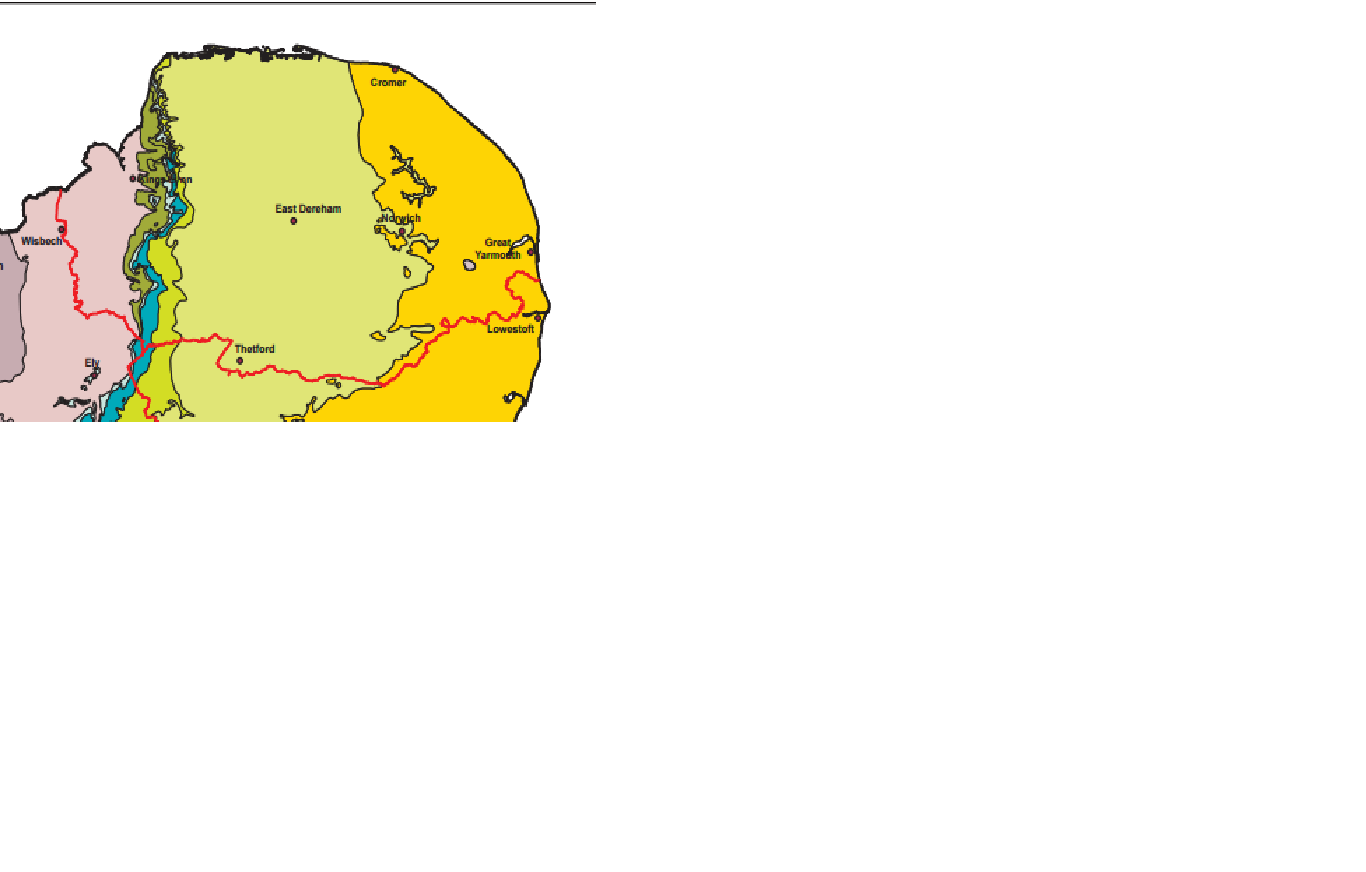
The Drift, which I walked along to reach Bypass Wood, was once access to the western sections of a much-larger Dersingham Common. The western reaches of the common were flatter than the current commons, and drier than the Bog Common. The edges of the old Dersingham Common and the edges of the sand-belt in the base soil map below follow a common line. Walking the Drift, the subtle land contours can be seen, especially at the western end, where the islands of high land rise above what once once marsh. Now only undulations in the wheat show the difference.

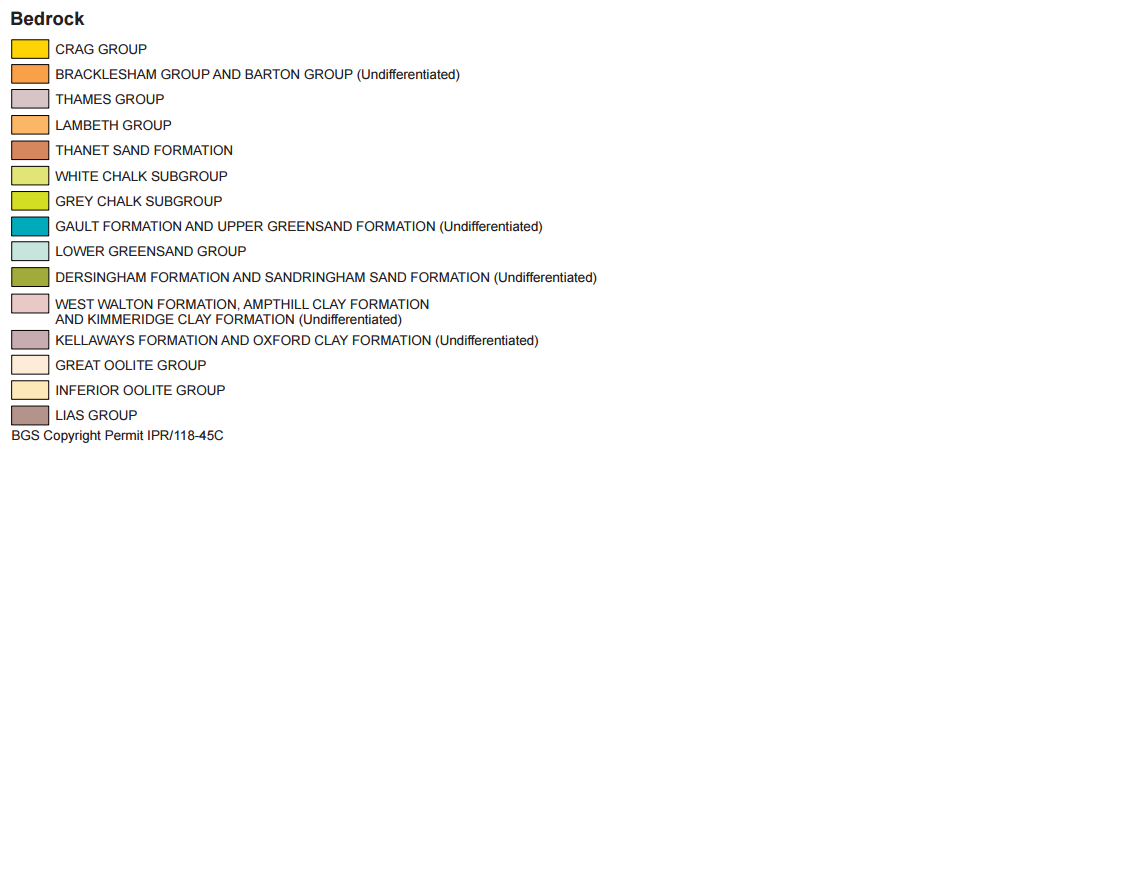
The base soil-map is below. Light mauve indicates coastal clays; the sand belt, running north through Sandringham and Dersingham, is avacado green. Blue is greensand, a mineral rich, coarser sand, and, moving west, the bright-and-dull greens are chalk.

bedrock mapBedrock legend

Walking east along the Drift, back into the village, the land rises infinitesimally, obvious only as the dyke on the southern edge gradually blends into the fields. Woodland and pasture lie on both sides now. These were part of the common land, but these were lands that could be put to the plough, and so, it appears, they were taken as part of the Dersingham Inclosure Act of 1797, when land-owners fenced common land for their own purposes. What was left as commons, for grazing, bracken, and wood for the villagers of Dersingham, was the common land lying on the less fertile, steep, greensand ridges that now make up Open and Shut-up Commons, and, the wet fenland of the Bog Common. This was the pattern repeated over Norfolk: the land left for the villagers was the poorest heath and fenland. (Although, deeper digging shows that some of the uses of Dersingham’s common land includes arable, grazing, and shooting rights…but the land used in this way is effectively not common land, although the revenues fund the management of what is left.)

My father’s memories of the common were of land utilized by the villagers. Pea-sticks were cut from the birches, and bracken gathered for fodder. There was a common-keeper, who slept in a shack on the common on a bed of bracken. Ponies grazed. Rabbits were taken for food. Heathland is a man-made landscape, but one so ancient it it is a valid and valuable ecosystem, habitat to flora and fauna found nowhere else. But changing ways of life changed the use of common land, and heathland was left to revert to birch and nettles, or else became pine plantations. Dersingham’s three public commons now are used primarily for dog-walking.

Heathlands may have sand, greensand, or chalk as the bedrock, but each type of heathland is slightly different. Sand heathlands tend to be acidic; that on chalk may have a thin layer of acidic soils overlying the alkaline chalk. Acidic heathlands, dominated by Erica species, were often planted to pines, especially where rabbits, warrened on the heath as a source of food, reduced the landscape to blowing sand. On the old map Sandringham Warren adjoins and perhaps includes part of Dersingham Common. Walking up the sand ridge that rises into Sandringham Park, the demarcation is a boundary ditch, crossed frequently now by unoffical paths; ‘official’ ones have bridges. This is all plantation, with an understorey of rhododendrons and other shrubs, and home to several species of tits. In early June they are all feeding young, and begging and contact calls fill the woods. Jays flit among the pines. There are no rabbits to be seen.

I feel no affinity for plantation (or most woodland, to be honest) and walk here only occasionally. But just west of here, and below the sand ridge, lies a large expanse of open heath: Dersingham Bog National Nature Reserve.

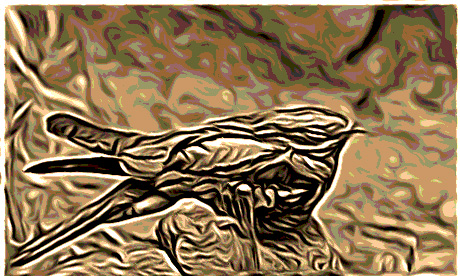
At dusk, (which is at ten p.m.) we drive to the Bog and walk out and down onto the reserve. We stand on the track, listening. From the pines edging the heath comes the churring of nightjar, a bird related to North America’s whipporwills and chuck-wills-widows. A night bird, becoming active at dusk to hunt moths and beetles over the heathland; sleeping motionless by day on horizontal branches.

Nightjar

Several birds churr, from both left and right of us. Brief glimpses are all we get as the birds swoop over the heath in the increasing dark. Dersingham Bog is low, a triangular scoop of land surrounded on two sides by the sand ridge and on the third by pine plantation: the birds do not show easily against the dark trees. Higher heaths give better views. As we walk back to the car glow-worms shine from the bracken.

In daylight, stonechat, woodlark, and tree pipit can be found here, and in the acidic bog that lies in the lowest elevation of the heath, a number of specialist acid plants – sundews, bog myrtle – grow. Butterflies and moths flit, and bumblebees (three species, told apart by the colours of their rumps and/or legs) gather nectar and pollen. In August, the heath flowers, brilliantly purple, and it can be very hot in this sheltered, sandy bowl. Like most heaths, it became significantly overgrown in the years following World War I, cleared in part and occasionally by fires generated by the railway that once ran beside it. Significant work was needed to return it to open heathland, maintained now by grazing cattle.


How Stories Come to Be

If you’ve read my profile on this or other sites, (or if you read the post called Landscape and Story I posted a few days ago) you will know that I describe myself as (among other things) a part-time student of archaeology.  Currently I’m in the middle of an on-line course from the University of Exeter called “Landscape Archeology I”.  This week’s assignment was to look at what types of environmental archaeological evidence – things like animal bones, soil and water micro-organisms, wood – can be used to interpret either a castle or monastery site.

My response to the assignment was to write a brief story about a fictional monastery and point out all the things we knew about this monastery because of the archaeological evidence, which was fun and more interesting for me than just making a chart or list.  However…now this fictional monastery has a life of its own in my writer’s brain, and doesn’t want to go away.  It wants to tell its story more fully.

It doesn’t fit into the series I’m writing right now, but it may just fit into another planned novel/novel series. Or maybe it will be something completely new.  I don’t know yet.  I’m hoping I can use it for further assignments for the course, but regardless, it is now a real, dynamic place inside my mind, and another dimension of my created landscape(s) has made itself evident.  Now I have to see where it takes me.