Trident, A Snowverse Novel, by L.C. Mawson: A Release-Day Review

I think I’ve lost track of how many Snowverse books there are now, but they keep gettingTrident better and better; more focused, the writing tighter, the characters more developed.  Trident, the latest in the series, follows Freya as she accompanies her friends Mel and Sarah to the underwater realm of Atlantis.  Mel is challenging the head of her Mer house for the right for Atlantean citizenship, and the quest she must undergo to gain that right needs all of Freya’s varied and multiple magical abilities to even give them a chance of succeeding.

Along with this fast-paced adventure, developments in both Freya’s personal life and in her existence in the Shadow Realm are entwined in the story, further framing Freya’s growth in her earthly life and in her life beyond Earth’s bounds. A fairly short novel at about 180 pages on my Kindle app, Trident kept me reading…I only put it down to watch the second-last episode of Doctor Who.  Speaking of which, I think there’s a bit of an homage to the Tenth Doctor in Trident – if not, then ‘great minds think alike’ (or write alike!).  Five stars.

I received a copy of this book in exchange for an honest review.

Catching Up

Posts have been few and far between recently….my apologies.  Here’s why.  I’ve just finished printing and framing twelve new versions of graphic prints, to be included in atepsave1 cutout351 display of eighteen of my works that I’m hanging next Wednesday.  I also completed Empire’s Hostage, Book II of the Empire’s Legacy Series, this week, prepped the files for printing, and sent them off – just waiting now to get the first proof edition. cover ebook under 2MB smaller This was also the last week of the on-line university course I’ve been taking, on the landscape archaeology of Britain…and then there’s been the community newsletter, the community herb garden, retirement parties to attend, books to edit, the kitchen cabinets to prep for painting (next week!), and all those little things – like grocery shopping and meal prep and time with friends – in-between.

“Retirement” still seems to involve twelve-hour days – I’m usually started on the day’s work a bit after 7 a.m…..and it generally continues on to about 7 p.m.  I’m still fairly reliant on my on-line calendar to remind me what’s next to be done. The huge difference is that I’m doing exactly what I want to, most of the time, and an hour-long bike ride to pick up my library books and a liter of paint is multi-tasking – exercise and errands in one – but it’s FUN.  And if I feel like taking a day (or more) off, there’s no-one to tell me I can’t, or shouldn’t…hence our week in Cape Cod and the White Mountains at the beginning of the month, a fairly last-minute decision. (But if we were ever going to see Bicknell’s Thrush, it had to be done. I’m pleased to say we were successful.)

I’m going to drop the pace for a few weeks, though: it is, after all, summer.  There are outdoor concerts to attend (weather permitting, in  changeable and stormy Ontario this year), books to read….and cupboards to paint. I need a break before I start writing Empire’s Exile, Book III, plus there are a few other projects that have been on the back burner…and in the fall I start a new university course that will help with the background for Exile.  I will, of course, keep everyone updated on the release and promotions for Empire’s Hostage, but also, I hope, some other posts…I miss it!

To my Canadian readers, have a safe and fun Canada Day weekend, remembering that Canada 150 is also Turtle Island 15,000. We have a lot to celebrate, some things not to, and a lot of work to do.  Happy July 4th to my US readers: stay safe:  Nolite te bastardes carborundorum; and to the rest of the world, whatever season it is, enjoy!


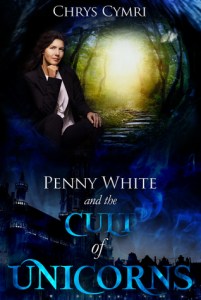
The Cult of Unicorns, by Chrys Cymri: A Review

When characters from a story begin to inhabit your dreams, you know the story has Cult of Unicornsreally taken hold of your imagination.  In my case, it was a snail shark, a creature of Chrys Cymri’s mythical, magical land of Lloegyr, a mere thin-space transport away from our own world, that began to crawl through my nightly fantasies.

When dead bodies and unicorns begin to appear in the English midlands, Penny White, Church of England vicar and official Church liaison with Lloegyr, has work to do.  With the help of Peter, the local detective, her brother, the devil-may-care dragon Raven, and her gryphon companion, Penny must navigate the glamour of unicorns and the deep pockets of a multi-national corporation to find the truth.  Interspersed with realistic examples of the difficulties of running a parish in an increasingly secular world and glimpses into Penny’s personal struggles, The Cult of Unicorns is a satisfying read set in an easily-believable world just a little skewed from ours (or is it?)

An appreciation of Doctor Who and good whiskey likely add to the reader’s delight in Penny’s world (I qualify for both) but aren’t necessary.  But you do need to accept a beer-loving snail shark named Clyde that loves the Teletubbies and can sing…and clearly my subconscious was quite happy to suspend that piece of disbelief, because Clyde comes to visit every so often, sliding his way into otherwise normal dreams.  He’s delightful…as is The Cult of Unicorns.  Five stars.

Rain

It’s been raining, hard, for several days now. In some areas of Ontario, and in neighbouring Quebec, flooding has become a serious issue.  My own issue is minor: I can’t write.

I can’t write – or more specifically, I can’t build plot and setting and action –  because I can’t go walking.  Walking is when my brain makes lateral connections, seeing relationships, making jumps of understanding. Treadmill walking doesn’t work: I’ve tried, but I need, it seems, to be outside, letting the wind and birdsong and all the other distractions of nature occupy enough of my active brain to let the ruminations occur behind the scenes, as it were, until something pops out. Once the understanding is there, I can put words to paper regardless of weather – but the understanding needs the walking.

I’ve got enough to occupy me, with the continuing copy-editing and formatting of Empire’s Hostage in preparation for publication, but Book III is bubbling somewhere in the depths of my subconscious, and it wants out.  It wants me to wander for hours along trails (which are currently mires of mud), looking for warblers, listening for catbirds, while synapses connect bits of ideas and previous knowledge and pure imagination to begin the next stages of Lena’s journey. The rain is due to stop tomorrow: a huge relief for those affected by flooding, and a different relief for me.

Rain photo:  By Juni from Kyoto, Japan (Flickr) [CC BY 2.0 (http://creativecommons.org/licenses/by/2.0)%5D, via Wikimedia Commons

Roddons

This is the creative non-fiction piece I read at the Guelph Spoken Word evening, Grounded, on April 22nd.  The theme of the call for submission was ‘exploring our relationship with our landbase’ (in honour of Earth Day).

roddon, also written as rodham, is the dried raised bed of a watercourse such as a river or tidal-creek, especially in the Fen District of East Anglia in England. (Wikipedia)

Beyond the village, west towards that great bay of the North Sea called The Wash, flat fields of barley and wheat, latticed with ditches, lie on either side of the right-of-way out to the water. Once, this was marsh, and from the satellite images on Google Earth, the patterns of waterflow can still be seen, like a ghost, or a memory, held in the soil. Roddons, they are called, these traceries remembered in the land.

I grew up with stories of this landscape, knowing the names of streets and lanes, buildings and fields: before I could read, or understand a map, they had substance in my imagination, places with a separate reality from the fields and woodlands and streets of southern Ontario. Here my father lived as a child and early teenager; here his mother’s family had lived and worked for generations uncounted. His grandfather, a cabinet-maker, came here from London to work at the manor house, lodged at the pub, fell in love with the publican’s daughter, and stayed.  The village I ‘knew’ from the stories, the village I saw in my mind, was the village seen through the eyes of a child in the 1920’s, roaming widely, roaming freely, through the west Norfolk countryside.

One name recurred in the stories: the Drift. A drift, in Norfolk vernacular, is a droveway, a wide green lane, to move sheep on and off the marshes; it was also my father’s access to those same marshes, a paradise for a small boy.  I imagine the marsh as mix of rush and sedge and ling, cut with hundreds of channels and small ponds, rich with wildfowl, water vole and waders. Perhaps not, though; perhaps it was grazing marsh, diked and drained, wet meadow. And perhaps it was a mix of the two; I suspect this is the most likely.

My instinct when walking is always to go west, out into the fields, or the remnant fen, towards the Wash. I am drawn to this flat and open land.  I watch buzzards hunting, one coming down repeatedly into the uncut hayfield beside me. A kestrel hovers over the same grasses but does not dive. In the distance a cuckoo calls, and the ubiquitous wood pigeons beat across the fields. I access these fields from the Drift, in my father’s footsteps, ninety years later. The Drift runs, for much of its length, between a thick hedge or woodland on the south and a ditch on the north, edged first with houses and then with fields. Before it was a droveway, it may have been the path that led to the salt-making works of the Romans, in the first few centuries of the common era; at the Norman invasion, in the 11th century, it led to the harbour where the village fisherman kept their boats.

Where the Drift ends now at a cross lane, I stop, and look west, thinking of a story. A century ago my great-grandfather built a tiny wooden bungalow, a beach cottage, on the shingle beach at the edge of the sea, beyond the marshes. I do not know exactly where. One summer’s day, my grandfather and two of his wife’s brothers decided to walk from the village to the beach cottage. There were at least three waterways to be crossed: Boathouse Creek, a drain, and the River Ingol, challenges in themselves, but also a vast web of minor channels between them. They made it, wet and muddy, smelling of the marsh, soaked to the waist and the skin, to a thorough scolding from their wives.  I’d like to recreate that walk, but it can’t be done: the land is drained now and farmed, and there is no public access except the bridleway.

But while the land has changed, from Iceni to Roman to Saxon to Norman times, and from my father’s childhood to my middle age, two things have not: the sky and the sea. The vast Norfolk skies, the ebb and flow of the tide over the sands of the Wash, and the birds that belong to both: in May, oystercatchers, dunlin, knot and grey plover, feeding at the edge of the sands, moving with the tide, or taking to the skies in huge wheeling flocks, sometimes put up by a peregrine, sometimes by seemingly nothing.  In the winter months, the flocks of geese, pink-footed and white-fronted, greylag and brant, coming south from Scandinavia and Russia to feed on the fields and marshes.

A gamekeeper and his black lab begin to walk a field north of me, paralleling the Drift. As I turn and walk east again, we keep pace with each other. When he reaches a small woodland, I hear the shotgun. I can’t determine what he’s after – possibly wood pigeon, more likely crow or magpie. I hear half a dozen shots as I continue east. I watch a family of robins in one clump of birches, and a single female blackcap. The path branches and I cross the road and enter woodland, immediately turning left and back up the hill, crossing at some point into the village common. I follow the track across to Heath Road and onto, and across, another section of common.

Had I chosen to walk up Heath Road, I would have passed the house my great-grandfather had built, the house where my father grew up. From there, it’s a twenty-minute or so walk through the common and across what is now the country park to the manor house itself, a walk (or perhaps a boy’s run) my father did frequently in the years he lived here, sent to the big house with a message for his grandfather. When he and I and my sister came back, he was in his early eighties; he had not made that walk in seventy years, but he unerringly took us across the overgrown common with its branching paths, and onto the estate in exactly the right place, the memory of the landscape lying deep within his mind, in the roddons of memory.

I return here yearly now, like the wintering geese, between the winter solstice and the spring equinox, walking, watching, being.  The landscape etching itself into my memory, my senses recognizing the smell and feel and sight of this land, my experience overlaying the stories, blending with them, becoming one, becoming home.

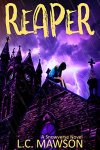
Reaper: A Snowverse Novel, by L.C. Mawson: A Release-day Review

Reaper is the seventh book in the Snowverse series, continuing Freya’s adventuresReaper almost immediately after Enhanced.  With Alex, Freya is travelling in Europe, dealing with car-sickness and more: the diversity of supernatural genes she carries result in upheavals she cannot fully control, and her past experiences are adding to the volatility.

Freya’s difficulties in controlling her emerging powers, and in tapping into the ones she needs to access, reminded me (not in a plagaristic manner, but in a thematic way) of the “Threshold Sickness” of the psi-enhanced characters in Marion Zimmer Bradley ground-breaking Darkover series.  The disruption that uncontrolled psi powers can wreak, when an untrained individual accesses them, can have far-reaching and dramatic effects: a great subject matter for a book,  and I was pleased to see the issue addressed in Reaper. (By the way, if you’re a fan of the Snowverse, then I’m guessing you’re a fan of diversity in science fiction and fantasy – and if you haven’t read the Darkover series, give it a try. Yes, it was written in the 1960’s, but for early introduction and acceptance of LGBTQ characters, it was truly a ground-breaker.)

Lucy Mawson’s skills as a writer have blossomed over this series, and her depiction of Freya’s internal conflict about Alex, and her realization of how to access her Angel powers, are some of the author’s best writing. Freya is learning, too, to make the distinction between how her autism directly affects her relationships, separate from how her (unrecognized?) emotional reactions to past events affects both herself and how she relates to others.  I’m treading carefully here, because I’m allistic, or as my husband prefers, a neurotyp, but certainly Alex’s attempts to help Freya handle her reactions and understand them rang very true to me, after thirty-eight years of living with a man with ASD.

Reaper is short – 139 pages in my e-book edition – but it doesn’t suffer from that; in fact, I found it more satisfying than some of the longer books. It’s tighter, more focused on the immediate issues. Five stars.

I received a copy of this book in exchange for an honest review.

Procrastination 101

I should be copy-editing and reformatting the e-book proofs of Empire’s Hostage, but I’m not. Instead, I’m finding lots of other things to do.procrastination

Most of my ‘other things’ are writing related.  I updated my website, I wrote a book review.  I worked on some of the editing work I do.  I worked on a presentation I’m assisting with on growing herbs.  Monday, a surprise acceptance to read at an event this coming Saturday arrived in my in-box, so I’ve polished that piece, and practiced it, and polished some more.  Now I’m writing this.

I tell myself the following excuses:  I’m waiting for the feedback from the beta-readers; I haven’t downloaded the latest copy to my ipad (it’s easier to find the errors working with both the ipad and the PC interface); I’ve got lots of time to get this done.; my hips hurt from sitting at my computer too long.  All these are true, but I think they aren’t really why I’m procrastinating.  I think I’m procrastinating because there is part of me that doesn’t want to let this book out to the wide world, to the ratings and reviews (or lack of them); to the marketing, to the mostly uncaring public…and then there is the fact that, once it’s out there, I need to start the extensive research needed for the third (and probably final) book.

On the other hand, I know there are people waiting impatiently for Empire’s Hostage.  I have a responsibility to those people, my public, if you like. It’s a good thing they’re out there: sometimes I need extrinsic motivation.  So, I’m going to make a cup of tea, and upload the newest proof to the ipad, and get going on those edits.

Or maybe tomorrow…..

Cover Reveal!

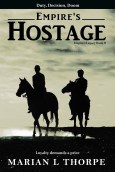
I’m pleased to share with you the cover – back and front – for Empire’s Hostage, again the work of the talented A.J O’Brien (check his own psychological thriller out here.)

Marian- book cover final

‘Hostage’ is currently with its beta-readers and I’ll be making the last changes, copy-edits, etc., in the next few weeks. I’m hoping to release in late June or early July, just in time for summer reading!

I still have a few ARCs available for Kindle or e-pub….and if you haven’t read the first book, Empire’s Daughter, I can provide an e-book of that as well, if you’d like.  Send me a message!


The Quantum Ghost, by Jonathan Ballagh: A Review

In the same near-future world as Jonathan Ballagh’s The Quantum Door, a young girlQuantum Ghost called Remi sees a glowing dome in a pond near her house…a glowing dome that is almost immediately snatched by a hand that rises from the water.  Shortly afterwards, strange dreams begin; Remi finds herself writing strings of meaningless numbers…and then parcels begin to arrive, parcels containing items that she is compelled to put together.

What Remi builds takes her into the same world of technological wonder and menace that Brady and Felix entered in The Quantum Door.  But The Quantum Ghost, while building on events in the previous book, can successfully be read as a separate, stand-alone book.  Characters overlap, but they are introduced again, and any previous history relevant to this book is given in a natural way.

The target audience for The Quantum Ghost is middle-grade students.  Ballagh’s prose and pacing is perfect for this age group; the science is presented in a comprehensible manner without over-simplifying it or talking down to the reader. The action is rapid, but with enough character development to create empathy and identification with Remi.

As in The Quantum Door, Ballagh manages to take what could be clichéd scenes and turn them into truly frightening images. There are some quite dark scenes (age-appropriate) in the story, so a young person with a vivid visual imagination might find the book a bit difficult in places, but Remi is a heroine who faces dangers with courage and initiative. In both this frightening alternative universe and in her ‘real’ life, she acknowledges her fears and confronts them.

The artwork by Ben J. Adams, both on the cover and the interior illustrations, is brilliant, perfectly complementing the story.  Highly recommended for ages twelve to sixteen, or for less confident, slightly older, readers.

I received a copy of this book in exchange for an honest review.

What may still lie between the mountains and the sea….


“…will you face east with me, and bow to that memory, and to what may still lie between the mountains and the sea?” 

Those enigmatic words seal a truce called in the fifteen-month war between the Empire and Linrathe, the country north of the Wall, binding the Emperor Callan, the Teannasach Donnalch, and their people. But in additional surety of peace, the truce requires hostages, children of the leaders. 

Lena is a Guardswoman on the Wall when this peace is negotiated, one of many women who rode north to defend their land. When the General Casyn asks her to take the place of one of his daughters as a hostage, Lena agrees, to learn that she will be sent to a Ti’ach, a house of learning, for the duration of the truce. Here, perhaps, she can learn more about the east, and what its place is in the history of the Empire.

 But not every student welcomes her, and Lena soon learns that the history of both the countries beyond the Wall and her own Empire are more complex, and more intertwined, than she imagines.  When circumstances take her even farther north, into lands of a people unknown to the Empire, all her skills of leadership and self-defense are needed to avert danger to herself, the Empire, and its fragile allegiance with Linrathe…at an ultimate cost beyond her imagining.

Empire’s Hostage, book II in the Empire’s Legacy series, is fast approaching release. It follows Lena, the protagonist of Empire’s Daughterinto a larger world and into greater danger, testing her loyalties once again.

ARCs will be available soon in either e-pub or mobi format.  Interested in reading, rating, and/or reviewing?  Send me a message.