Accepting Applications for Book Reviews until August 1st!

I am accepting books for review again until August 1st, but you must read this before you submit.

I (reluctantly) need to become MUCH more selective about what I review.  Between the work I do as an editor and beta-reader and the reviewing  (and the rest of my life), I’m not finding enough time for my own writing.  And I am a writer first, as I know you will all understand.

I will accept twelve books a year to review, so for the rest of 2016, I’m accepting SIX.  

When you submit a review request, please include a few pages or link to a preview, as well as your webpage/Amazon/Goodreads links, and tell me a little bit about you as a writer.  If you already have a fistful of reviews, I may decline; if I think I can’t do justice to your book, I will decline. I don’t want to add to the stress of marketing/publicizing indie books…believe me, I know about it.

And I promise this…I will reply to you.  Not until after August 1st..but if this page says I’m accepting books for review, then I will reply, even if I’m declining to review your book, and I will let you know the reasons for my decision.

I review published or pre-publication works.  My preference is for unusual fantasy/dystopia/sci-fi but will consider other work. But I am getting saturated with young adult fantasy, both dystopic and otherwise, so to do writers of that genre justice I’m going to turn those down for a while.  I accept both e-books and paperbacks (but check regarding paperbacks as I travel frequently and may be away from my mailbox for some time!)

Please note that I do not automatically give four or five star reviews.  I am a somewhat critical reader, wanting to see the same sort of quality in indie works that I would in a traditionally published work.

Requests to marianlthorpe (at) gmail.com, please.

for further details, please click here:

The Ballad of Allyn-a-Dale, by Danielle E. Shipley: A Release Day Review

For a delightful and amusing quick read, Danielle E. Shipley’s newest book, The Ballad of Cover and Spine, Ballad of Allyn-a-DaleAllyn-a-Dale, will be hard to beat if you – as I do – enjoy suspending disbelief and going along for the ride. The founding conceit of the story – that Faerie has turned the isle of Avalon into a space where the great heroes of British mythology: Arthur, Merlin, Robin Hood and his band – are unaffected by time and mortality, and that this protected place is further hidden in the 21st century by disguising it as a medieval/renaissance fair – had me hooked from the start.

Allyn-a-Dale, a wandering minstrel of royal blood, falls – literally – into Avalon, blown in from another world by the influence of the Winds. Quickly taken up by Marion and the rest of the merry men, Allyn finds a place in the fair, only to find that he is caught up in a quest to recover the stolen scabbard of Excalibur, the magic item that provides the protection to Avalon.

Shipley writes with a deft and light hand, her characters recognizable as their mythical counterparts but thoroughly of the modern world, if somewhat confused by it. Will Scarlet has the most page time and is the most thoroughly developed character, (and character he is) but others are well represented. This is less true of Arthur and Guinevere, but they are peripheral to the story.

This is not a complex or deep story. The conflicts and solutions are fairly simple, but that suits the light-heartedness of the novel; Shipley is not investigating deep truths and personal angst here, she’s writing a fun tale. It’s the first in a series, and I look forward to the next book.  A good summer read on the deck, and one that is suitable for middle-grades to adult. Four stars.

The Redemption of Erâth: Consolation and Exile, by Satis: A Review


Consolation Digital Cover

Exile Digital Cover


Epic in scale and epic in style, The Redemption of Erâth series by Satis is the story of Brandyé Dui-Erâth. Born in fire, orphaned, raised by his reclusive and private grandfather, Brandyé is not truly accepted in his village. He learns to accept his unchosen outsider status, tempered by his two good friends, Elven, a boy of his own age, and Elven’s sister Sonora.

But there is a locked room in Brandyé’s grandfather’s house…and there are Brandyé’s dreams. Slowly it becomes evident that there is more to Brandyé – and to his grandfather, Reuel Tolkaï. Creatures from myth begin to menace; powerful tools of war come to Brandyé, to be used for good or evil. Rebellion simmers and flares, with unintended consequences. Darkness threatens all Brandyé knows, and Brandyé himself, sending him into exile.

Brandyé’s story is compelling, although the telling of it is detailed and slow-paced. And I use the word ‘telling’ intentionally: the author definitely tells this story; he does not, for the most part, show us it through Brandyé’s thoughts, emotions, or reactions. The voice is usually passive; the action recounted to us. It reminded me – in stylistic terms only – of an old book of Grimm’s Fairy Tales I had a child, which used the same passive voice for most of its re-tellings. The language is mannered and slightly archaic, bordering on the style of Lord Dunsany in his classic epic fantasies. While this almost bardic telling of the story is interspersed with conversations and scenes written in an active voice, the overall feel of the books is detached, the reader distanced from the characters by the stylistic choice. I almost think The Redemption of Erâth would benefit from being read out loud; the language deserves to be heard.  

While the plot – that of the magic child with a difficult road to walk in the saving of his/her world – is a classic fantasy plot – Satis does not flinch from making difficult choices for his characters. The world-building is extremely detailed. Satis is building a complex and finely-drawn world, more finely-drawn than some readers will be happy with, especially when combined with the slow-moving action. (There is also a companion volume, The History of Erâth, which I have not read.) Influences from classic fantasy, especially Tolkein (the name of Brandyé’s grandfather clearly an homage) are obvious.

I found these two books – Volume 1: Consolation and Volume 2: Exile – difficult to rate. The story is compelling if slow in the telling; the style will deter some readers, especially those used to action-based, fast-paced dystopian fantasy. But this is a deeply imagined world, and I will continue to read the next books in this series.Three stars.

Collision Course

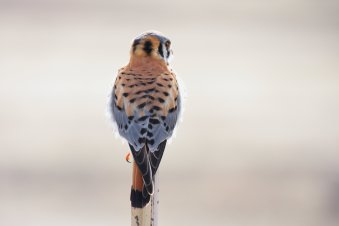
Skestrelometimes two parts of a life can collide unexpectedly. At my Monday morning writer’s group, which meets in the upstairs restaurant/bar of an independent bookstore, we had propped the patio doors open to let in the summer breezes. We’d all been working about an hour – this is a place for silent writing, not discussion or sharing – when I heard a high-pitched, rapid cry from the bar area. My writer’s brain disengaged, my birder’s brain engaged – that was the cry of a bird in fear of its life.

I and another writer ran for the bar area. Fluttering against the glass windows was a young kestrel. Pursuing a house sparrow, it had flown in the open door of the patio. The house sparrow was somewhere in the room, but our priority was the kestrel.

A sweater was found and thrown over the terrified bird. The other writer – herself experienced in bird banding – carefully carried it out onto the patio and let it go. I searched the room for the sparrow, but it was hiding somewhere.

About half an hour later someone came in from the bar area to say the sparrow was fluttering against the front windows. It was a simple matter to drop my cotton shirt over it, and carry it carefully to the patio. It vocalized the same rapid, high-pitched distress call the whole time I held it, but flew away as soon as I freed it from the confining cloth.

The chances of this happening are minuscule. Kestrels eat primarily insects, although small birds are also part of their diet; my guess is this was an inexperienced and hungry young bird that thought a house sparrow was fair game.

And when both birds were free again, my writer’s brain re-engaged and I went on to write 600 words of Empire’s Hostage.

photo by Dominic Sherony (American Kestrel (Falco sparverius)) [CC BY-SA 2.0 (http://creativecommons.org/licenses/by-sa/2.0)%5D, via Wikimedia Commons


Fools’ Apocalypse, by Anderson Atlas: A Review

Fools’ Apocalypse took me by surprise. What started out as, I thought, a techno-thriller concerned with an anarchic leader and his followers targeting the United States in a series of terrorist attacks on infrastructure turned into a zombie story, and a good zombie story at that. The undead, or ‘puppets’ have been spawned by the terrorist attacks, but how? And can the band of survivors, almost all with their own dark secrets, be resourceful enough to outwit the ‘puppets’ and each other?

Anderson Atlas’s strengths are in creating and developing characters. Each character is an individual, with strengths, weaknesses, and motivations that help to make them believable, and each are facing the terrible consequences of choices they made. The plot moves along at a good pace, once the introductory chapters are done; these are a bit slower, as we are meeting characters and learning their roles in the action, but as this is the first book in a planned series, the slower start is understandable. The writing is for the most part competent, although I found a few lines awkward or ineffective in conveying the emotion of the character.

What struck me about Fools’ Apocalypse is that Anderson Atlas has taken two of the great themes of American writing: the river journey, and the band-of-travelers-against-the-wild, and used them to give new life to the zombie apocalypse. Combined with a back story about a mysterious religious relic, and the characters’ growing realization of the effects of their individual actions, the story seemed remarkably fresh, not just another version of The Walking Dead. The illustrations, done in black-and-white, were an unusual but attractive addition.

All in all, I’m giving Fools’ Apocalypse four stars; it gave me several hours of reading enjoyment and left me wanting more.

Brexit, birds and boxes

The disruption to my writing life from the move has settled down, and the opportunities are emerging. My new city has a vibrant and supportive writers’ community, as I’ve said before; yesterday I went to my first ‘Genre Writers Group’ meeting in a downtown coffee shop. This is a brand new group, so it seems I made my move at a good time!

Six of us met at this first meeting, self-published and traditionally published, experienced and newbies and in-betweeners. We talked about plotting and planning vs free-flow writing; we talked about sales, and mostly we talked about publicity and marketing, exchanging ideas and opportunities. As a result of this, I sent an email yesterday afternoon and have been accepted to read at the next Chi Reading Series here. Put on by Chizine Publications, the Chiaroscuro Reading Series takes place in a number of Canadian cities every few months and focuses on fantasy, science fiction, and horror. I’m not sure what I’m reading yet – it will depend on the time given – but it’s a chance to network with other genre writers and to reach a larger audience. I’ll keep you posted!

I’m back to the Writing Room, the Monday morning quiet-space-and-coffee meeting, after an absence of six months. I made it back just in time to read at our spring open-mic night last week. I chose to read from Empire’s Hostage, which has been on the back burner as well for the last half-year, figuring it would give me the prod to get back into it. Which it did, and perhaps all the better for the hiatus – and perhaps too for the reactions and emotions stemming from the Brexit vote, which in some ways reflect the themes of the book: what is independence? Does a country stand better on its own, or as part of a larger unity? Where do concepts of love of country, love of leaders, duty, stand when allegiances shift?

In a different mode, I’m also writing a monthly birding column for our neighbourhood newsletter, and have been ‘coerced’ (not really) into the production team, which means I am learning desktop publishing software in my spare time. It’s a very different type of writing and editing, but it’s all writing.

I should get a review out in another week or so, and hope then to be back into a rhythm on those. I’ve started investigating paperback production for my books, and I’m looking into some creative writing courses, either at the university or at the local college, in the autumn. For the next two days, I’m giving my niece, who is heading off to university in Halifax in September to study journalism (another writer in the family!) a mini-vacation, exploring this city and environs, riding bikes, eating ice cream, hiking the river trails.

Somehow I think the boxes still languishing in the basement may never be unpacked…when will I have the time?

Coming home

At last. It’s been a long dry period without work on Empire’s Hostage; I lacked the concentrated time not just to actually write, but to think about where the story is going. The creative process and managing the logistics of moving just weren’t compatible for me. I managed a few blog entries, on Two Simple Lives and All the Birds of My Life, but nothing fictional.

But we’re moved in – we’ve been here ten days now: all the important boxes are unpacked, and my office and laptop are set up. I have time for long walks or bike rides, time to think, and today I started writing again. It feels unbelievably good, like welcoming back an old friend into your life, or, after a long absence, coming home.


.

The Urban Boys, by K.N Smith: A Review

Five teen-aged boys from an idyllic small American town venture into a forbidden forest, and are touched by a mysterious power that enhances their senses. With these heightened sensibilities, they become crime fighters, almost superheroes, at night, battling the destructive forces tearing their neighboring town apart.

The premise of The Urban Boys has potential as a young-adult story-line (I would say especially for a graphic novel) but in author K.N. Smith’s handling of the tale, the potential is not realized. There are several reasons for this: flowery prose inappropriate for the genre and the target audience; convoluted world-building containing far too much detail about issues not feeding the plot, and unrealistic familial relationships.

The author’s bio states she is a ‘passionate advocate of childhood literacy’, and The Urban Boys reads as if the intent was to provide moral messages and/or guidance embedded in an adventure story, aimed, I would guess, at early-teen boys. The characters and their families represent a fairly diverse section of middle America, with students from several races and various family dynamics as the protagonists, providing a range of characters for young male readers to identify with. Action sequences (including an overly detailed football game) punctuate the plot at frequent intervals. But the overwritten prose and the convoluted plot development would, in my experience (twenty-five years of teaching focused on students with behavioral and learning disabilities) make The Urban Boys inaccessible to many of the putative audience.

I found the family relationships in The Urban Boys unrealistic. Although set up to be a cross-section of families: a single divorced mother; a father raising two boys after the death of his alcoholic wife; a twenty-something sister looking after her younger brother after the loss of their mother to breast cancer, there were few real conflicts and too much easy understanding to be representative of what really happens in families. This underestimates the ability of young readers to recognize when a story reflects real life – and even in a young-adult fantasy, the core of the story should be recognizable to readers, regardless of the presence of magic in the world.

If good intentions made a good novel, then The Urban Boys would rate at least four stars. But they don’t, and the best I can give it is two.

The author provided me with a copy of the book in exchange for an honest review.