Here’s the link:


It’s common knowledge that humans have access to more digital media than ever before. Five hundred television channels, streaming movies, You Tube, ebooks, music in mp3 format or from streaming services… it’s everywhere. It’s wonderful that we have such a huge number of choices but I think something happened along the way. The huge volume of available digital media has caused it to lose its perceived value. Today, people fully expect this type of media to be free to the public.
Want to listen to the latest Lady GaGa album? Don’t worry, someone has tossed it onto You Tube for everyone to enjoy free of charge. At least until You Tube discovers it and takes it down, soon to be replaced by someone else in no time. If you don’t want to use You Tube, there are a number of sites to pass music and movies free of charge. I can’t tell you how many times I have seen people watching newly released movies on their laptops that they received for free. Love to read books but have a small budget? Sure, you can go to your local library, but why? Jump onto Amazon and grab a free copy of something interesting. I’ve seen people with tens if not hundreds of e-books on their Kindle that they downloaded for free. How did this happen? Where did this way of thinking start?
Here’s my guess.
Technology has allowed artists (musicians, writers) to make themselves visible to the public with as little as a click of a mouse button. In the old days, record companies ruled the music industry with an iron fist. They determined which bands made it and which ones didn’t. The few that did make it, sold millions of albums and filled huge arenas and those that didn’t were left to play at the local bar on Saturday night. But today, a band can set up a website and promote their music to the entire world without the help of a record company.
The publishing business has followed the exact same route. An independent author can write a book and easily toss it onto his/her own website, Amazon or Smashwords without the help of a publishing company. And this is great. As mentioned, this gives the public a huge variety to choose from and allows artists to be discovered. But as time has progressed a pattern has appeared. Four or five years ago, you would see indie e-books on Amazon for $4.99 or $3.99 [U.S. Dollars], with main stream published e-books coming in around $7.99 or $8.99. This makes sense to me since the quality of the indie books might not match that of the mainstream books. OK… I get it. But as time has passed, the price of the indie books has dropped and today most indie books are $0.99 or free. If an indie author sticks his e-book onto Amazon for $4.99, forget it… no one is going to look at it, because the public knows they can get another book that may be just as entertaining for free.
Don’t get me wrong. I’m an indie author. I run promotions where I give away ten or fifteen e-books over a weekend to try and increase readership and get reviews. But I believe that authors (and musicians) that provide their work to the public free of charge on a permanent basis, send the wrong message. I personally don’t write books with the sole purpose of generating income. I enjoy writing and I like to see people enjoy what I write. But I firmly believe that there should be a value attached to my work. Even a program like “Kindle Unlimited” that gives the perception of a free service, puts a value on a book through a subscription fee. (On a side note – I think KDP Select which gives an author access to Kindle Unlimited is a bit too restrictive over the long haul, but could be used for a period of time when a book is first released to draw attention and get reviews.)
My hope for the future is for artists to realize that the way to increase readership is not to lower the price of their goods but to make them better. Come up with a really good song or a really good book and people will notice. I don’t expect to become wealthy selling the few books I have written, but I feel they have a value and the public should provide me with the small amount I am asking for, to enjoy my book.
John A. Autero is an indie author of speculative and techno-thriller adventure novels. An
engineer by education, John employs a technical style of writing that combines existing technologies with those that are yet to be developed. John enjoys anything sci-fi, automotive, heavy metal and ballistic. Always a fan of government conspiracies and black-ops, stories like The Terminator and The X-Files are always on his list of favorites. John was born in the United States and has spent his entire life there, where he happily lives with his wife and pets. The Scorpion is his latest book.
“There was a pool of darkness in the midst of the light, where the wind had come in  accompanied by a shadow, a shadow with shoulders and a head that stretched into the lighted space on the floor at the bottom of the stairs.”
Reminiscent of Neil Gaiman, of the darkest episodes of Doctor Who, of some of the madness of Tim Burton, Devon Michael’s Hollo: The Gatecaster’s Apprentice is an artfully told, dark, and frightening coming-of-age tale with a twist. Hollo, the title character and protagonist, is a puppet made of wood, but one that can think and feel and move autonomously, created by her ‘father’ Fredric. (This might remind you of Pinocchio, but it shouldn’t.)
When Hollo reaches her twelfth birthday, Fredric takes her out into the world, a place far more complex and menacing than her sheltered world of Fredric’s house and the metal-casters workshop next door. Here she first hears the name Bander-Clou, and the words ‘Zygotic Pneuma’. Just what is she? And who is her father, really?
Clock-work soldiers of metal and wood pursue her. Hollo befriends a human girl; statues come to life; elemental forces protect her. Hollo’s world is under siege, and she is caught in a larger story, one older than she but one to which she belongs, and one in which she has an integral part to play. Michaels writes fluidly and effectively, his words invoking horror, happiness, fear and joy, the pacing moving the plot along quickly, but not so quickly the world-building is overlooked. This is a well-realized and developed world, one that the author leads the reader into by hints and clues: the reader learns the world along with Hollo.
Characters are well-developed, especially Hollo, whose innocence at the beginning is lightly but effectively shown, but also the supporting cast, from the malapropistic statue ‘The Countess’ to the marvellously conceived Lightening Man. And they all have a role to play; none of these characters, some of whom would not be out of place in Alice Through the Looking-Glass, are superfluous to the story.
Hollo: The Gatecaster’s Apprentice earns a rare five stars from me. I didn’t want to put it down, and yet conversely I rationed myself as to how much I read on any day, so as to savour the book and anticipate where it was going: it was far too good to read in one gulp. One caveat: in the e-book version I read, there were a few production errors, and a few errors that slipped through editing. In several places ‘won’t’ was written as ‘wont’; the common error of ‘broach’ for ‘brooch’ appeared a few times, along with the newly-frequent (in my experience of 55 years of reading) confusion of ‘piqued’ with ‘peaked’. One’s interest is piqued (excited); one’s interest in something can ‘peak’ (reach a height). Both can be correct, but are often, these days, confused. BUT: sometimes, as I wrote here, the overall quality of a book or a movie outweighs a few production errors, and this is one of those few cases. Regardless of the (easily-corrected) errors, Hollo deserves five stars.
I received a copy of the book in exchange for an honest review.
On long-haul flights, I occasionally watch animated films, usually from Disney/Pixar, enjoying their satisfying simplicity; they’re a pleasurable, escapist way to pass a couple of hours. Throne of Lies, from new author Sara Secora, falls squarely into this category. If you’re a fan of Disney’s princess films, you’ll like this book.
Princess Amethysta Serelle of Northwind is the heir to the throne….but she doesn’t want to be. Betrothed to a man she dislikes, bored and irritated by the restrictions on her life, and puzzled by the odd and frightening things that happen when strong emotion grips her, she attempts to escape the expectations of her parents. Her journey of self-discovery is both aided and frustrated by her newest personal guard, the disturbingly handsome commoner, Soren.
Throne of Lies is a charming fairy-tale incorporating many of the aspects of classic, Disneyfied fairy-tale, but with a modern twist. Fingers are pricked on thorns, apples are eaten, shoes are tried on…but these are all peripheral to the story, background reminders of the genre. Nor is it the cautionary fairy-tale of the Brothers Grimm: there is nothing terribly dark here, although one scene does not flinch from the realities of what can happen to a young girl alone. But not all apparent monsters are what they seem, either.
The ARC I read had the usual number of production errors, which is to be expected from a pre-publication version. There were also a few grammatical errors, odd changes of tense within sentences, and non-traditional uses of words that affected flow and comprehension. The story, I felt, was a bit slow to get going; there are some early scenes that are too detailed or drawn out without substantially adding to either the world-building or the plot; this might discourage some readers.
I would have recommended this book for readers eleven and up, but two scenes in the book suggest that thirteen and up is a better age recommendation. My personal rating is 3 1/2 stars; this will be 4 stars on Goodreads and Amazon.

Arboretum Press is pleased to announce the release of

In a world reminiscent of northern Europe after the fall of the Roman Empire, this historical fantasy, meant for young and new adults, explores the meaning of loyalty and love in a rapidly changing society. Seventeen-year-old Lena must decide between her love for her partner Maya or her loyalty to her village, her people and her land.
“…a lovely novel….”
Mezzalily’s Teen Book Reviews
“…easily one of the most intriguing books I’ve read all year…(an) indie-published gem….”
Writerlea Book Reviews
“…this book is just something special….It was absolutely fantastic!”
Cover to Cover
“…expertly done world-building….”
Creating Worlds with Words
I am now closed to review submissions for the remainder of 2016. I plan to begin accepting review submissions in January of 2017. If you want a reminder of this, please follow me on Twitter @marianlthorpe or subscribe to this blog.
Elemor once had magic, but it has gone. Or has it? For there are doors that will open only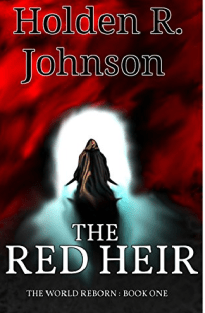 for Vall, doors that used to open into another room, or out to the street, but now, when Vall passes through them, they take him to another place, where the Essence flows freely. Vall doesn’t just open doors: he is the Terror of Helforn, an assassin, driven to serve the dark forces from that other place in order to free his father.
The Red Heir, the debut novel by indie writer Holden Johnson, is a cut above most high fantasy books I’ve read in the past couple of years. Johnson’s world is carefully and consistently constructed, and the detailed back-story fleshing out the characters of Vall (and others) gives a solid foundation to the events and action of the book. Both character development and plotting are strengths; the story may be a bit slow for some readers but it is the first of a series, and personally I like a well-developed, fully-explained world.
I could detect influences from the world of gaming and from Tolkien, but influences were all they were, not copy-cat situations, and all writers are influenced by other sources. While some sentences were awkwardly worded, for the most part the writing was fluent, not overblown as some high fantasy writing tends to be, nor too ‘modern’. A bit of tightening and polishing wouldn’t hurt the book, but on the other hand it held my attention and interest as it stood.
Overall, I’m giving The Red Heir four stars out of a possible five, for its unique, well-developed world and attractive characters, as well as a compelling plot. I look forward to the next instalment in the series.

Since Amazon moves pretty quickly, if you live in the US or the UK, you can order the paperback of Empire’s Daughter from Amazon:
Canada? Not so quickly. I’ll let you know when it can be ordered from Amazon.ca….or when you can order it in Canada directly from me.
I’m excited to announce that the paperback version of Empire’s Daughter will be available in August. I’ll post ordering options as they become available, but here’s a quick look at the new cover, front and back, designed by Anthony O’Brien.
A week or so ago, I was researching battles to find one I could model a battle in Empire’s Hostage on. Battle strategy and action are NOT my strong point! After entering the keywords I wanted into Google, I was led to a website on medieval warfare, which had a wonderful detailed description of the Battle of Stamford Bridge. It was perfect.
So, I emailed the site’s contact for permission to adapt the description, explaining how I wanted to use it. He emailed me back, telling me that those articles were written by someone else, who held the copyright – but was kind enough to start an email conversation with that writer and me. Today I heard back from the author, who gave me permission….and then, having checked out Empire’s Daughter on Amazon, bought the book!
I don’t know any of these people from Adam, and they had no reason to even respond to me, except that they are kind and polite people. The sort the world needs more of. I’ll pass that kindness on in some way, if I can….and I have to say, it made my day.


You must be logged in to post a comment.