Stone & Iris by Jonathan Ballagh: a mini-review

Do not pass up this short story by the author of The Quantum Door. Moving into adult fiction from his outstanding middle-school debut novel, Stone & Iris is a haunting look at choice, second chances and consequence in a future world, but one that could well be awaiting us.  Ballagh’s writing rarely falters and some of his phrases are simply beautiful. Stone & Iris can be read in less than an hour and will cost you less than a cup of coffee, and its imagery will remain in your thoughts for a long time. Pour yourself a glass of wine, settle down into your armchair, turn off the phone, and give it the attention it deserves: you won’t regret it.  5 stars.

Stone & Iris is available from Amazon.  I was provided with an ARC of the short story by the author in return for honest feedback.

The Realmsic Conquest by Demethius Jackson: A Review

The Realmsic Conquest series consists of two books: The Hero of Legend and The Icon of Earth.

The Realm is the world’s only magical kingdom and at the heart of its magic lies the Realmsic Crystal. The Wizard Kelm and the new, young King Maebus must protect the Crystal and the Realm against a potent threat from the Warlord Damian, who will not scruple to use any power to overcome the Realm’s defenses. To do so, they must make the right decisions, choose their allies wisely, and utilize the power of The Hero of Legend….if they can find him.

Author Demethius Jackson describes this series a ‘self-help fantasy’, designed to provide a model for young readers in making choices and developing self-reliance and resilience. Given that, I was a bit apprehensive in beginning this pair of books, concerned that the story might be a bit ‘preachy’. That concern, I am happy to say, was completely unfounded.

What Jackson gives us is a well-plotted, very well written fantasy adventure story in which the values of consultation and cooperation underlie the story but are not blatantly obvious. In that way (and that way only, because the genres are so different) they reminded me of the British children’s classic Swallows and Amazons by Arthur Ransome (and other books in the series) which I once heard described as “a lesson in good manners”. While there is nothing strikingly new about The Realmsic Conquest, as a solid fantasy-adventure for readers at the younger end of the young-adult readership it more than passes muster. Had I a twelve-to-fourteen year old to recommend books for (or either a younger readers with above-average reading skills or an older reader for whom reading was more difficult) I would be buying them this pair of books. Strong male and female characters, solid plotting, good dialogue and well-paced action all added to my positive impression. Jackson’s writing flows well; action and description are well balanced. There were almost no errors of typography or production in the e-pub copies I read. I really couldn’t find much to fault the books on at all.

So, five stars to both books for the late middle-school/early high school age reader. More from Demethius Jackson should be hoped for!

The author provided me with copies of both books in return for an honest review.

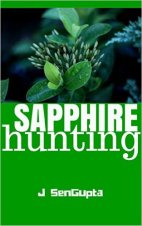
Sapphire Hunting, by J SenGupta: A Review

sapphire huntingJames is a math/physics student at an unnamed university somewhere in England. He’s likely a genius, or at least a savant; concepts, equations and theories of energy flow come easily to him; he likes the challenge but knows he can find the solutions. Other facets of university life are less attractive, but he’s coping.

But it’s not just the theoretical concepts of energy flow that James understands almost intuitively and without effort. There are other sorts of energy flow, a flux of darkness, destruction, focusing in on his world, something James can sense, something perhaps attracted to him. Others know only the frightening results of this dark power; James is caught up in its forces. Trying to escape, yet strangely attracted to this force, James steps through a doorway into another world, to find he is not alone in his fight against this dark vortex.

Sapphire Hunting is not a typical young adult fantasy novel. Written in a detached, dream-like style, bordering on prose poetry, Sapphire Hunting demands a lot of its readers. Action is fairly minimal; descriptions are long and lyrical, focusing on feelings, emotions, impressions, mood: “…a spark discharged from his forefingers, like winter, into the mantis-shaped thing, the fog, the flying rags looming over.” The words flow and pattern like the energy that fascinates and focuses James.

I read Sapphire Hunting in small chunks, both because it demanded close attention and because I wanted to draw out the experience. The closest other reading experience I can remember was that of reading Joyce’s Ulysses. So, for a reader who is looking for a book where the focus is on the action and the plot, one that reflects others in its genre, this may not be the book for you. But it is one whose imagery and language will stay with me for a very long time.

Did I have any niggles? One or two….there were sentences, that, despite their overall beauty, I would have restructured, changed the punctuation. There were one or two small typos. Neither issue detracted from my overall impression. Is it a young adult book? I wonder: probably for a few – I would have swallowed it whole at fourteen or fifteen – but it might be better directed to the New Adult readership. Five stars for a unusual and memorable book.

The author provided me with a copy of the book in exchange for an honest review.

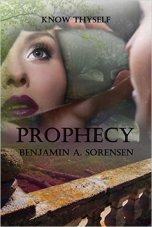
Prophecy, by Benjamin A. Sorensen: A Review

prophecyThe magical Dragoncrystal has been stolen, and eyewitnesses identify Arana as the thief. Aware of her innocence but terrified of what might happen to her at the hands of the Kaylarian Knights who are seeking her, she flees, with her brother Jard, first into a magical woodland, and then to the city of Marsa, and then onward, as many factions pursue the young farm girl and her brother.

What unfolds is a classic quest story, with the world’s fate in Arana’s untested and untaught hands. Prophecy is set in the world of high fantasy, and it’s a solid addition to that genre. Sorensen’s writing is competent and polished; narrative flow and structure fit the action of the story. Characters are familiar but not usually stereotypical, although I did find myself mentally ‘casting’ various characters from the television version of A Game of Thrones in some of the roles. The plot is complex enough to keep the reader’s interest without being unnecessarily intricate.

I particularly liked Sorensen’s ability to portray Jard’s over-protectiveness and Arana’s varied reactions to it as her abilities and her confidence in them increases. All important characters grow and develop throughout the book, Arana especially. In an unusual twist on one of the oldest themes not just of fantasy but of foundation myths throughout the world, Arana’s fate – and that of the world – will depend on her ability to fully accept herself.

I had very few niggles: an occasional awkward sentence, a few minor points that didn’t ring true to me. Not enough to detract from its overall score, which is five stars. If high fantasy is your genre of preference, then Prophecy will be well worth your time.

The author provided me with a copy of this book in exchange for an honest review.


The Nth Day, by Jonathan Huls: A Review

A new virgin birth, and the son of God is reborn into the USA in all its early twenty-first century dysfunctional glory. A premise worth exploring, and a book with quite interesting characters: Justin, the newest regeneration of the Messiah; Cassie, a neglected, abused child on the run; Theodore, a rich-beyond-belief man who lives on the streets; Nick, a drug dealer who has suffered through flames.

My scoring rubric gave this book 3 stars. For once, I’ll give the breakdown. These are my scoring criteria: writing style, dialogue quality, plot development and believability, character depth and development, world-building, spelling and grammar, and production quality. The Nth Day scored well in some of these, and badly in others. Let me explain.

I found the character depth and development the strongest quality of the book. The major characters were than outlines, more than stereotypes. I liked them, and I cared about most of them. The world they inhabited – twenty-first century America, after some rather world-shaking changes – was for the reasonably believable, although I found the effect of the changes perhaps somewhat understated.

Where the book failed for me was in the actual writing. Poorly structured sentences, extremely long paragraphs (which should have been broken up into multiple paragraphs in most cases), and too many word errors – either plain mis-spellings or homophones which spell-check didn’t catch – were a large part of the problem. But along with those issues, some of the content of some of those long paragraphs was gratuitous descriptions of bodily functions in excruciating detail. I’m not turned off by these sort of descriptions when there is a valid, plot or setting driven reason for them – but in The Nth Day, I could never quite work out what the purpose was. Unfortunately, to me, they came across more like the foul-mouth bluster of an adolescent trying to impress or rebel than descriptive detail with a purpose in this narrative.

The author reinterpreted biblical events and stories into the setting and story quite effectively. The major characters were appealing, or at least held my attention (I can’t say Nick was appealing), the premise interesting and the conclusion suitably enigmatic. Further editing would have benefited the novel greatly, in my opinion.

The author provided me with a copy of the book in exchange for an honest review.

The World, by Robin Wildt Hansen: A Review

The World describes the metaphysical journey of Arkin from initiation to Magus through the structure of the four suits and the twenty-two major arcana of the Tarot deck. Arkin, the protagonist, may be schizophrenic; the voices he hears and the obsessions he has may be related to his emerging schizophrenia, or, they may be the manifestations of power that he is too frightened to embrace.

The World can be read allegorically, or it can be read as straight-forward fantasy, although my preference is for the former interpretation. Drawing on Norse, Christian, classical and Yoruba mythologies (those were the ones I recognized, at least), Arkin’s journey through the labyrinth of his neurology, or through the labyrinth of initiation and testing, to his ultimate goal, is written in a mix of prose poetry, stream of consciousness, and straight-forward prose, not always the easiest read but one worth pursuing.

Just before I read The World I had – coincidentally – been reading about the religious experiences of subjects using mescaline or peyote in Aldous Huxley’s Doors of Perception. There are strong similarities to parts of Arkin’s journey, although I do not think the book is an indictment or an endorsement of the use of mind-altering drugs. Instead, I read The World as an alternative interpretation of differences in perception that the Western world sees as mental illness. I kept thinking of the classic (but very different) work of the 1960’s, Joanne Greenberg’s I Never Promised You a Rose Garden, which also delved into the mind of a young schizophrenic patient, and how she also communicated with gods and angels.

The World will not be a book for everyone. It isn’t, as I said, an easy read, and a knowledge of at least the basic symbolism of western – and other – religions is likely necessary to appreciate Arkin’s journey. I suspect I missed a fair bit, but understood enough to appreciate the roles that most of the beings that appear to Arkin played. The use of the Tarot deck to frame and structure the story is interesting. Many years ago I read – somewhere – that the purpose of a Tarot deck was to help the person for whom the reading was being done to break out of their automatic ways of thinking and search for new interpretations of what was happening in their life – in very simplistic terms, to help them see that what they thought of as a barrier might actually be a door. That interpretation of Tarot and Arkin’s initiatory journey through the card’s symbols resonated for me.

I’m giving The World four stars: there were a few production errors, some awkward sentences, a few run-on paragraphs that I felt detracted somewhat from the narrative. They were not serious, though, and did not prevent me from reading The World in one day, which is a testament to its strength.

Paper Crowns, by Mike Cyr: A Review

I really liked the premise of Paper Crowns, a debut novel by author Mike Cyr. Three late-teenage female cousins, Amy, Carrie and Renee, and two male friends (Mitch and Dean) find their way to another world via a magic mirror. Alice, however, would have nothing in common with these teens; neither are they the noble and polite children of Narnia. These are modern teens from a small town, teens with drinking problems, issues with sexuality, self-esteem problems, and, in Amy’s case, a mother who wrote stories about the world they find themselves in, before self-destructing, leaving Amy in the care of an aunt and obsessed with her mother’s writings.

The talking animals of Ezrantia are also not the talking animals of Narnia. Amy and company soon learn that the crumbling politics and rivalries of Ezrantia are largely due to her mother’s influence: the stories, were, after all, real. And it will be up to Amy and her friends – if they can survive their own dysfunctions – to save the land and its inhabitants.

At times Cyr writes with real skill. Descriptions can border on lyrical, and some of the action scenes are very effective. Characters develop over the book, especially Amy and Carrie, and to a lesser extent Dean. The plot moves quickly – almost too quickly, sometimes: there are multiple Ezrantian characters and multiple side plots which feed the larger one – but at times I found this confusing. I needed more background to fully understand allegiances and motives of the Ezrantian characters. In other places, the writing is awkward: ‘Its surface, rough and flecked with imperfections, quickly melted nice and smooth…” or ungrammatical: ‘..that between the spells he used to stabilize the portal and their eased minds would make this easier.’

One character – Shiraz – is referred to consistently as ‘they’, without explanation. Having only one character using a gender-neutral pronoun seemed odd to me, especially since at one point Shiraz is referred to by another Ezrantian character as ‘she’. This may be more of my problem as a reader than that of the writer, but because only Shiraz was ‘they’, I felt an explanation was needed.

The e-pub version I read was marred by multiple production errors. In a sample of 120 pages I recorded errors on thirty-one of them. Errors mostly resulted from poor editing: ‘Otkwo leaped into action, Yanking Kadesh back..’ and included the misspelling of characters’ names. Unfortunately, this number of errors significantly distracted from my reading pleasure: I found myself looking for errors instead of simply getting lost in the story. A final, critical proof-reading would have improved the reading quality of Paper Crowns greatly.

I would summarize Paper Crowns as a novel with a good premise, a complex world, and interesting, original characters, but also one that would have benefited from more thorough editing. There’s some good creation here: it will be interesting to see what the author produces as he matures as a writer. Three stars.

The author supplied me with a copy of the book in exchange for an honest review.
Citizen Magus, by Rob Steiner: A Review

citizen magusWritten with a deft, sure, and light hand, this is the story of Remington Blakes, a.k.a. Natta Magus, a twenty-first century magus who has been transported against his will back to the Rome of 6 B.C. by his magical mentor. Steiner blends action, ethical dilemma, romance, humour and an accurate geographical and physical portrayal of ancient Rome to create a magical romp, that, while mostly light-hearted, also addresses some serious ethical questions.

The self-effacing hero of Citizen Magus has managed to set himself up as an artisan magus, providing finding services (his specialty) for the citizens of Rome. But he has not given up on searching for his mentor, William Pingree Ford, both to stop him meddling with history and to perhaps get home. When an evil, vampire-like creature murders a young woman and kidnaps another, Remington is swept up into a battle to defeat the creatures, which are part of Ford’s plot.

I particularly liked two things about Citizen Magus: the magic, and the setting. Remington’s magic is neither particularly arcane, nor is it matter-of-fact. Almost all people of this alternative Earth of the 21st century have magic. It’s a subject to be studied in university, which Remington has been doing back home in Detroit. There’s a believable explanation of how it works and what energies it uses, and of the laws and vows that govern it. The fact that Remington’s magical regalia includes a Detroit Wolverines baseball cap worn backwards reflects the overall light-hearted tone of the book.

As a writer whose own work is set in an analogue of the post-Roman world of northern Europe, I’ve spent a lot of time reading about, and taking courses on, the Roman Empire. Steiner’s portrayal of the geography, politics, and ways of life (and smells) of ancient Rome and its people added to my appreciation of the book: magic is more convincing when it’s inserted into a world that is otherwise realistic. But having set the book in a well-described Roman Empire, Steiner does not attempt to make the spoken language a direct translation of Latin, or archaic English. People speak fairly standard English, with a few Latin words that are easy to understand thrown in, effectively reminding the reader of the setting without adding difficulties to the dialogue that might detract from the flow of the narrative.

At this point in a review, I usually discuss my ‘niggles’: things that weren’t quite right. With the exception of one error missed in the copy-editing (an ‘it’s’ used when ‘its’ should have been) I found no errors of grammar, spelling or production in the e-pub version I read, for which the author and his editor should be commended.

I’m giving a solid 5 stars to Citizen Magus. I’m looking forward to the further adventures of Remington Blakes, as well as to reading Steiner’s earlier Codex Antonius series: if they are as good as this book, they’ll be well worth reading.

The author kindly provided me with a copy of this book in exchange for an honest review.

Firequeen (The First Covenant), by J.S Malpas: A Review

This is one of the hardest book reviews I’ve ever written. On the surface J.S. Malpas’s Firequeen is a fantasy novel with many of the familiar characters and elements of that genre: evil witches influencing young kings; a simple rural lad caught up in an adventure larger than himself, an old woman who is not what she seems; and a queen running from betrayal and gathering power and followers.

But I think the author may have been attempting something more. There is an odd feel to this book that I have encountered only once before. About a year ago, and for a different site, I wrote a review of Kazuo Ishiguro’s The Buried Giant. It was a book I really wanted to like, and couldn’t. I couldn’t get past the almost emotionless prose, the sometimes unnatural dialogue, and the sense that the whole thing was an allegory I couldn’t quite fathom. I found the prose in Firequeen almost equally emotionless, and the dialogue flat and frequently unrealistic, but in the way some translations of medieval works such as Gawain and the Green Knight or some of Lord Dunsany’s fantasies are – mannered, almost banal – although without the archaic language of Dunsany.

Many, if not most, of the characters are not fully-realized people, but are archetypes, and again it is my sense that the author expects us to recognize them as such and know how they fit into the world of the story. Even a monstrous animal that appears towards the end of the book appeared to be a version of the Questing Beast. Pulling themes and archetypes from a variety of mythologies and traditions, my feeling is that Malpas attempted to create a complex saga where much detail in world-building is unnecessary because it is already known to the audience and where the familiar characters’ roles and meanings are also known. Where Firequeen differs is in its multi-faceted nature: there are several stories here, all of which contain archetypal characters and set-piece situations, and which will, it is assumed, intersect at some point in the series.

I had one niggle that remains a niggle, regardless of the author’s intent in writing this book, and that is his unconventional use of punctuation in dialogue. Instead of the conventional ‘“I think the day will be rainy,” Bob said.’, Malpas consistently uses ‘“I think the day will be rainy.” Bob said.’ I found the replacement of the conventional comma with a period annoying and distracting.

As my regular readers know I use a rubric to evaluate and rate books. On the basis of this rubric, Firequeen rated poorly, coming out at 2 stars. But I have to say I’m not entirely sure that’s fair to this book, although I read it more with an analytical and sometimes puzzled eye than in enjoyment. If the author’s intent was simply to write a high-fantasy story, then I think the rating is fair. If the intent was to create something different, a retelling and amalgamation of tales of magic and mystery (in the sense of a mystery play, not a who-done-it) from a variety of traditions…well, it’s a valiant but (in my opinion) overall unsuccessful attempt.