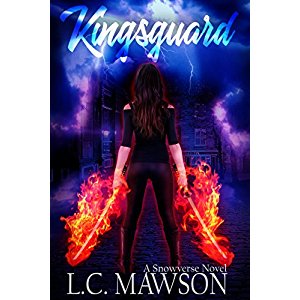
Kingsguard: Freya Snow Book IX: A Mini-Review

Both Freya and L.C. Mawson’s writing have matured in Kingsguard, the latest installment Kingsguardin the Snowverse series.  The writing is more direct and the plot structure clearer than in some earlier instalments, although it is still a complex and convoluted universe the author has created.

In Kingsguard, an earlier episode in Freya’s life is central to the story: an episode the series reader will remember but of which Freya has very edited memories.  This adds an element of almost amusement and anticipation for the reader:  when will Freya realize?

Kingsguard is another solid addition to the Snowverse and its cast of diverse, original characters.

Trident, A Snowverse Novel, by L.C. Mawson: A Release-Day Review

I think I’ve lost track of how many Snowverse books there are now, but they keep gettingTrident better and better; more focused, the writing tighter, the characters more developed.  Trident, the latest in the series, follows Freya as she accompanies her friends Mel and Sarah to the underwater realm of Atlantis.  Mel is challenging the head of her Mer house for the right for Atlantean citizenship, and the quest she must undergo to gain that right needs all of Freya’s varied and multiple magical abilities to even give them a chance of succeeding.

Along with this fast-paced adventure, developments in both Freya’s personal life and in her existence in the Shadow Realm are entwined in the story, further framing Freya’s growth in her earthly life and in her life beyond Earth’s bounds. A fairly short novel at about 180 pages on my Kindle app, Trident kept me reading…I only put it down to watch the second-last episode of Doctor Who.  Speaking of which, I think there’s a bit of an homage to the Tenth Doctor in Trident – if not, then ‘great minds think alike’ (or write alike!).  Five stars.

I received a copy of this book in exchange for an honest review.

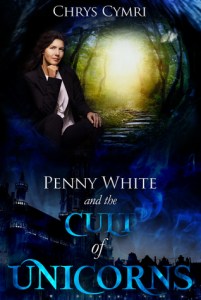
The Cult of Unicorns, by Chrys Cymri: A Review

When characters from a story begin to inhabit your dreams, you know the story has Cult of Unicornsreally taken hold of your imagination.  In my case, it was a snail shark, a creature of Chrys Cymri’s mythical, magical land of Lloegyr, a mere thin-space transport away from our own world, that began to crawl through my nightly fantasies.

When dead bodies and unicorns begin to appear in the English midlands, Penny White, Church of England vicar and official Church liaison with Lloegyr, has work to do.  With the help of Peter, the local detective, her brother, the devil-may-care dragon Raven, and her gryphon companion, Penny must navigate the glamour of unicorns and the deep pockets of a multi-national corporation to find the truth.  Interspersed with realistic examples of the difficulties of running a parish in an increasingly secular world and glimpses into Penny’s personal struggles, The Cult of Unicorns is a satisfying read set in an easily-believable world just a little skewed from ours (or is it?)

An appreciation of Doctor Who and good whiskey likely add to the reader’s delight in Penny’s world (I qualify for both) but aren’t necessary.  But you do need to accept a beer-loving snail shark named Clyde that loves the Teletubbies and can sing…and clearly my subconscious was quite happy to suspend that piece of disbelief, because Clyde comes to visit every so often, sliding his way into otherwise normal dreams.  He’s delightful…as is The Cult of Unicorns.  Five stars.

Reaper: A Snowverse Novel, by L.C. Mawson: A Release-day Review

Reaper is the seventh book in the Snowverse series, continuing Freya’s adventuresReaper almost immediately after Enhanced.  With Alex, Freya is travelling in Europe, dealing with car-sickness and more: the diversity of supernatural genes she carries result in upheavals she cannot fully control, and her past experiences are adding to the volatility.

Freya’s difficulties in controlling her emerging powers, and in tapping into the ones she needs to access, reminded me (not in a plagaristic manner, but in a thematic way) of the “Threshold Sickness” of the psi-enhanced characters in Marion Zimmer Bradley ground-breaking Darkover series.  The disruption that uncontrolled psi powers can wreak, when an untrained individual accesses them, can have far-reaching and dramatic effects: a great subject matter for a book,  and I was pleased to see the issue addressed in Reaper. (By the way, if you’re a fan of the Snowverse, then I’m guessing you’re a fan of diversity in science fiction and fantasy – and if you haven’t read the Darkover series, give it a try. Yes, it was written in the 1960’s, but for early introduction and acceptance of LGBTQ characters, it was truly a ground-breaker.)

Lucy Mawson’s skills as a writer have blossomed over this series, and her depiction of Freya’s internal conflict about Alex, and her realization of how to access her Angel powers, are some of the author’s best writing. Freya is learning, too, to make the distinction between how her autism directly affects her relationships, separate from how her (unrecognized?) emotional reactions to past events affects both herself and how she relates to others.  I’m treading carefully here, because I’m allistic, or as my husband prefers, a neurotyp, but certainly Alex’s attempts to help Freya handle her reactions and understand them rang very true to me, after thirty-eight years of living with a man with ASD.

Reaper is short – 139 pages in my e-book edition – but it doesn’t suffer from that; in fact, I found it more satisfying than some of the longer books. It’s tighter, more focused on the immediate issues. Five stars.

I received a copy of this book in exchange for an honest review.

The Quantum Ghost, by Jonathan Ballagh: A Review

In the same near-future world as Jonathan Ballagh’s The Quantum Door, a young girlQuantum Ghost called Remi sees a glowing dome in a pond near her house…a glowing dome that is almost immediately snatched by a hand that rises from the water.  Shortly afterwards, strange dreams begin; Remi finds herself writing strings of meaningless numbers…and then parcels begin to arrive, parcels containing items that she is compelled to put together.

What Remi builds takes her into the same world of technological wonder and menace that Brady and Felix entered in The Quantum Door.  But The Quantum Ghost, while building on events in the previous book, can successfully be read as a separate, stand-alone book.  Characters overlap, but they are introduced again, and any previous history relevant to this book is given in a natural way.

The target audience for The Quantum Ghost is middle-grade students.  Ballagh’s prose and pacing is perfect for this age group; the science is presented in a comprehensible manner without over-simplifying it or talking down to the reader. The action is rapid, but with enough character development to create empathy and identification with Remi.

As in The Quantum Door, Ballagh manages to take what could be clichéd scenes and turn them into truly frightening images. There are some quite dark scenes (age-appropriate) in the story, so a young person with a vivid visual imagination might find the book a bit difficult in places, but Remi is a heroine who faces dangers with courage and initiative. In both this frightening alternative universe and in her ‘real’ life, she acknowledges her fears and confronts them.

The artwork by Ben J. Adams, both on the cover and the interior illustrations, is brilliant, perfectly complementing the story.  Highly recommended for ages twelve to sixteen, or for less confident, slightly older, readers.

I received a copy of this book in exchange for an honest review.

The Eye of Nefertiti, by Maria Luisa Lang: A Review

The Eye of Nefertiti is a worthy sequel to Maria Luisa Lang’s delightful The Pharaoh’s CatNefertiti, which I reviewed in November of 2015.  Written in the same light-hearted style, the sequel follows the adventures of Wrappa-Hamen, the walking, talking cat Egyptian cat and his family…who just happen to be a High Priest of Amun-Ra transported to modern-day New York City, his 21st century wife Elena the Egyptologist, and their child, who is the reincarnation of Wrappa-Hamen’s beloved Pharaoh.

Travelling from New York to England to Ancient Egypt, and involving Tarot cards, opera, and various gods and rulers, The Eye of Nefertiti can be read as a stand-alone story, but I recommend reading the previous book for a fuller understanding of the back-story here.  Like its predecessor, it’s a light novel, and again that is not a criticism: we all need amusing distractions and Lang’s novels fit that bill perfectly.  It probably helps to be a cat-lover, because walking and talking or not, much of Wrappa-Hamen’s behaviour will resonate with cat owners (or those owned by cats).

I’m hoping we haven’t seen the last of Wrappa-Hamen; surely as the baby Pharaoh grows up there will be more adventures for his cat to be involved in!  Four stars for a well-written, fun read.

I received a copy of this book in exchange for an honest review.

Escaping Infinity, by Richard Paolinelli: A Review

Losing their way on desert roads, and nearly out of gas, Peter and his work partner escaping infinityCharlie are relieved to see a hotel – a magnificent, modern hotel – standing alone on a highway.  They check in, only to find, like in the Eagles’ Hotel California, they can’t check out.

Peter and a rebellious receptionist, Liz, attempt to escape the Hotel Infinity; Peter’s explorations and their escape attempts make up the first part of the book. This part is a pretty good science-fiction story; there are a few issues with pacing, but overall, I would have given it maybe four stars.  The problem is, it’s only the first section of the book.  The second section is, basically, an outline: written in primarily passive voice, the reader is told what occurs over the next several hundred years after the climax of the first part.

Spoilers after this point!

Author Robert Paolinelli should have, in my opinion, taken the time to create this story, not hand the reader a summary. As a two or even three book series, Escaping Infinity could have expanded into an thoughtful exploration of redemption, responsibility, and the realistic problems in the attempted creation of a second-chance utopia.  Even when the chosen people have escaped hell-fire; even when their leader has god-like properties and apparent eternal life, for the society to evolve as problem-free as it is described here stretched my belief beyond its breaking point. Stories depend on conflict, tiny conflicts, large conflicts, to propel them forward, and the second part is a narrative almost free of any struggle.  I found it immensely disappointing.

As a result, Escaping Infinity is only getting a 2 1/2 star review from me.  Good potential, unrealized.

I received a copy of this book in exchange for an honest review.

Shattering Glass, by Connor Coyne: A Review

Universities run on thought.  It’s why they exist: to share thought, to foster new thought, toShattering Glass turn thought into something, tangible or intangible, new to the world.  But what if they ran on thought in a different way, if thought could be turned into power, not of the kind wielded by politicians and heads of corporations, but the sort that turns on lights, runs motors, boots up your laptop?  And what would happen to those whose thoughts were channelled into that power?

In a rust-belt town in Michigan, a businessman creates a new university on the grounds of an abandoned psychiatric hospital. First-year students Samo, Monty, Ezzie, and Dunya share a residence floor, below ground in the Calliope Cradle. None is quite sure how he or she ended up here, but the angst of first-year adjustment is more than enough to occupy them.  But even in the confusion of buying overpriced and unaffordable textbooks, joining clubs, figuring out where to eat, and discovering mid-terms can be in almost any week of the semester, they come to realize something wicked this way comes…or rather, is already here.

Complex, intricate, perhaps a little self-indulgent (like its protagonists at first), Shattering Glass is neither straightforward nor stereotypical. It contains elements of steampunk, Greek tragedy, absurdist theatre, and film noir, all wrapped up in a superficially Harry Potteresque setting transported to a failing industrial city.  But it also delves into some difficult questions….what does happen to a personality subsumed into a university’s -or a universe’s -power system? How do we stay ourselves? Can we? At what price?

This won’t be a book for everyone. Its non-linear narrative, metafiction techniques, and elaborate detail does not make it an easy read.  But if you read Vonnegut, give Shattering Glass a chance. I’m giving it 4.5 stars here on my blog, which will translate to five on Amazon and Goodreads.

I received a copy of this book in exchange for an honest review.
A Gleam of Light: Book 1 of the Survival Trilogy, by T.J. & M.L Wolf

Drawing on ‘documented’ UFO sightings, Hopi cosmology, and some non-mainstreama gleam of light interpretations of various petroglyphs, religious practices, and experiences from around the world, A Gleam of Light pits a young Hopi woman and a reporter against the U.S. Army in a race for the secrets buried deep within a cavern on Hopi land.

The concept of using the cosmology of a people whose beliefs can be interpreted to mesh with UFO and alien sightings isn’t new – I’m old enough to remember – and to have read –  Chariots of the Gods, by Erik Von Daniken (although that was marketed as non-fiction.)  It’s a decent premise for a book, and in many ways A Gleam of Light reminded me of Dan Brown’s books, building a story around a race to interpret symbolic messages left by a previous generation.  Throw in some action and settings reminiscent of Indiana Jones and The Temple of Doom, and you’ve got the general idea.

But while it’s a decent premise, the Wolfs don’t quite pull it off.  The book suffers from a number of structural issues: uneven pacing; exposition disguised as conversation (usually almost monologue) to give background or explanation; coincidences that stretch credulity, solutions to dilemmas that just come a little too easily.  I think there is a good adventure story here, and one more rewrite under the guidance of a good developmental editor could have brought it out.  As it stands, 2 ½ stars.

I received a copy of this book in exchange for an honest review.

Penny White and The Temptation of Dragons, by Chrys Cymri: A Review

What do these have in common? Single-malt whisky, Doctor Who, dragons,temptation-dragons Northamptonshire, the Church of England. While this might sound like a round of Only Connect, the actual answer is that they are all integral aspects of Chrys Cymri’s delightful book Penny White and The Temptation of Dragons.

Penny White is the vicar of a small parish in Northamptonshire. One night she finds herself at a vehicular accident, giving last rites to a….dragon?  This act of compassion is Penny’s introduction to the parallel world of fantastic creatures that exists alongside our own, a world where St George is the dragon, not the knight. Asked to take on a significant position liaising between our world and this other one, with a gryphon as her assistant, Penny accepts, to find herself not only caught up in a murder inquiry, but attracted to the ultimate bad boy, the James Dean of dragons.

Chrys Cymri writes with a deft, light hand, a fine sense of pacing, and an ear for comedy. I found myself laughing out loud many times while reading The Temptation of Dragons.  But behind the light-hearted fantasy is a story about frailty, love and forgiveness. Penny has her own tragedies; she may be too dependent on her single-malt, and she’s lonely. Her gryphon companion has his demons, too.  They need to work past their differences, not only to be an effective team, but to find the commonalities that bond them.

I may have been just about the ideal reader for The Temptation of Dragons. With a mother from Northamptonshire, a voracious reader of anything fantasy since childhood, an upbringing in the Church of England, and a definite fan of both single-malts and Doctor Who, the book was, for me, a perfect storm of reference points.  But I doubt all those are pre-requisites to appreciating Chrys Cymri’s writing. Five well-deserved stars!

I received a copy of this book in exchange for an honest review