Fools’ Apocalypse, by Anderson Atlas: A Review

Fools’ Apocalypse took me by surprise. What started out as, I thought, a techno-thriller concerned with an anarchic leader and his followers targeting the United States in a series of terrorist attacks on infrastructure turned into a zombie story, and a good zombie story at that. The undead, or ‘puppets’ have been spawned by the terrorist attacks, but how? And can the band of survivors, almost all with their own dark secrets, be resourceful enough to outwit the ‘puppets’ and each other?

Anderson Atlas’s strengths are in creating and developing characters. Each character is an individual, with strengths, weaknesses, and motivations that help to make them believable, and each are facing the terrible consequences of choices they made. The plot moves along at a good pace, once the introductory chapters are done; these are a bit slower, as we are meeting characters and learning their roles in the action, but as this is the first book in a planned series, the slower start is understandable. The writing is for the most part competent, although I found a few lines awkward or ineffective in conveying the emotion of the character.

What struck me about Fools’ Apocalypse is that Anderson Atlas has taken two of the great themes of American writing: the river journey, and the band-of-travelers-against-the-wild, and used them to give new life to the zombie apocalypse. Combined with a back story about a mysterious religious relic, and the characters’ growing realization of the effects of their individual actions, the story seemed remarkably fresh, not just another version of The Walking Dead. The illustrations, done in black-and-white, were an unusual but attractive addition.

All in all, I’m giving Fools’ Apocalypse four stars; it gave me several hours of reading enjoyment and left me wanting more.

Did you ever wonder what became of Huck and Tom?

I’m pleased to give space today to fellow author Andrew Joyce, author of some intriguing books continuing the lives and adventures of two of American literature’s favourite characters: Huck Finn and Tom Sawyer.  Here’s an introduction to the series from Andrew.

My name is Andrew Joyce, and I write books for a living. Marian has been kind enough to allow me a little space on her blog to promote my new book, RESOLUTION: Huck Finn’s Greatest Adventure, so I thought I’d tell you how it came about. It all started way back in 2011 . . .

My first book was a 164,000-word historical novel. And in the publishing world, anything over 80,000 words for a first-time author is heresy. Or so I was told time and time again when I approached an agent for representation. After two years of research and writing, and a year of trying to secure the services of an agent, I got angry. To be told that my efforts were meaningless was somewhat demoralizing to say the least. I mean, those rejections were coming from people who had never even read my book.

So you want an 80,000-word novel?” I said to no one in particular, unless you count my dog, because he was the only one around at the time. Consequently, I decided to show them City Slickers that I could write an 80,000-word novel!

I had just finished reading Mark Twain’s Huckleberry Finn for the third time, and I started thinking about what ever happened to those boys, Tom and Huck. They must have grown up, but then what? So I sat down at my computer and banged out REDEMPTION: The Further Adventures of Huck Finn and Tom Sawyer in two months; then sent out query letters to agents.

Less than a month later, the chairman of one of the biggest agencies in New York City emailed me that he loved the story. We signed a contract and it was off to the races, or so I thought. But then the real fun began: the serious editing. Seven months later, I gave birth to Huck and Tom as adults in the Old West. And just for the record, the final word count is 79,914. The book went on to reach #1 status in its category on Amazon—twice. It even won the Editor’s Choice Award for best Western of 2013. The rest, as they say, is history.

But not quite.

My agent then wanted me to write a sequel, but I had other plans. I was in the middle of editing down my first novel (that had been rejected by 1,876,324 agents . . . or so it seemed) from 164,000 words to the present 142,000. However, he was insistent about a sequel, so I started to think about it. Now, one thing you have to understand is that I tied up all the loose ends at the end of REDEMPTION, so there was no way that I could write a sequel. And that is when Molly asked me to tell her story. Molly was a minor character that we met briefly in the first chapter of REDEMPTION, and then she is not heard from again.

So I started to think about what ever happened to her. After a bit of time—and 100,000 words—we find out what did happen to Molly. It is an adventure tale where Huck Finn weaves through the periphery of a story driven by a feisty female lead. Molly Lee was my second book, which achieved #2 status on Amazon.

Now I was finished with Huck Finn and Tom Sawyer for good. Now I could go back to my first novel and resume the editing process.

But not quite.

It was then that Huck and Molly ganged up on me and demanded that I resolve their lives once and for all. It seems that I had left them hanging, so to speak. Hence, RESOLUTION: Huck Finn’s Greatest Adventure. Here is the blurb from the back cover of the book:

It is 1896 in the Yukon Territory, Canada. The largest gold strike in the annals of human history has just been made; however, word of the discovery will not reach the outside world for another year.

By happenstance, a fifty-nine-year-old Huck Finn and his lady friend, Molly Lee, are on hand, but they are not interested in gold. They have come to that neck of the woods seeking adventure.

Someone should have warned them, “Be careful what you wish for.”

When disaster strikes, they volunteer to save the day by making an arduous six hundred mile journey by dog sled in the depths of a Yukon winter. They race against time, nature, and man. With the temperature hovering around seventy degrees below zero, they must fight every day if they are to live to see the next.

On the frozen trail, they are put upon by murderers, hungry wolves, and hostile Indians, but those adversaries have nothing over the weather. At seventy below, your spit freezes a foot from your face. Your cheeks burn—your skin turns purple and black as it dies from the cold. You are in constant danger of losing fingers and toes to frostbite.

It is into this world that Huck and Molly race.

They cannot stop. They cannot turn back. They can only go on. Lives hang in the balance—including theirs.

The three books are stand-alones and are not part of a series. They can be read in any order. RESOLUTION is available as an eBook and in print. Both versions are available on Amazon.

There you have it. Now, if you nice people will just go out and buy RESOLUTION, perhaps Huck and Molly will leave me alone long enough so that I can get some editing done on my first novel.

Thank you for having me over, Marian. It’s been a real pleasure.

AndrewAndrew Joyce left high school at seventeen to hitchhike throughout the US, Canada, and Mexico. He wouldn’t return from his journey until decades later when he decided to become a writer. Joyce has written four books, including a two-volume collection of one hundred and forty short stories comprised of his hitching adventures called BEDTIME STORIES FOR GROWN-UPS (as yet unpublished), and his latest novel, RESOLUTION. He now lives aboard a boat in Fort Lauderdale, Florida, with his dog, Danny, where he is busy working on his next book, YELLOW HAIR.

Follow Andrew at his blog  or on Facebook


Canadian indie writers – join me in supporting Fort McMurray fundraising!

All proceeds from the sale of my two e-books, Empire’s Daughter and Spinnings,in the month of May, will be donated to the Red Cross to aid Fort McMurray residents.  Canadian indie authors, join me in raising funds!

Fort McMurray

By DarrenRD – File:Landscape view of wildfire near Highway 63 in south Fort McMurray.jpg, CC BY-SA 4.0, https://commons.wikimedia.org/w/index.php?curid=48561288

Where have I been?

I haven’t been writing much recently: there are a couple of reasons for that.  One is that we’re moving, and packing up a house you’ve lived in for 22 years, and at the same time supervising the renovations to the new place, takes a lot of time!

Secondly, it’s May: spring migration in world of birds and birders, of which I’m one (birder, that is, not bird….) so adding several hours spent in the fields and woods most days, on top of the moving chores, leaves just about zero time for anything else except the bare necessities of life.

I’ll be back…probably about mid-June.  Thanks for not giving up on me!


Over the Dragonwall, by H.C. Strom & Dennis Montoya: A Review

At the borders of the land called Delvingdeep lies the Dragonwall, and what lies beyond the Dragonwall is the stuff of legend. When the young monk Oberon (Obi) confesses to his Sovereign that he dreams of crossing that wall, not for gold or riches but to see a dragon, to add to the body of knowledge his order maintains, he is sent to do exactly that.

Obi and a band of friends and new acquaintances, including a half-elven brother and sister, decide to take a short-cut, and – well, this is fantasy, and we all know what happens when short-cuts are taken in fantasy. Suffice it to say that the results of that short-cut, and the ensuing adventures across the Dragonwall, make up the rest of the story.

What came to mind as I finished the book was the quote attributed to Mother Theresa  “Not all of us can do great things. But we can do small things with great love.” It sums up this book perfectly. It’s not a great book: the authors’ influences, from gaming to classic fantasy, are obvious – in some ways it’s a bit like fan fiction. The story is not complex. There are a number of production errors in the paperback copy I read. But it has clearly been written with great love, especially for the protagonist Obi.

I’d recommend Over the Dragonwall for young readers of fantasy whose interest will be in the plot and characters, and not in the literary quality of the writing. My review rubric gives Over the Dragonwall 2 1/2 stars, which is 3 stars on Amazon and Goodreads, and for what I believe is its target audience, I think that’s fair. Obi’s adventures will continue in a sequel, and I look forward to it; Obi has rather charmed himself into my heart.

The author provided me with a copy of this book in exchange for an honest review.


This Morning’s Walk – Random Obervations from April 17th

Courting yellow-shafted flickers, the male at the top of a dead branch, the female lower on the same branch. The male drums, moves his head to the left, fans his tail. The female moves her head to the right. Back and forth they do this, the male drumming every third or fourth time, heads moving back and forth in precise time. He’s dressed to impress, every black dot on his buff-yellow breast crisp, his red nape gleaming, his tail feathers glowing gold in the morning sun. The dance goes on for about five minutes, until the male flies to another drumming perch to beat a louder cannonade. There is no visible response from the female.

A small, thin, whistle from high in the maples catches my attention. Looking up, thinking to find a small bird, I find instead a male wood duck, standing on a branch. I watch his bill open and close as the thin ‘zeeting’ is repeated. Definitely him. An unexpected sound from a duck.

Walking through Victoria Woods, a funnel of leaves rises and falls from the forest floor, rising to no more than a foot or so off the ground, falling nearly to nothing, then rising again, moving east to west. I can see the track of disturbed leaves several meters into the woods. It looks animate, or animated by something invisible – which of course it is: a small whirlwind. But the experience had an odd feel, as if I was seeing something of faerie, not this world.

The Rowanwood Curse, by Elizabeth O’Connell: A Review

In a world where magic helped the industrial revolution begin, the sons of one of the greatest industrial magicians England has known are called upon to lift a curse laid on the daughter of mine owner Jasper Pryce. Bored with the routine probate magic they are practicing, they accept the offer, and travel north to find the girl near death, the local farmers besieged by a beast, and the mine itself beset by problems.

Reminiscent of Susanna Clarke’s Jonathan Strange and Mr Norrell, but less dense and less complex, The Rowanwood Curse nevertheless is an enjoyable read. Author Elizabeth O’Connell writes in a consistent period voice with almost no mis-steps, giving us tantalizing glimpses into a world where magic is part of everyday life, practiced by those trained in it and both revered and rejected by those who are not initiates. Because magic, as it exists in O’Connell’s world, behaves consistently with traditional faerie and elemental magic known to us from children’s books onward, there is little cognitive dissonance for the experienced fantasy reader: the tale is one of familiar elements, not surprises. Nonetheless, the story is well-crafted. The Rowanwood Curse is one of a proposed series, and therefore its lack of detail in world-building is more teasing than annoying: I want to know more about aether-engines, and probate magic, and all sorts of things hinted at but not fully explained, and that desire to know more will bring me back to the series, as the author intends.

The Rowanwood Curse is short, more novella length than full novel, and fairly predictable. The characters – magicians Hal and Jem Bishop, industrialist Sir Jasper Pryce – will feel familiar to readers of Victorian-era stories and/or those of us addicted to BBC period dramas. In short, I’d describe the book as a comfortable excursion into an almost-known magical world, a good book to curl up with on a rainy afternoon (or as I did, read on a flight, where escapism without significant challenge is an antidote to the discomfort of flying); bake some gingerbread, brew some tea, light the fire, (diet coke and pretzels really didn’t quite suit it) and enjoy the story. Four stars.

Rarity from the Hollow, by Robert Eggleton: A Review

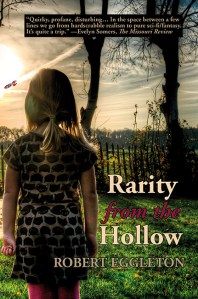
Rarity from the Hollow is subtitled A Children’s Story. For Adults. The author, Robert Eggleton, 1 Rarity Front Cover WEB (2)writes with the accuracy of familiarity about the lives of children caught in a multi-generational cycle of abuse; of men scarred by war and poverty, of PTSD, of the coping mechanisms of wives and mothers trying to hold families together.

The opening scenes of this book are difficult to read and harrowing in their blunt depiction of the kinds of abuse that Lacy Dawn, the protagonist, and her friend Faith experience. As Lacy Dawn narrates the story, elements of fantasy begin to develop, fantasy that then changes to a coherent, but oddly detached story of extra-terrestrial (and human) intervention. The extra-terrestrial intervention addresses primarily the psychological and behavioural issues confronting Lacy Dawn’s family; the human intervention – of a type beyond (or above?) the law, in a renegade Gates Foundation way – provides employment and support.

The book could be read, I think, as pure fantasy, revealing Lacy Dawn’s imagined escape from the cruel realities of her life, or, as a satire on the hurdles faced by agencies or individuals attempting to intervene in the lives of families caught in the vicious cycle of abuse. Or, perhaps, a combination of the two. I lean toward the latter. In either case, it is not a particularly easy or enjoyable read, the reality of the described lives always in the back of the reader’s mind, emphasizing the unreality of the unfolding events. A strong element of sexuality, realistic but disturbing given the age of the protagonist, remains throughout the story. But it stands in good company: I can think of other disturbing satires that have been difficult to read, but carry a strong message: A Clockwork Orange, for one.

This is not a book for children, or even for teens, and it is not a book for those who are looking for escapist fantasy. Rarity from the Hollow pulls no punches: even though some passages are very funny, it is unlikely to be those the reader remembers. It’s also a book you’ll likely need to take breathing spaces from. But I remain glad I was offered it to review. I’m giving Rarity from the Hollow four stars.

All proceeds from the book have been donated to a child abuse prevention program.

Available on AmazonLulu, or from Doghorn Publishing.

After the Queens of the Sicarii, by William Wire: A Review

Social Agent Nancy Rose inhabits a dark and dangerous world, where she must navigate a complex, convoluted underworld where power resides in the few, lives are short and shadowed, and the lines between law enforcement and the underworld are blurred.

Several generations after a virus has destroyed all men, scientists have found a way to return men to the world, but there are those – the Queens of the Sicarii – who oppose this. Nancy Rose has her own complex relationships with men, and her own motives in the pursuit of her duties may be suspect. While Wire’s novel is science fiction, it owes much to classic crime noir.

Wire writes in a style that strongly evokes the dark mood and setting of this story. Characterization and character development reflect the noir genre, revealing just enough about the protagonist, her allies and her enemies to move the plot forward. The first book in an intended series, it could be argued that the world-building is a bit weak, but more is likely to be revealed in further stories. There were times I found myself slightly confused about the motivations of some characters, and I found the the pacing a bit uneven.  But overall, After the Queens of the Sicarii kept me intrigued and entertained. Wire’s world may be post-apocalyptic, and his protagonist is a young woman, but this is far from the various Hunger Games or Insurgent clones that are offered to me for review.  Four stars for this debut novel from a talented new author.