Lena’s World: Sexuality in the Empire. Empire’s Daughter Backgrounder IV

This is the fourth in an occasional series on the history and geography that lies behind and informs my historical fantasy series, Empire’s Legacy.  Book I, Empire’s Daughter, is available on Amazon: Book II, Empire’s Hostage, will be released around June of 2017.


In Lena’s world, the world of the Empire, sexuality is varied and fluid.  This is, I hope, presented simply as part of the background and the culture of this world, but to some extent it is also based on history.

Sexuality is both innate, sexual preferences and gender identity something we are born with (and that do not necessarily conform to the gender identity we are assigned at birth) but the strength of sexuality as a basic human need can also mean that sexuality can be situational.  Men or women deprived of the company of their preferred sexual partners for long periods will seek and find sexual release and comfort where they can.  In the Empire, the structure of the society, where men and women live separately for all but a couple of weeks per year makes situational sexuality a normal and accepted practice in the lives of both men and women.

But of course, there is a wide range of sexual preference within this society, as there is in any, so the partnerships range from the men and women who prefer their own sex: Finn, the young officer; Siane and Dessa, at Tirvan; those who prefer the opposite sex: Tali, whose love for Mar keeps her living alone throughout her life; and those who are more fluid: Lena, the protagonist;  many of the women of the villages, many of the men of the army.  One or two characters may be construed as transgendered: Halle would be one.  My intent was not to define the characters by their sexuality, but let them be whatever they are, incidental, for the most part, to the story.

Where did this come from?  Greek and Roman societies were well known for accepting sexual love among athletes and soldiers of the same sex.  The Oxford Classical Dictionary, paraphrased on Wikipedia, states:

The ancient Greeks did not conceive of sexual orientation as a social identifier as modern Western societies have done. Greek society did not distinguish sexual desire or behavior by the gender of the participants, but rather by the role that each participant played in the sex act. (Oxford Classical Dictionary entry by David M. Halperin, pp.720–723)

The Sacred Band of Thebes was a 4th Century BCE troop of elite soldiers, comprised of 150 pairs of male lovers from the city of Thebes in Greece.  The troop, whose historical existence is accepted by most scholars, given its mention by classical writers such as Plutarch, was destroyed by Philip of Macedon (Alexander the Great’s father) in 338 BCE. Indeed, some military commanders of the classical era believed troops of lovers fought the hardest, because they were defending those whom they loved, not just the state.

Less is known about female same-sex relationships.  The Greek poet Sappho was head of a thiasos, an educational community for girls and young women, where same-sex relationships were part of life. The same may have occurred in Sparta.

Moving forward to the Roman era, many of the same attitudes regarding male to male sex continue, with the exception being within the military. In the Republican period (4th to 1st centuries BCE) soldiers were forbidden, by penalty of death, to have sex with each other, although sex with male slaves appears to have been acceptable. In the Imperial period, this prohibition may have been lifted, as marriage was forbidden to soldiers.

Hadrian, the Roman Emperor from 117 – 138 CE, whose British wall is the model for the

Wall in Empire’s Daughter (and the upcoming sequel Empire’s Hostage) had a lover named Antinous, one, likely, of Hadrian’s ‘harem’ of both male and female lovers.  But when Antinous drowned, Hadrian mourned him publicly, founding the Egyptian city of Antinopolis in the boy’s memory and having him deified, suggesting (strongly) that his attachment to him was deep and serious. In the British Museum’s exhibition marking fifty years since the decriminalization of homosexuality in England and Wales, the heads of Hadrian and Antinous stand side by side, honoring their relationship. (Hadrian’s the one with the beard.)

So, like most of the cultural structures in Empire’s Daughter, the sexuality is rooted in historical fact, although I do not pretend it is historically accurate. I write alternative history, or historical fantasy, (choose your category), not historical fiction!  But I also chose to honor the existence of these relationships in history, because so many books of this type seem to gloss over or totally ignore love that is not heterosexual, and that’s just not the way it was, or is.

For the previous installments in this series, click the links below:
Part 1

Part 2

Part 3

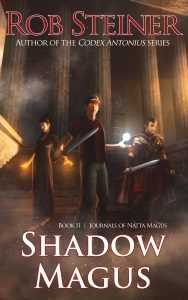
Shadow Magus, by Rob Steiner: A Review

shadow_magusShadow Magus continues the adventures of Remington Blakes, aka Natto Magus, a 21st-century American magus transported to 1st century Rome.  (It’s not necessary to have read the first book to enjoy this one, but I’d recommend it.) Steiner continues to blend good writing, likeable characters, fast action and sense of humour in a well-paced and well-plotted story.

I reviewed the previous book in the series, Citizen Magus, about a year ago, giving the light-hearted and fast-paced fantasy five stars. The sequel continues the mood and quality of the first book.

Another magus, with a type of magic that Natto Magus can’t identify, appears in Rome…and apparently bent on destruction. Caesar Augustus needs Natto’s help to save Rome. From the Circus Maximus to the underworld of Egyptian mythology, Remington pursues the magus in a desperate quest, while not losing his own life to this new power.  Even Remington’s household god Lares gets involved in the crusade.

I don’t want to give away too much of the plot.  But as in the first book, Steiner captures Ancient Rome in all its crowded, smelly reality, without ponderous archaeology weighing the book down.  The magic remains internally consistent and very well described, even the new type of magic the intruder brings, and the historic backstory to the conflict is accurate.  And Natto Magus’s character continues to develop; the next in the series should prove quite interesting!

Five stars to the second installment of a fun series.

I received a copy of this book in exchange for an honest review.

Lena’s World: The Social Structure of Empire’s Daughter

In Empire’s Daughter, men and women lead very separate lives, the women living together, primarily in farming and fishing villages, the men in mandatory military service.  Male children are taken at age 7 to begin military training; girls are educated in their own villages, and then apprentice to a trade.  Where did these ideas come from?

There isn’t one source, one society that I borrowed from.  The idea of male children being taken at seven into military training is from the social structure of the ancient city-state of Sparta, where exactly that happened.  Spartan boys were basically cadets until age 20, when they took on greater responsibility in the military; they could marry at 30, but did not live with their wives, but stayed with their military comrades in barracks….and that was the germ of the idea of the men and women living almost completely separate lives, except for a couple of weeks each year.

The Roman Empire’s military structure also influenced how I envisioned the lives of menroman_soldiers_at_rest2 in the Empire. Roman soldiers served 25 years in the military, and could not (officially) marry unless they were of officer class, although they often formed permanent relationships with local women.  But again, it was that sense of a primarily masculine life that influenced how the men live in Empire’s Daughter.
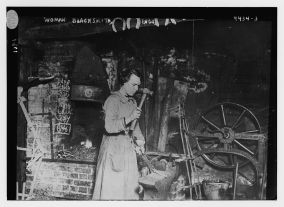
The lives of women were influenced by a number of sources: Icelandic and Viking women, for one, where women frequently were completely responsible for farming and fishing and all the other work woman_blacksmith_-_eng-_i-e-_england_loc_24225694456while the men were at sea, either fishing (Iceland) or raiding (Vikings).  The apprenticeship of girls at twelve to a trade is simply based on long practice throughout much of the world, for both boys and girls: even my own grandfather was apprenticed at age twelve to a coal merchant in England, in about 1896. (The photo is from England, c 1915-1920)

Now, as to why there is this tiny, isolated Empire at the edge of the world, underpopulated and ring-fenced by the Wall, the mountains and the sea….well, to say more would need a big SPOILERS alert.  You’ll have to read the books to find out!

Empire’s Daughter, book one of the Empire’s Legacy series, is currently available from Amazon in e-book format or paperback.  Look for book 2, Empire’s Hostage, around June of 2017!

Roman soldier picture: By Pablo Dodda (Flickr: Roman Soldiers) [CC BY 2.0 (http://creativecommons.org/licenses/by/2.0)%5D, via Wikimedia Commons

Woman blacksmith picture:  Bain News Service; taken in England c 1915-20; courtesy of Wikimedia Commons.  No known copyright restrictions.


An Interview with Aaron Hodges, Author of Soul Blade

Today I’m talking to Aaron Hodges, author of the The Sword of Light trilogy.  The third author-picturebook, Soul Blade, has just been released on Amazon to consistent 5 star reviews.

Aaron, where are you from and what do you do outside of writing?

Sure thing! Well, the first thing you should know about me is that I’m from New Zealand. And yes, I like The Lord of the Rings ;-). I am an Environmental Scientist by profession, but gave that up a few years back to see the world – an Overseas Experience (OE) as we call it in New Zealand. And, well, since then I haven’t really looked back. I’ve travelled through SE Asia, lived in Canada, backpacked down the west coast of the USA, bused through Mexico, Central and South America, and I am currently living in Argentina.

As for my writing, that came about almost completely by accident. During my travels, I started rewriting a story I’d written for an old High School project. I finally completed and published it back in December 2015, and to my surprise, it took off. Since then I’ve been working on book 2 and 3 while continuing my adventures around the world!

Where did you get the inspiration for your first series?

My first series is The Sword of Light Trilogy, and I think it draws on a lot of my own experiences throughout life. At its heart, my first trilogy is about standing against darkness whatever the odds – and those odds are pretty bad for my poor characters. In the words of one of my reviewers: “Toughest. Baddies. Ever.” In my own life I have faced a few challenges, including the loss of my father when I was 13, and those challenges have definitely added to my works.

Tell me about your process for writing a book?

My books actually developed in waves. As I mentioned, The Sword of Light Trilogy first began way back in High School, which was over ten years ago for me… But in the ten years since then, I’ve revisited the story several times, rewriting it over and over again. In each of those rewrites, more aspects of the plot came into light, and it slowly grew and developed into something quite substantial over the years. Questions like ‘where did the God of Light go?’ are actually answered now, in this third book, Soul Blade, rather than being a mystery that is never resolved.

Who is the bad guy in your books?

My primary antagonist, Archon, first seems a reflection of the classic epic fantasy villain. For example, Sauron in The Lord of the Rings. All powerful, completely evil, etc. But personally, for much of the story I think of Archon more as death himself – inevitable, a shadow hanging over all the characters. He is a dark power influencing things around them, always threatening, but never quite there. Not until the final book anyway – Soul Blade finally brings him to the forefront, and reveals the truth about his character.

What book are you reading right now?

I am currently reading ‘Wild’ by Cheryl Strayed. Not my usual kind of book, but I picked it up in a hostel and have been slowly making my way through it. It’s an interesting read, although I must admit a few of Cheryl’s mistakes on the trail make me wince inside. As a traveller, the idea of carrying a backpack I can’t even pick up horrifies me. My pack is now a tiny 38L, and I plan on downsizing again the next time I’m home!

Who is your favourite author?

I actually have two: David Gemmell and Ian Irvine. David because of his characters. It’s a very rare thing that a writer can make me cry with his story, but the characters in David’s novel are just so real, so vivid, I can’t help but cry every time I read Druss the Legend.

As for Ian Irvine, I love his worlds. His Three Worlds books are absolutely amazing. He actually spent 20 years developing them before he began to write – he even created a map the size of a door to show just one of his three worlds. And that’s just the geography. There’s also a detailed history, magic system, and four races of human. It all makes for an incredibly rich story.

Now the Sword of Light trilogy is done, what are you working on next?

After taking a breather, I will be starting a new series. This time, I’m hoping to write a Science Fiction thriller focused around genetic engineering. It will focus on a group of young men and woman who awake to find themselves trapped in a prison. They remember nothing of a world outside or a prior life, but it won’t take long for them to find out their future is not looking too bright.

How can readers get in touch with you?

Readers can find me at www.aaronhodges.co.nz, or email me at author@aaronhodges.co.nz.

I now have three books on Amazon. The first book, Stormwielder, is now only 99c and can be found using this link.

Thanks, Aaron.  Best of luck with Soul Blade!


Soul Blade, by Aaron Hodges: A Blog Tour Post

I’m pleased to be participating in the blog tour of Aaron Hodges, promoting his newest book.  Aaron is the author of the #1 Amazon Bestselling novel Stormwielder, book 1 of the Sword of Light trilogy. It’s a Sword and Sorcery novel about a young man with an uncontrollable power over the weather. The trilogy follows his adventures as he learns to master his magic, while encountering your standard fare of magic wielders, dragons and Gods. Soul Blade, the third book of the trilogy, is out today and is available for a limited time for $0.99 from Amazon.

Soul Blade (The Sword of Light Trilogy #3)

soul-blade-2


The Three Nations are crumbling.

Darkness is gathering.

And only one remains to stand against it.


Eric stumbles through the wilderness, searching, hunting – desperate for sign of his sister. But the girl is gone, stolen away by the power of the Soul Blade. With each passing hour its hold on her tightens, her spirit fading before the onslaught of its magic. If he cannot save her soon, it will claim her soul. And he will have to kill her.

Meanwhile, Gabriel is lost in the darkness. It is his whole world now, its presence absolute, suffocating. Time, hope, sanity, all have long since slipped beneath the waves of his despair. Only it remains – the unrelenting voice of the demon. It haunts the darkness, mocking him with false promises of freedom.

How long can he resist its call?

 https://www.goodreads.com/book/show/32614241-soul-blade

Look for an author interview with Aaron Hodges on this site later this week!


The Power of Illustration

I’m working on a little stand-alone ‘chapbook’ of my short story, In an Absent Dream. It will be illustrated with black & white drawings by the artist Duy Trinh, who is capturing the setting and feel of the story with great skill.  Publication date is still to be announced, but here’s a preview of one of the illustrations, with the passage from the short story that inspired it.

duy-1

“It’s just this world, these streets, these fields…but it’s overlain with roads and paths and occasionally buildings that don’t exist in the world under the sun. It’s like they hover over (or under) the solidity of the everyday world, taking shape and substance only when someone – me – enters them.”

“In An Absent Dream” is published in the small collection Spinnings available as an ebook ….or you can wait for the chapbook to have a hauntingly illustrated paperback!


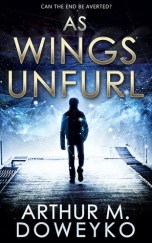
As Wings Unfurl, by Arthur M. Doweyko: A Review

The idea of the guardian angel who is supposed to watch and not interfere, and who loses its divine status if it becomes as-wings-unfurlemotionally entangled with the person or persons it watches is not new. (For a thoughtful and beautiful take on this, watch the Wim Wenders film Wings of Desire. Watch the original, please, and not the Nicholas Cage remake City of Angels…they are very different films.) But, of course, no-one owns this concept, and in As Wings Unfurl, author Arthur M. Doweyko brings his own twist to the tale. Here, the ‘angel’ is an alien being, and humans are not what we think we are. Nor are we the oldest sentient hominid on Earth.

The protagonist, Applegate Bogdanski, is a Vietnam war vet with scars both physical and emotional. Through his work in a used book store, he becomes caught up in a scandal involving the Catholic Church…but the scandal, which on the surface appears to be a classic sexual misdemeanour, is so much more than that. The plot moves quickly, events piling on events. The writing is competent and consistent, the action scenes well-crafted, and the story structure keeps the reader interested.

But beyond all that, there are multiple parallels to the stories of the Old Testament (and likely stories from the other religious texts of the People of the Book – those of Jewish and Muslim holy books, but my knowledge of those is limited.) Even our protagonist’s name: Bogdan means, more or less, ‘beloved of God’; ‘Applegate’ could suggest the story of the Garden of Eden. Without giving any of the story away, there are parallels to the story of Lucifer; parallels to the story of creation; Apple’s physical injury mirrors that of Jacob after his wrestling match with an angel. Is any of this intended? That’s a question for the author, but for this reader it appeared so.

All of this – both the quality of the plot and the perceived allegory – intrigued me enough to keep me reading when I should have been doing other things; I finished the book in just a couple of days. Four stars for a book that can be read on more than one level.

I received a copy of this book in exchange for an honest review.


Witch (Freya Snow Book 5) by L.C. Mawson: A Review

Witch is the fifth book in the Freya Snow series, following the experiences of autistic, bi-witchsexual, non-human Freya as she learns to navigate both the human world and the world of magic, discovering the complexities of both.

In the human world, Freya has a job as a barista; in the non-human world, she is mostly concerned with finding a way to lift a curse that has placed a friend into a coma-like state. As she solves this problem – with noticeably more skill in negotiation and communication than in earlier books – she also learns more about herself, her non-human family and her place in the hierarchy of magic. Freya’s friends play a larger part in this book; her human family is barely seen, and this is appropriate given Freya is older and more independent.

Freya’s developing maturity is paralleled by author L.C. Mawson’s development as a writer. Witch is perhaps a more thoughtful book than earlier installments, with less physical action and more development of, and insight into, Freya’s character and personality. The ending of Witch is indicative of Freya’s ability to accept responsibility, moving her from adolescent to adult.

Four stars to a pivotal installment in the series. For an overview of all the Freya Snow books, I suggest the author’s site here.

Xan and Ink, by Zak Zyz: A Review

Many fantasy books start out well but lose their way somewhere in the middle. Xan and Ink does the opposite: I found the first third of thxanandinkcovere book fairly rocky going, but once the author had his characters where he wanted them – trying to stay alive in the insect jungle of Kalparcimex, caught up in the feud between the Ranger Xan and the sorceress Ink – the story found its feet.

Banished brothers Sandros and Gregary, and their companions Brakkar and Osolin, are on a quest, to find a way to rid Joymont of the insectine creatures that are destroying it. Chance takes them in search of the legendary Xan, scholar and ranger of the Kalparcimex, to ask for his help. Both the world and the characters the author has created are complex and multi-layered, and we are given only glimpses of the back-story and motivations of the four sworn to find help for Joymont. We learn the most about Osolin, the escaped, condemned slave. Nor do we learn much more about Xan or Ink, except hints and little tastes of what made them who they are, and the past history between them. I found this intriguing; others may find it disappointing. We are only beginning to understand the complexity of the characters when the book ends, but as the ending demands a sequel, more may be revealed if that sequel is forthcoming.

The insect jungle, the Kalpa, is one of the most unusual and creative ways to pit the environment against the protagonists that I’ve come across. The insects – ranging from annoying to fatal, from mindless to sentient – are antagonists that most of us can easily imagine – anyone who’s hiked in a mosquito-laden wetland, or fought off blackflies or sand-fleas or leeches (or the black wasp of Uganda that stings just for the love of it) – can extend that experience to the horror of the Kalpa. It had me shuddering more than once.

Sexually explicit, this is a book for adults, not younger readers. Xan and Ink was far from the usual fantasy that crosses my desk, and I appreciated it more for that. Four stars.

I received a copy of this book in exchange for an honest review.