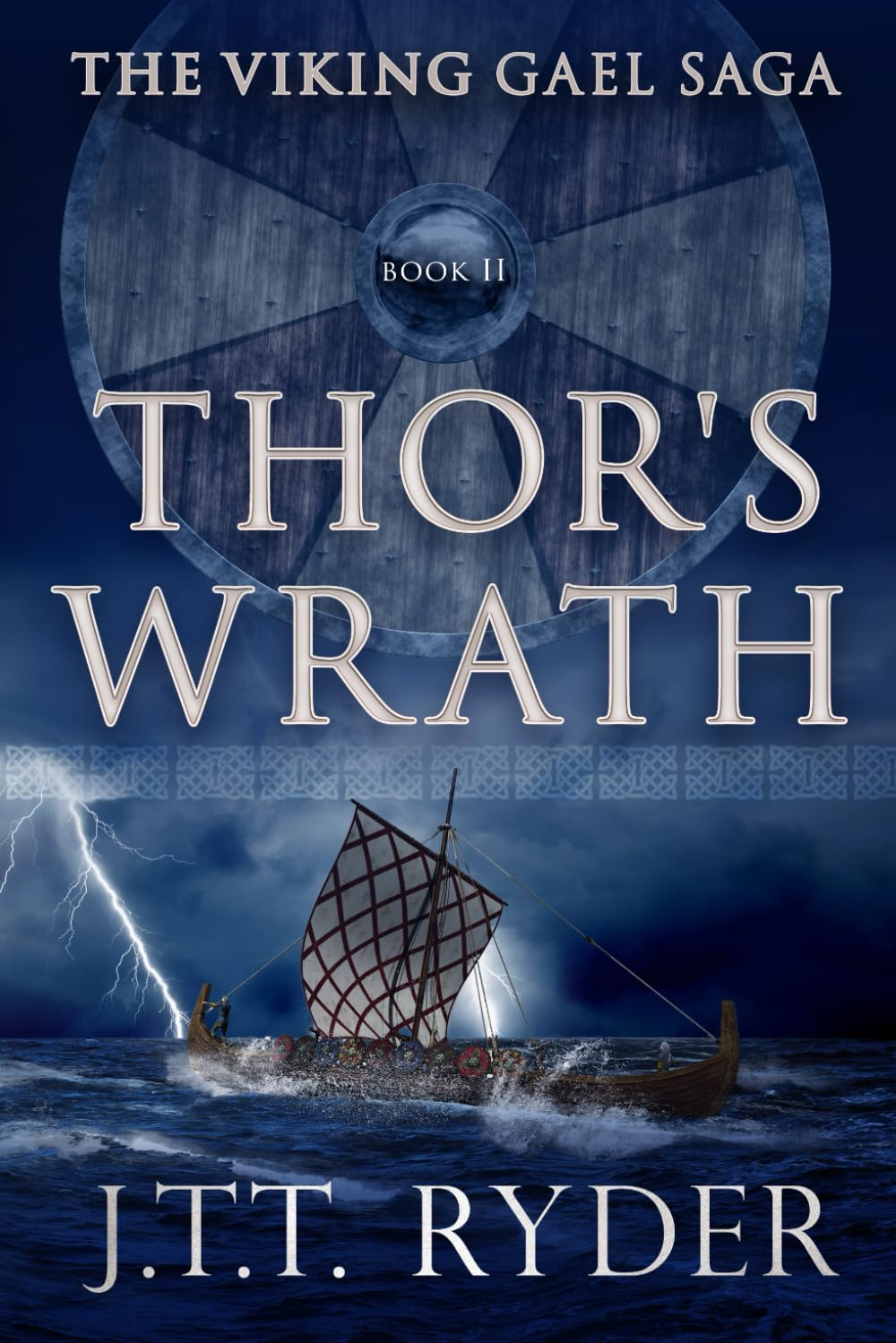
When we left Asgeir in book 1, he had saved his life (and his cat) but lost his honour. Now, as Harold Finehair works to unite Norway, Asgeir lands in the Orkneys, into conflict and battle: a chance for Asgeir to overcome his shame and redeem himself in his eyes and his gods.
J.T.T. Ryder continues to draw on his extensive knowledge of the history and archaeology of the setting – both time and place – in recreating a 9th century north-western European world. While Asgeir (and his compatriots) worldview is not ours, it is convincing: enmity and friendship flipping back and forth; the importance of personal honour; the role of single combat over warfare. This is a world of foresight, of visits from gods, of visions and portents–all are real, all are to be taken seriously.
The story moves quickly; the reader and Asgeir together are given little respite as threats are overcome, peace is agreed, only for another threat or a betrayal to begin the action again. Ryder’s writing is sometimes lyrical, especially in his place-based descriptions: ‘A whirlwind of puffins blackened the sky over the rocky, chilly islet… Mist shrouded the horizon like unspun wool, and the wind bit as remorseless as a fox…” In other places it echoes the alliteration of the sagas: ‘shocked him with sleet sideways.’ Even the occasional unusual word choice adds to the story, creating a sense of a world different from ours, refracted through time and distance.
The story is perhaps Ryder’s best, the complexity of Asgeir’s choices and of his thinking deepening as the youth matures into manhood. The telling is excellent. The editing, I am sorry to say, is less so.
(I dislike on-screen reading, so whenever possible I buy the paperback, so these comments pertain to the first paperback edition published in 2023.) I am tolerant of a certain number of typographical errors: they appear in even the best edited books, traditionally published or independent. But repeated sentences, repeated scenes, should not. Nor should a leg of lamb in one paragraph become a leg of pork in another. These errors spoke of a rushed production, an incomplete editing process, and one, inevitably, that jolts the reader out of the story. A second, corrected edition* is strongly suggested.
But! Thor’s Wrath is still well worth reading, and I look forward to the next book in Asgeir’s saga. (And yes, the cat is still Asgeir’s companion at the end of this installment.)
*Update: correspondence with the author assures me these errors have been or are in the process of being corrected.
How many of us have wandered through an art gallery and daydreamed about a painting that catches our eye or an intriguing sculpture on the plinth? I definitely do. So the idea of coming up with a short story based on this premise didn’t require me to consider for long.
I had been researching Mesopotamia, particularly the foundation of the Akkadian Empire, when I learned about the discovery of the Bull-Headed Lyre of Ur. I have been trying for several years to write a work of fantasy using the Akkadians as an anchor for the setting of my fictitious world, but the final form of that book has been elusive. When I was invited to write a piece of short fiction, I realized that using this lyre would be a great way to use my research on the Akkadians even if my longer novel is proving difficult to finish.
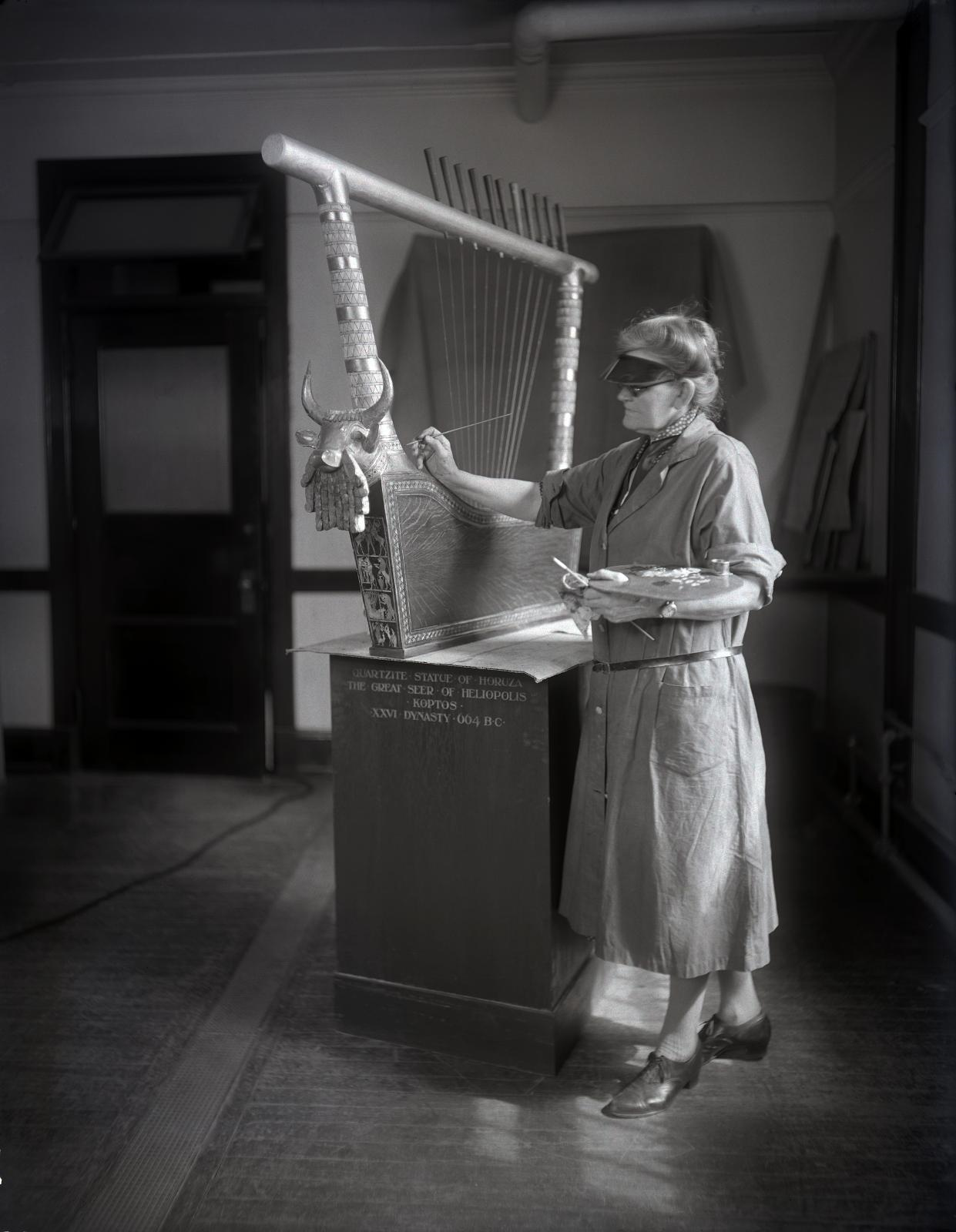
The Bull-Headed Lyre of Ur is one of the most iconic and well-preserved artifacts from ancient Mesopotamia. It is also one of the oldest string instruments ever discovered, dating back to around 2550-2450 BC. The lyre was unearthed in 1926 by British archaeologist Leonard Woolley, during his excavations of the Royal Cemetery at Ur in what is now southern Iraq.
Woolley and his team had been excavating the Royal Cemetery at Ur for several years when they came across tomb PG779 which was (they later decided) the burial place of Queen Puabi, a Sumerian queen who lived during the Early Dynastic III period. The tomb produced a treasure trove of grave goods, including gold jewelry, weapons, and pottery.
The lyre was found in a wooden coffin, along with the bodies of several attendants. Made of gold, silver, lapis lazuli, and shell, the lyre is decorated with intricate carvings and inlays, depicting a variety of scenes from Mesopotamian mythology and everyday life. The most striking feature of the lyre is its bull’s head, which is attached to the front of the soundbox.
Music was very important in ancient Mesopotamian civilization and was played during a variety of occasions, including religious festivals, royal banquets, and military campaigns. It was also used to accompany poetry, dance, and storytelling. For my story, I envisioned its use in private homes as well, even if occupants couldn’t afford anything as luxurious as the Bull-headed Lyre from Ur.
What would life have been like for the person who played such an exquisite instrument? Particularly for one who played in the court of a queen? To make my story work, I moved the lyre from its actual, historic era forward a couple hundred years to the reign of Sargon of Akkad, placing it in the Ekishnugal Temple in Ur where Sargon’s own daughter, Enheduanna, served as En, or high priestess, to the moon god Nanna. Enheduanna had her own court musicians, so I simply needed an individual to fit the role. From there, I simply told the story of how a girl with a passion for music ended up serving as music-giver for Enheduanna, the historic lyre her instrument of music-weaving.
I’d love for you to discover the inspiration of these pieces of art for yourself. Look for Masterworks on Amazon, available now.
About Stephanie Churchill
Being first and foremost a lover of history, Stephanie’s writing draws on her knowledge of history even while set in purely fictional places existing only in her imagination. Filled with action and romance, loyalty and betrayal, her writing takes on a cadence that is sometimes literary, sometimes genre fiction, relying on deeply drawn and complex characters while exploring the subtleties of imperfect people living in a gritty, sometimes dark world. Her unique blend of non-magical fantasy fiction inspired by real history ensures that her books are sure to please fans of historical fiction and epic fantasy literature alike.
After graduating college, she worked as an international trade and antitrust paralegal in Washington, D.C. and then in Minneapolis, Minnesota. It was only at the suggestion of New York Times best-selling author, Sharon Kay Penman, that Stephanie began to write. She has since written three novels loosely inspired by the Wars of the Roses: The Scribe’s Daughter, The King’s Daughter, and The King’s Furies. Her first short story, Shades of Awakening, originally appeared in the Historical Writers Forum anthology, Hauntings. A Našû for Ilu, part of the Masterworks anthology, was published November 1, 2023.
Luminous: The Story of a Radium Girl, by Samantha Wilcoxson.
Imagine you are a young working-class woman in 1920s USA. Imagine you have elderly relatives to help support, and are offered a well-paying job in your home town. You would, of course, take it.
Imagine that job will kill you. Not just you, but many of your friends. And the company will deny the dangers, smear your name, conduct false medical tests, and conceal others, while all the time ensuring that their lab personnel have all the protected equipment available at the time.
You and your friends were disposable.
This piece of history, played out in Illinois and New Jersey, is the focus of Samantha Wilcoxson’s Luminous: The Story of a Radium Girl: a fictionalized biography of Catherine Wolfe Donohue, a worker at the Ottawa, Illinois Radium Dial factory. Catherine and her coworkers, all young women, were hired to paint watch dials with radium paint, so that the numbers would glow in the dark. To create the fine point needed on the brush for the exacting, precise work, they were told to run the brush point, loaded with paint, between their lips. One by one, they began to sicken and die.
Wilcoxson begins Catherine’s story in the late summer of 1921, when she is nineteen. Fall is in the air, garden produce is being harvested, and the slow rhythms of small town life are evoked in a few brief, effective paragraphs. An advertisement for girls to work at Radium Dial is advertised in the local paper; Catherine applies and is hired.
For a while, the job seems wonderful. The pay is good and the camaraderie with other girls creates close friendships. But then the illnesses start, and the deaths: horrible deaths, in many cases.
Catherine is not one to rock the boat, but she begins to ask questions. The management of Radium Dial deny any relationship with the paint; a fact claimed in Ross Mulner’s book Deadly Glow but not mentioned in Wilcoxson’s is that in some cases the women’s symptoms were blamed on syphilis, effectively destroying both their credibility and their reputations.
When her friends continue to sicken and die, painfully and gruesomely, Catherine—now married—has also fallen ill. Wilcoxson does not shy away from the details of the illnesses, primarily bone cancers, that these women contracted. With the support of her husband, eventually she and others sue the company, a nearly hopeless cause.
The devastation that radium poisoning caused to women and their families is clearly told, and the ground-breaking fight for compensation that Donohue helped win with her deathbed testimony is an important part of the history of workers’ rights. But perhaps because the dialogue often didn’t quite ring true to me, or perhaps because the story is told over twenty years, and is therefore necessarily episodic, while I felt for the destruction of lives and the injustice of their treatment intellectually, I never quite connected emotionally with the character: I was observing Catherine’s life, not immersed in it.
Luminous: The Story of a Radium Girl is a solid work, historically accurate and a window into a terrible exploitation of workers in the name of profits and a fight for workers’ rights—rights which are under siege in many places today as profit, not people, remains the focus of too many companies. Could this happen again? Under a slightly different guise, I am afraid so.
Royal bastard, powerful magnate, capable commander – King Stephen’s man?
By Cathie Dunn
What if…Robert of Gloucester had not supported his half-sister, the Empress Matilda? Would the mid-12 th century civil war that ravaged much of England, and Normandy by association, have happened at all?
A Race against Time, my short story in the wonderful anthology, Alternate Endings, published through the Historical Writers Forum, is set just before the period now widely known as The Anarchy. It begins on December 1st , 1135, with the death of King Henry I at his hunting lodge at Lyons-la-Forêt in Normandy.
Henry’s illness appeared quite suddenly, made worse by a meal of lamprey eels, apparently, that didn’t do his constitution any good, and it didn’t give his administrators enough time to consider the serious matter of a successor. Henry refused any discussions on the subject. So the status quo remained that, as designated heiress, Matilda, Countess of Anjou and former Holy Roman Empress, was considered Henry’s heir as his only surviving legitimate child. But she was, of course, a woman, and one married to a rather unpopular and ambitious young noble, Geoffrey of Anjou. It didn’t help matters that Henry had been quarrelling with the couple before his untimely death. In short, the situation was a mess.
In A Race against Time, Robert of Gloucester, illegitimate eldest son of King Henry I, seeks to scupper Stephen of Blois’ rushed accession to the English throne (and you’ll have to read the story to find out what happened!), but what if Robert had stayed on at Stephen’s side, for good?
After all, with Hugh Bigod claiming that Henry had released the barons from their oath of fealty to Matilda on his deathbed, he opened the door for an alternative candidate – one more suited to the responsibilities of kingship than a mere woman. It was a view that was shared widely amongst the English nobles. Very few were surprised when Stephen – Matilda’s cousin through his mother’s side – made a dash to Westminster and had himself crowned with unseemly haste. Very likely, they approved of his ’decisive’ action.
The effigy of Robert of Gloucester’s tomb by: George Hollis, The Monumental Effigies of Great Britain, Public Domain.
As did Robert of Gloucester at the time, it would appear. Early on, the Empress’ older half-brother, a highly valued commander and astute politician, pledged his allegiance to Stephen. But by 1138, he’d seen enough, and was easily persuaded to pursue his sister’s claim to the throne.
There were rumours of a strong dislike between the two men, and that Robert did not hide his disappointment in the new king. But how could Stephen have kept this man, whose sweeping lands in the west country stretched into south Wales, on his side?
With Robert covering his back, Stephen could have pacified the squabbling nobles. They’d have toed the line rather than challenge him and doing pretty much what they wanted. Perhaps Robert could even have kept Stephen’s brother Henry, Archbishop of Winchester, from scheming. He’d have had a task at hand to convince Matilda’s supporters to give up any hopes of her becoming queen, but they would likely have heeded his guidance.
But how could Stephen have ‘bribed’ this man who did not seek the highest power, who was no backstabbing traitor? Perhaps if Robert had been granted a position of high power, and in particular support against his enemies in the ranks of the barons, he may have stayed. If Stephen had been less dithering, less of a ‘good guy’, but come down harsh on the troublemakers, Robert would have supported him. If Stephen had been a decisive king, hard but fair, a medieval ruler not relying on his popularity amongst the peers, and if he’d not given in to their increasing demands. If…
Without Robert, Matilda’s chances would have been close to nil. She had friends, barons in the west and south-west of England. But with her husband’s focus on reining in the small uprisings in Normandy, she wouldn’t have had the influence or the manpower to stage an attempt at claiming her throne. Without Robert, she’d never have made it to England. Perhaps as a visitor, but never as a potential queen in her own right.
This would have also meant England and Normandy remaining divided – England firmly in Stephen’s hand and Normandy in Matilda’s and Geoffrey’s. Normandy was her true home, but her husband’s campaigns to consolidate his power and defend Normandy against raids from the French may have counted for nothing without the backing of powerful magnates such as Robert. A small duchy with a large, greedy kingdom on its doorstep, snapping at its heel.
Matilda may have lost everything.
And Robert? Well, he’d have been in a high position of power, possibly responsible for defence of the kingdom, or even for the upbringing of Stephen’s son, Eustace. Perhaps the boy may have turned out a nicer character than he so clearly was. And maybe, then, he’d have survived his father…
The balance of power would have shifted, had Robert of Gloucester remained at Stephen’s court and in the king’s favour. The good folk of England wouldn’t have seen nearly two decades of fighting, particularly across the south and west. There wouldn’t have been all the burnt crops and destroyed fields and castles. And there wouldn’t have been all that needless bloodshed.
But then, Robert of Gloucester was a man of principle, of loyalty and honour. Any personal ambition of his never made him aim for top job itself, as he knew it to be wrong. Times had changed. Also, it would appear, he didn’t suffer fools gladly, in that he preferred to see his headstrong sister accede to the throne of England, rather than malleable, indecisive Stephen. He gave the man the benefit of a doubt early on, and then chose his side, never again wavering in his support for Matilda.
It is, perhaps, for those reasons that Robert, earl of Gloucester, is my favourite historical character. And I dare say, he’d have made a fine King of England, even if he was born on the wrong side of the blanket…
A Race Against Time, my short story in Alternate Endings
The King is dead. Long live the…Queen?
A Race against Time begins with the news of the death of Henry I, King of England and Duke of Normandy. His illegitimate son, Robert, earl of Gloucester, has expected the news. Like the other lords, he has sworn allegiance to his half-sister, Matilda, Henry I’s only legitimate heir. But she is a woman!
When word reaches him that their cousin, Stephen of Blois, is on his way to London to seize the throne, Robert and his fellow lords must decide how to proceed, fast. Should they put a woman on the throne, after all, in her own right and with an ambitious husband no one can control? Or is there perhaps another contender?
Cathie Dunn writes historical fiction, mystery, and romance. The focus of her current historical fiction projects is on strong women through time.
For many years, Cathie has been intrigued by the period in English history now known as The Anarchy, the mid-12th century civil war that affected England and Normandy. Although her current novel writing projects are set in other eras, she is planning to return to The Anarchy soon again, with a sequel to her romantic murder mystery, Dark Deceit.
In her spare time, Cathie loves to explore castles and ruins, allowing her to get ‘in the zone’ with her historical characters, fictional or real. She currently lives in the south of France with her husband and two rescue pets.
Eva Seyler is the author of four historical novels or novellas. Here, we discuss how she weaves emotion and reaction into her books, while maintaining a simple style.
Eva:
“Writing for effect”, in my books, is all about the characters.
Snogging
I’m notorious for writing gratuitous snogfests that (often) don’t make it into the finished projects (for example, there’s an extremely un-kid-friendly RageSex scene that did not make it into The Summer I Found Home because it’s designed to be appropriate for kids).
The scenes that do make the cut have to meet a few criteria: they need to signify something about the characters’ development, and they need to be focused on emotions rather than mere physicality. The goal is for what I don’t say, what is left to be read between the lines, to be as punchy as what I do say.
His voice caught as he wove his fingers into my hair and searched my eyes. “I am abominably drunk but I will show you things…”
He bent close, his mouth exploring my throat and shoulders and breasts. His restless, certain fingertips called forth blissful whimpers from deep within me. Clothing shed, skin on skin, fingers of one of his hands interlacing with mine while the other hand like a magician’s called forth sense and life I hadn’t known existed. His mouth on mine, tasting of brandy and cigarettes and heaven, layer upon layer of feeling, sinking—drowning, but never dying, curiously alive, singing strings within. He was intense and he was focused and he knew what he was doing.
Marian’s reaction:
My sense here is that the narrator is inexperienced, if not virginal: ‘sense and life I hadn’t known existed’. Perhaps she’s taking a risky step here? And that the man is experienced, and both cultured and perhaps a little disreputable: – ‘abominably drunk’ – not the language of an uneducated man; the brandy also suggests this. How far off am I?
Eva:
Right on every count. She’s been married before, but the husband was, shall we say, unimaginative at best—and it is a risk because this man is her best friend’s husband. (This snippet is from Ripples, the companion novella to The War in Our Hearts.)
Snappy dialogue
Louise and George’s banter in The Summer I Found Home and its sequels has segued into an experiment: trying a brand-new (for me) style of dialogue that is intended to evoke the frenetic energy of 1930s-40s screwball comedy. I’m trying to perfect this for a WIP that’s third down the release pipeline: basically, using as few dialogue tags as possible, but still making it clear who’s speaking.
Just one example of many from the WIP in question:
“I mean, friendship is wonderful. Everything is more fun with a friend. But imagine having, say, me for a friend, Miss Shipton.”
“I wasn’t aware we were friends. Anyway, I’m home now, you needn’t linger—”
“We could be. Friends, that is. Not home. We could be that too. I mean. Together.”
“Are you this eloquent and seductive with all your lady friends?”
“Oh no. Much more with them.”
“You flatter me.”
“You hoover all the panache right out of me.”
“How romantic.”
“As I said.”
“Will you stop leaning in that impertinent way?”
He was too close, his forehead nearly touching hers. “What kind of person do you want to marry, Miss Shipton?”
Marian’s reaction:
The short and sometimes interrupted sentences are very effective here, and it’s easy to follow who’s speaking by the inclusion of ‘Miss Shipton’ and/or ‘lady friends’. And then at the end the tone changes to more serious, simply by the dialogue becoming slower and a full sentence, and, the inclusion of an action tag prior to the dialogue. Was that your intent?
Eva:
I’m not sure I thought it out that thoroughly, but it’s true!
Simplicity
Another strong aspect of my style is staying sharply on point. I don’t write flowery descriptions of scenery or events. I’m not against such things, by any means—it’s just not something that comes naturally. This Great Wilderness, at over 90,000 words, is incredibly long for me. Usually my books (including my two earliest, experimental novels) run considerably shorter. The Summer I Found Home is only around 62,000 words.
I attribute this to focusing on character development and the specific events that drive that development.
As with my snogfests and sex scenes, setting descriptions must enhance character development. Here’s an example from This Great Wilderness that encapsulates the scenery in a few short paragraphs, and the description is directly related to the state of Leni’s mind.
The scenery is stark and incredible. There is the brown, desert-like landscape going one direction, like what the American West always looked like in the cowboy pictures we sometimes sneaked out to see when I was little.
But face the other direction, and it is saw-toothed mountains, and snow, and ice, and vast lake.
Two worlds. The desert is my life with Mauritz. The mountains are my life now. Both of them are terrifying to me, and the solitude is immense.
Marian’s reaction:
I’m sure this has a formal definition in writing (it’s not quite pathetic fallacy), but I couldn’t find one – the landscape reflecting the emotions of the narrator. It’s one I use a lot myself. I particularly like the starkness and simplicity of the contrast here between the desert and the mountains, and the threatening aspect of the mountains: ‘saw-toothed’ and cold. But the lake – water is usually a symbol of life and renewal – modifies that. Was that your intent, to suggest to the reader that there is hope for Leni In this new environment?
Eva:
I had not thought of the water aspect! At least not consciously, but that’s an absolutely legit interpretation, and it’s true that the wilderness does bring her back to life.
This is the first in a blog series, the purpose of which is not only to spotlight an author’s work, but, in a dialogue between myself and the author, to illustrate the variety of ways the techniques of writing can be used, and how styles differ. My first guest is Bryn Hammond, author of Amgalant, historical fiction based on the Secret History of the Mongols, which is is the oldest surviving literary work in the Mongolian language. It was written for the Mongol royal family some time after the 1227 death of Tchingis Khan (Temujin). Bryn has chosen to discuss how she used poetic speech, homely metaphor, and lively conversation in her work.
Bryn
This is going to be about Amgalant, my main work – my life’s work, though I potter with other things.
I call my historical fiction a ‘close reading’ of the Secret History of the Mongols. More than a source, the Secret History is my original, and I want to imitate its features – not merely its content. Early on, I confronted the fact that I had one major difference from most historical fiction: that I am text-based, text-to-text, not trying to re-create history as such but to give a version of a story already told. In search of a model or template, I looked to T.H. White and Malory. White’s Once and Future King riffs on Malory’s Morte d’Arthur, quotes Malory, talks to him and about him. That was me and my text. I was after a deep fidelity, and yet room to be myself – as T.H. White does not shy from idiosyncrasy of style or interpretations that are meaningful to him. My aims often felt like a contradiction, but as my Temujin says once, ‘Contradictions, when they work, generate much heat and light, or else they blow up in your face.’
Topic: poetic speech
In my first excerpt, young Temujin composes a message to his anda – a friend with whom he has exchanged blood, where resides the soul. His anda too has suffered at the hands of the king who has stolen Temujin’s wife. This is Temujin’s request for Jamuqa to join him in a war of rescue.
Simplest leaves least to go wrong, he thought, and he stitched together a few simple verses. Verses, for formal wear. And when underway he found that verses gave him a truer language, truer to his emotion, that was only flagrant in daily felts and furs.
They have cut the liver from my side.
How our fates, my anda, coincide.
Can we right the wrong?
We feel each other’s injury:
Your wound bleeds my blood and mine bleeds yours.
My other self, can I avenge you?
Can you comfort me?
It was his first draft, but he didn’t fiddle.
I feel strongly that I have to use as much poetic speech as does the Secret History, or else I belie the rich oral culture of the Mongols as well as the techniques of my original. The Secret History itself gives much weight and space to the spoken word. I am dialogue-heavy, but only in equivalence to my original. The Secret History marks significance by turning a speech into poetry, but it also reports people’s own poetic speech. People use this particularly when they need to be ceremonious, or courteous, or emphatic, or heartfelt. Now, Temujin grows into a great ability with words. Here he is young and gauche and not used to formal communications. It is his first go at a message in verse. I had to make him heartfelt, I had to make him sound first-drafty, spontaneous, yet suggest he has a knack for this. I took the opportunity to explain, through his experience, the value of talking in verse from time to time. Of course, the challenge is not to be off-putting to a readership who doesn’t burst out into verse, who might tend to see verse as stilted, as the opposite of spontaneous and heartfelt. I have to convince readers that the Mongols, in a culture of oral poetry, could slip into poetic speech with facility and no loss of genuine feeling.
Marian
“No loss of genuine feeling.” – or maybe a way to express deeper feelings, or perhaps more subtle ones? The use of ‘flagrant’ in verses gave him a truer language, truer to his emotion, that was only flagrant in daily felts and furs is an interesting choice – I think of ‘flagrant’ as meaning ‘blatant’, or even ‘over-the-top’, so I read this as an indication that verse allows him to convey a more nuanced, truer emotion.
The use of avenge/comfort in juxtaposition – I think Western perceptions of Mongol culture (as a warrior society) would expect ‘avenge’ but not ‘comfort’. The cognitive dissonance for the Western reader here speaks to our own preconceptions, but what does it reveal about Mongol society?
My last comment on this section is that the use of verse here in formal (courteous, ceremonial) context is reminiscent of Shakespeare, where nobles speak in verse but commoners do not. Did you consider that at all?
Bryn
With ‘flagrant’ I wanted to suggest an extravagance of emotion, that might have seemed too much to talk about. Verse gives him permission to feel as much as he feels, and say so. ‘Comfort’ I chose with great care, aware that it subtly undercuts preconceptions about the Mongols. I can say the same of hundreds of other choices I made. There’s a word, ‘hachi’, important to the story from the start, because a khan before Tchingis, captured and tortured by China, sends a message back to his people in which he asks for ‘hachi’ – a message Tchingis cites as motivation when he strikes at China over thirty years later. If you’ve read a history on the Mongols you’ve probably seen ‘give me my hachi’ translated simply as ‘avenge me’. Now, my interest in revenge as a motive, whether I’m reading or writing, hovers around zero. So I’m going to look closely at that word, and I’m going to give you more shades to its meaning. I have Temujin’s grandfather think about the word when he hears the captured khan’s message:
Hachi means that which is owed, or felt due. It can mean an act of humanity. It can mean vengeance. It meant justice.
The word occurs in the Secret History for both gratitude and revenge. That’s nothing if not juxtaposition. ‘Hachi’ became one of my most beloved words to use – one I leave untranslated, because my reader has grown familiar with its cluster of meanings. There is a strong tendency to translate things, understand things, believe things as per our preconceptions. When I began to write about the 13th-century Mongols, back in 2003, I had to dismantle the preconceptions in my own head. That wasn’t a short or easy process – it took real vigilance, self-examination, again and again stepping back to question.
On Shakespeare – I am a Shakespeare-head. I am certain he helped teach me how one talks in verse, or how verse can be a cadence in more ordinary speech, when the culture is steeped in it. The noble/commoner split doesn’t map onto the Mongol situation, at least in my telling (everything about the Mongols is contested, everything).
Topic: homely metaphor
My next excerpt is Temujin as Tchingis Khan, a king, fifteen years later. He has been caught listening to what his companions are saying about him.
Laughingly he called across to him, “Ile Ahai, you have your hare by the ears. I listen to learn, to learn what you make of me, for you are one of my principal makers. You make very much, but I shan’t be cowed, neither embarrassed. For my task is a joint labour and whereas Temujin is me, Tchingis is us. Mine is the sack, yours is the milk poured in; Tchingis is stood by the door with the churn in his neck and together we try to beat him a thousand times a day, and whenever we step in or out we lend a hand.”
To help write Temujin’s turn for homely metaphor, I admit I thought of Jesus’ parables in the Bible, that use a humble subject matter. Temujin’s style as a king is humble and common, but a gift for speech is among his greatest assets. So this is one of Temujin’s little parables, based on a homely subject: the process of churning milk into the fermented drink ayrag. It is spoken to his inner circle, and involves them in the Tchingis project, in his kingship. Metaphor is much used in speech acts recorded by the Secret History – and other Mongol histories. Sometimes, at a critical moment, people have expressed themselves by a metaphor whose context is lost to us, and we can’t make sense of what they say. My challenge is to keep my English-language readers familiar enough with Mongol daily life that I can use those metaphors drawn from humble things, without the clunk of an explanation in (figurative) brackets. To work, this piece of speech has to have the casual references to ayrag-making and -drinking through the few hundred pages before it.
Marian
The concept of the separation of Temujin from Tchingis – the individual vs. the role really struck me (perhaps because I am writing a character in a similar situation.) The ‘homely metaphor’ works really well here to delineate this separation of person from position, and using the Mongol analogy brings it into its context beautifully. Which came first, the references to ayrag-making and -drinking in the previous pages, or the metaphor?
The lost metaphors: I couldn’t help but be reminded of theStar Trek: The Next Generation episode Darnok, where Picard is trapped on a planet with an alien captain who speaks a metaphorical language (from his own culture) incompatible with the universal translator. I don’t know if that means anything to you, but while (of course) it was easily solved, there are other examples in the Scandinavian sagas and perhaps even in Old English where we don’t understand the metaphors, concepts lost to time and change. It also brings to mind Robert MacFarlane’s book The Lost Words, which came about because of the loss of words related to nature in the 2007 edition of The Oxford Junior Dictionary. How much, do you think, are the lost metaphors due to cultural change separate from the evolution of language?
Bryn
Which came first? Daily life, always. Then it is there when you need it – waiting to be picked up in a metaphor.
I loved that Star Trek episode – particularly because those metaphors were drawn from a body of epic story. And then Picard recites from Gilgamesh to the alien! – my heart. So yes, I think a lot of the loss is down to lost story, lost anecdotes. Most unfortunately, the only survivals of the oral story-world that Temujin lived in, pre-writing, are snippets extracted for use in other contexts. We know there was a wealth because of the Secret History’s ease of reference, as well as by analogy to the vast and wondrous world of Turkic epic, that began to be recorded from medieval times on because of its proximity to writing cultures.
Topic: lively conversation
Back to young Temujin for my third excerpt. He faces a circle of experienced companions-in-arms, who laugh – or try not to laugh – at Temujin’s naivety over the size of armies mentioned by his patron the khan of Hirai.
Grey-tailed Jungso of Noyojin started to effervesce silently and couldn’t stop. Others, two or three of them, told him, “Jungso. Jungso, don’t be uncouth.” “I’m not,” he effervesced. Then he claimed, “I’m laughing at the khan of Hirai.” “Fair enough, too,” declared Jirqoan of Oronar. “It helps when people are precise in military matters. Tumens,” he addressed to Temujin, “you can bet your bottom goat, is here imprecisely used.” Temujin turned student-like to him. “A tumen doesn’t mean ten thousand?” Bisugat, next to Jirqoan, answered. “In a fat year, like a cheese. Cheeses shrink in a lean year, but we still call them a cheese.”
It is an often-acknowledged truth that the real hero of the Secret History of the Mongols isn’t Tchingis Khan but his companions. I do a lot of group conversations to convey the input of the group. This means I have cast members who have one line, but I still want them to feel alive, like individuals. One reason I chose the Secret History of the Mongols is its wonderful exchanges of speech. That suited the writer that I am. In historical fiction, the danger is that speech becomes stiff and stilted, in part because our slang isn’t theirs, in part because we often hear them through paperwork and not everyday speech at all.
Marian
The group conversations convey the richness of the oral culture and the importance of individuals within it.
I loved ‘bet your bottom goat’ because I as an English-speaker of a certain age and time expected ‘bet your bottom dollar’ and that it wasn’t that familiar phrase reminded me very sharply that this was a different time/place/culture. Was that your intent?
The flexibility of the measure of a tumen is superb, so easily understood. Is this your invention, or something shown in the Secret History of the Mongols?
Bryn
I do like to merge English-language slang with Mongol slang. This one was an easy example. I use whatever Mongol slang and figures of speech I can convey sense in, but where I need to amalgamate them with English idiom for explanatory value, I don’t scruple to do that. Sometimes there’s a clash that’s fun to work with. Milk is a substance for infinite idioms in Mongol, which often come straight across in English. But if Westerners hear ‘he has milk in his veins’, they might well assume that’s an insult. In Mongol idiom, milk is pretty much always positive, and this isn’t said negatively, although it does tie in nicely with the English – and Shakespearean – ‘milk of human kindness’.
Tumens: This explainer was me.
You can find more information on Bryn and her books at
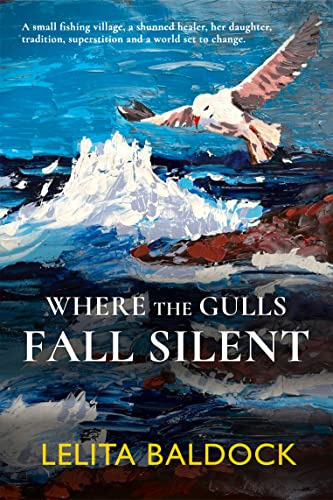
In a Cornish coastal village in the 19th century, the sea is both a source of livelihood and a source of fear, the ever-present power that can give or take. When the fish are abundant, life, although laborious, is good; when they are few, life is hard. Superstition is never abandoned in a community so tied to the rhythms and vagaries of nature.
Kerensa and her mother live, physically and socially, at the edge of the village, never quite part of the community. The reasons for this slowly unfold in this beautifully described novel, revealed both as understood through a child’s eyes and then, as she grows to maturity, through a deeper comprehension. Not all is what Kerensa has thought, nor is it as one-sided as she believed. As she matures, she overcomes both the village’s concerns and her own sense of not belonging, finding love and acceptance – only to have the tides of time and change threaten the village and their way of life.
Author Lelita Baldock’s writing is evocative of place and time, the details of life in fishing village brought into being by a deft hand and an eye for what matters: the sound of the sea, the smells of fish and blood and sweat, the rock of a small boat on the waves. Where the Gulls Fall Silent has no events of national importance, no battles with sword or guns, but the story told is one of both defeat and victory on a small scale, a human scale; social history revealed through the lives of ordinary men and women. Men and women who both dream and are pragmatic; who have strict precepts for living but also a deep capacity for forgiveness; who can ride the peaks and troughs of a life tied to the sea and the land.
Where the Gulls Fall Silent is not a romanticized view of life in a fishing village: life is hard, death always close, moments of peace and security rare and fleeting. A difficult life, one that leaves its mark on people, as Kerensa learns – but one not easy to leave behind. The beating of waves can merge permanently with the beating of a heart, the sea always calling.
If I had any quibble with Where the Gulls Fall Silent, it was in its last few chapters, which are perhaps an unnecessary epilogue to the true story. Leaving the future after a certain point to the reader’s imagination would have been my preference, but regardless, the book is one that will stay with me for some time.
Recommended. No star rating, because I don’t give stars in most cases. Wondering why? My reasoning is here.
In my work-in-progress, Empress & Soldier, the last third of its story overlaps with about a quarter of my third book, Empire’s Exile. In Exile, we see this section through the eyes of the narrator, Lena, and the characters of the soldier Druisius and the Empress Eudekia are peripheral (although very important) to the story.
But Empress & Soldier is told through the alternating viewpoints of Eudekia and Druisius, and so we are seeing the same events through different eyes – and discovering some those events can have very different motivations and interpretations. That’s not the problem: I enjoy exploring the ‘what ifs’ of different perspectives. But everything that happens in this section of Empress & Soldier must fit the chronology of events in Exile. Actions must occur within a framework that is set. Just like a real historical novelist, I can’t change what has already happened.
For me, working within this constraint is a huge challenge. It’s not how my brain works. I’m used to saying ‘oh, look, I really like how The Battle of Maldon is described, so I’ll borrow that but change its outcome.’ Now I can’t even change a conversation, a dinner served, a walk through the city. At the same time, these things are now background events, most happening off-page. My focus is on what Druisius and Eudekia are thinking, doing, feeling, learning—from and alongside the actions and events that already exist.
Which is, of course, what writers of real historical fiction deal with, in every story—and the more recent the history, the more records of events, the more constraints there are. I am not sure I could do this for an entire book, let alone more than one!
This is how I’m handling it: by a detailed analysis of each chapter (and each scene) in Exile that is reflected in Empress & Soldier. This is an exacting and layered process that is very different from the creativity of writing, and is remarkably tiring. But it must be done, and once it is, my mind will switch back to writing mode—and another challenge: how much of Lena’s story do I retell? (Enough for a new reader to understand what’s going on. Not too much, or I risk boring a returning reader. A fine balance.)
I occasionally consider writing a novel based firmly in historical fact. To save my temper, my hair, my liver—and perhaps my marriage— I don’t think I will.
Lady, in Waiting, the third novel in my Tudor Court series, takes place during the early years of the reign of Elizabeth I. Its main character, Margaery Preston, is a chamberer, one of many levels of waiting-women in the royal privy chambers.
Unlike a court headed by a king, where all public and private duties were carried out by men, a queen’s attendants, other than guards, were all female. This gave them some degree of power at court, as courtiers, court officials, and ambassadors all vied for attention and influence. To be a woman in Elizabeth’s court required connections: many attendants were related on her Boleyn side, but there were also cousins descending from her father’s sisters, Margaret and Mary.
The women were required to amuse the queen, and so had to be well-educated, often speaking several languages; skilled in music or dance; and able to keep up with the queen on horseback or at the archery butts.
At the top of the heap was Katherine (“Kat”) Ashley, first lady of the bedchamber and the queen’s former governess. Mistress Ashley kept the privy chamber running smoothly, handling expenses on behalf of the household and keeping an eye on the younger women. But her main concern was always Elizabeth.
The ladies of the bedchamber came next—senior ladies-in-waiting whose duties included dressing and undressing the queen, combing and styling her hair, serving her food, entertaining her with music or conversation, and occasionally sharing her bed. (The queen was a bad sleeper and liked company; it was also a form of security in that she would never be alone). These ladies were generally older, and often married. Most were related to Elizabeth in some way.
Next in line were the maids of honor, who were both entertaining and decorative. Maids were generally well-born girls of fourteen to eighteen years of age. Their placement made it easy to secure good marriages under the queen’s eye.
The other women, including chamberers, were more all-purpose, and did whatever needed doing at any given time, from carrying trays to emptying chamber pots to my character Margaery’s least favorite task, collecting the pins which held the queen’s daily costumes together. (Heads would not roll if Her Majesty stepped on a pin, but it would be an unpleasant time, nonetheless).
With so many women, the court should have been a brilliant display of color, but it was not. As Margaery learns early on from Mistress Ashley, “Her Majesty likes her women to be soberly dressed.”
Elizabeth Tudor did not like to be upstaged, even by those closest to her.
This unusual story of a marriage made for reasons other than love, between two people both with sometimes-conflicting duties to their sovereign and her advisors.
A round up of the reviews I’ve reposted for the social media promotion #FebruarySheWrote, highlighting women writers. I’ve focused on historical fiction authors for this month (primarily), and these are all reviews I’ve written, either for this website, or for Discovering Diamonds.
The War In Our Hearts: WWI fiction. ‘The depiction of {Jamie’s} troubled, doubting soul and the courage and resilience of Aveline are the centrepieces of this debut novel’
Discerning Grace: 19th C High Seas adventure. ‘an admirable debut novel, and a beguiling blend of historical fiction and women’s fiction.’
Summer Warrior: 12th C Scotland. ‘both entertaining and informative; a book to be enjoyed.’
Dear Comrade Novak: 20th C Romania. ‘one of the most devastatingly honest and brutal books I have ever read, yet I could not put it down. ‘














 marianlthorpe.com
You must be logged in to post a comment.