The Ravellers’ Guild, by Rachel Emma Shaw: A Review

Tahnner is a pawn in his father’s game of shifting allegiances.  Eager to prove his loyalty to the king, he offers his son to the Ravellers’ Guild, forcing him into a lifetime of serviceravellers-guild Tahnner never wanted, reading the past and future of his world in the mysterious Threads of morning and evening.

The Ravellers’ Guild is a novella by Rachel Emma Shaw, setting the stage for a book series in production. The world the author has created is both familiar and new: the warring political factions are the background for many a story; the Ravellers, adepts who can follow, understand and translate the messages of the Threads are new.

The novella jumps into action quickly, building both conflict and the world in which that conflict occurs, and introducing us to many of the major characters. The story moves over time – several years pass, allowing Tahnner to mature in his skills, bringing us to the climax, a moment of betrayal, self-realization, and regret for Tahnner, and leaving the reader with enough questions to encourage them to delve into the full series, when it is available.

I’m giving The Ravellers’ Guild 4.5 stars; not 5, because the pacing in the middle section of the book could have been tighter, and I found my attention wandering. But overall, it’s a tantalizing introduction to what may be a fresh new fantasy series.

I received a copy of this book in exchange for an honest review.

When We Go Missing, by Kristen Twardowski: A Review

When We Go Missing by Kristen Twardowski is a competently crafted thriller and a when-we-go-missingpromising debut. A young woman, Alex, falls for a charming man, Nathan; her sister’s antipathy towards him is dismissed.  But Nathan is not what he seems…and Alex slowly realizes this.

Told from the viewpoints of several characters over time, the author handles the various voices well and threads the related stories together effectively, creating sympathetic characters without letting their individual stories overwhelm the direction of the narrative. Tension and conflict are created, and mount throughout the story, well-paced until the denouement.  Here, I felt the story faltered: the related stories have woven together to create two narratives both heading for a climax, and in both cases the climax disappoints: the solution in both cases is just a little too simple.

But When We Go Missing was an enjoyable read, keeping my attention and making me wonder how the story would unfold.  Definitely, it’s worth considering as a beach or plane book!  Four stars for a debut novel that strongly suggests there will be more to look forward to by Kristen Twardowski.

I received a copy of this book in exchange for an honest review.

Enhanced: Book 6 in the Freya Snow series: A Review

Enhanced, the sixth book of the Snowverse series by L.C. Mawson, is the most enhancedaccomplished and polished book of the series. Freya Snow, the magical, autistic, bi-sexual protagonist, has grown up; no longer a frightened and unsure teen, she’s a competent, capable woman no longer afraid to ask for help. And she falls in love for the first time.

Freya is still young, so she’s still growing into her powers, and still determining her place in the magical universe. Her self-understanding and her willingness to accept responsibility have matured along with her (or are those parts of the definition of maturity?). But she’s still making mistakes, of course, or there wouldn’t be much of a story!

I found this book to be tighter in terms of story structure and pacing than some of the earlier books, more focused and with some needed reminders of previous occurrences that influence the events in Enhanced. Freya’s central conflict regarding her Dark and Light bloodlines is furthered without dominating the story.

The author has created a complex and evolving world in the Snowverse, and I definitely recommend reading the books from the beginning to fully appreciate the character and conflict development. Five stars for Enhanced.

Regolith, by H. William Glenbrook: A Review

I am of two minds about this book (a debut science fiction novel by author H. Williamregolith Glenbrook), because I liked half of it but not the other half. Two interconnecting stories make up Regolith: one is a fairly standard ‘spaceship crew fighting aliens’ story; one is a tale of corporate research, in-fighting, and one-upmanship that provides the climax and ultimately the back-story to the other half.

The half I liked is the ‘battle against the aliens’ story. It’s a pretty standard shoot-em-up for the most part; while set in space, it could have been set in any troubled area of the world, with a few changes in technology.  Written in spare, staccato prose, it still manages to convey emotion as well as action.

The corporate half, while ultimately necessary for the denouement, I didn’t like. Subject to too many clichés and wooden characters, as well as awkward dialogue, it might have been better addressed as a prologue to the main story, dealt with in a few pages of exposition until necessarily being reintroduced near the end of the main narrative.

While overall the story could be read as a metaphor for every misguided intervention in world politics made by various governments and countries over the centuries, three stars is the best I can do, and perhaps generously, for this debut novel.

I received a copy of this book in exchange for an honest review.

Kerala Hugged, by Ankur Mutreja: A Review

Kerala Hugged is a delightful and quirky travelogue, chronicling the author’s travels kerala-huggedthrough this southern-most part of India.  I travelled in Kerala a few years ago, so I agreed to review the book even though it’s well outside of what I usually review.

Ankur Mutreja has a very personal way of describing his relationships with landscapes, objects, and events. His description of muddy roads, busy towns, river trips, friendly people and home-stays brought back my own experiences there (I ate some of the best food I’ve ever eaten anywhere in the world in Kerala, the spice-growing area of India).  As he wrote about free-wheeling down through the tea-gardens on his hired motorbike, I thought of all the people we had met doing exactly that.

The writing is lyrical, and it’s clear the author fell in love with this area (just as I did). It’s far from the usual travel book: you’re not going to read detailed reviews or directions, or a list of the top attractions. It’s much more personal than that! It’s his impressions, emotions, reactions to the location and his experiences there, much written in almost poetical language.

When I first wrote this review, I commented that the biggest lack in the book was a map.  The author has since added one, much to the benefit of the reader who does not know southern India.

So…not a typical travelogue, but one I personally enjoyed. 4 stars.

I received a copy of this book in exchange for an honest review.

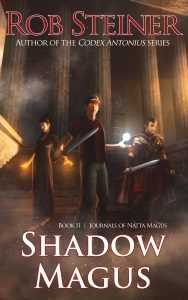
Shadow Magus, by Rob Steiner: A Review

shadow_magusShadow Magus continues the adventures of Remington Blakes, aka Natto Magus, a 21st-century American magus transported to 1st century Rome.  (It’s not necessary to have read the first book to enjoy this one, but I’d recommend it.) Steiner continues to blend good writing, likeable characters, fast action and sense of humour in a well-paced and well-plotted story.

I reviewed the previous book in the series, Citizen Magus, about a year ago, giving the light-hearted and fast-paced fantasy five stars. The sequel continues the mood and quality of the first book.

Another magus, with a type of magic that Natto Magus can’t identify, appears in Rome…and apparently bent on destruction. Caesar Augustus needs Natto’s help to save Rome. From the Circus Maximus to the underworld of Egyptian mythology, Remington pursues the magus in a desperate quest, while not losing his own life to this new power.  Even Remington’s household god Lares gets involved in the crusade.

I don’t want to give away too much of the plot.  But as in the first book, Steiner captures Ancient Rome in all its crowded, smelly reality, without ponderous archaeology weighing the book down.  The magic remains internally consistent and very well described, even the new type of magic the intruder brings, and the historic backstory to the conflict is accurate.  And Natto Magus’s character continues to develop; the next in the series should prove quite interesting!

Five stars to the second installment of a fun series.

I received a copy of this book in exchange for an honest review.

Shaman Machine the Mentor, by Trenlin Hubbert: A Review

On one level a meditation on sentience and consciousness, on another a story of shaman-machineexploration and adventure on a water-world, Shaman Machine the Mentor contains some beautifully-written and insightful passages:  “A commotion of scraping chairs opened a slim gap of welcome.”; or, “I grew up in a house filled with chaos,” he replied. “I was crowded out by indifference.  There was no room for a child in there.”

Both these passages occur in the first third of the book, where the writing is noticeably stronger than the rest of the narrative.  After a promising beginning, introducing us to the robot Chance, the wandering free spirit Ziggy, and the contained city in which Ziggy tries to find some semblance of freedom, the story extends outward to encompass another group of characters, and then another, and a different world.  In this widening of the scope and themes, the story loses its centre. The core characters in the next two-thirds of the book, the troubled architect Alex and the bot Chance, are trying understand each other and their worlds. Alex uses shamanic drugs and alcohol to try to still his critical, sarcastic mind but refuses to accept a different reality when it’s presented to him.  Chance uses its programming and its capability to learn from conversation to expand and encompass the new experiences presented to it. The machine appears to be master to the man.

There’s a good novel in Shaman Machine the Mentor. The book would have benefited from a developmental editor who could have guided the author towards a tighter and more focused narrative. As it stands now, there are too many events that don’t seem to really add to the story and an almost scatter-gun approach to events which the reader then needs to tie together. Some of the technology as proposed was fascinating but not fully fleshed out: the use of sound-clips from a new world to create interwoven agglomerations of spheres as the building blocks for a new city on that world, for example, should have been more important than it was, given the world’s reaction to that city. I wanted to know why the sentient beings of this world reacted as they did to a city based on their own ambient sounds, and how (if) that technology was used as they moved forward.  And while the ending is ultimately beautiful and appropriate, it is reached as an epilogue.

But regardless of its flaws, both the structural ones I have discussed and its need for a copy-editor to weed out inappropriate commas and semi-colons, and the very occasional mis-used word, I find myself contemplating the themes of, and questions raised in, Shaman Machine the Mentor well after I finished the book.  They are not superficial questions, but ones that ask us to think about the meaning of ‘humanity’.  Overall, 3 stars.

I received a copy of this book in exchange for an honest review.
The Dirt Walkers, by David Joel Stevenson: A Review

Just about a year ago, I reviewed David Joel Stevenson’s book The Surface’s End, a young-the-dirt-walkersadult dystopian story. I gave it four stars.  I’ve just finished the sequel, The Dirt Walkers.

Sequels are notoriously difficult, especially if the author did not plan a series from the beginning.  (As I as a writer know, being nearly done the first draft of the sequel to my own book Empire’s Daughter.) The Dirt Walkers continues the story of Jonah, the boy from the wildlands, and Talitha, the girl from the underground city, as they move toward the consummation of their relationship; as well, the story considers the inevitable tensions created for the community and for Talitha as they adjust to each other, and especially the aftershocks and consequences of Talitha’s defection from the underground community.

For those readers wanting to know more about what happened to Jonah and Talitha, the book serves to tell that story.  But in comparison with the first, which I described as ‘compulsively readable’, The Dirt Walkers pales.  Too much of the story is told to us, rather than shown in the actions of characters, and some of what I saw as the more important aspects – Talitha’s culture shock, for one – are glossed over, mentioned but not really dealt with.  Perhaps because more of the action of the story is concerned with what is happening underground, not enough attention is given to the people of the wildlands.  Talitha and Jonah are almost minor characters in this book, and I found the easy resolution  (I can’t say more without spoilers) difficult to fully believe.

Overall, I’m giving The Dirt Walkers three stars.

I received a copy of this book in exchange for an honest review.

Witch (Freya Snow Book 5) by L.C. Mawson: A Review

Witch is the fifth book in the Freya Snow series, following the experiences of autistic, bi-witchsexual, non-human Freya as she learns to navigate both the human world and the world of magic, discovering the complexities of both.

In the human world, Freya has a job as a barista; in the non-human world, she is mostly concerned with finding a way to lift a curse that has placed a friend into a coma-like state. As she solves this problem – with noticeably more skill in negotiation and communication than in earlier books – she also learns more about herself, her non-human family and her place in the hierarchy of magic. Freya’s friends play a larger part in this book; her human family is barely seen, and this is appropriate given Freya is older and more independent.

Freya’s developing maturity is paralleled by author L.C. Mawson’s development as a writer. Witch is perhaps a more thoughtful book than earlier installments, with less physical action and more development of, and insight into, Freya’s character and personality. The ending of Witch is indicative of Freya’s ability to accept responsibility, moving her from adolescent to adult.

Four stars to a pivotal installment in the series. For an overview of all the Freya Snow books, I suggest the author’s site here.