In my work-in-progress, Empress & Soldier, the last third of its story overlaps with about a quarter of my third book, Empire’s Exile. In Exile, we see this section through the eyes of the narrator, Lena, and the characters of the soldier Druisius and the Empress Eudekia are peripheral (although very important) to the story.
But Empress & Soldier is told through the alternating viewpoints of Eudekia and Druisius, and so we are seeing the same events through different eyes – and discovering some those events can have very different motivations and interpretations. That’s not the problem: I enjoy exploring the ‘what ifs’ of different perspectives. But everything that happens in this section of Empress & Soldier must fit the chronology of events in Exile. Actions must occur within a framework that is set. Just like a real historical novelist, I can’t change what has already happened.
For me, working within this constraint is a huge challenge. It’s not how my brain works. I’m used to saying ‘oh, look, I really like how The Battle of Maldon is described, so I’ll borrow that but change its outcome.’ Now I can’t even change a conversation, a dinner served, a walk through the city. At the same time, these things are now background events, most happening off-page. My focus is on what Druisius and Eudekia are thinking, doing, feeling, learning—from and alongside the actions and events that already exist.
Which is, of course, what writers of real historical fiction deal with, in every story—and the more recent the history, the more records of events, the more constraints there are. I am not sure I could do this for an entire book, let alone more than one!
This is how I’m handling it: by a detailed analysis of each chapter (and each scene) in Exile that is reflected in Empress & Soldier. This is an exacting and layered process that is very different from the creativity of writing, and is remarkably tiring. But it must be done, and once it is, my mind will switch back to writing mode—and another challenge: how much of Lena’s story do I retell? (Enough for a new reader to understand what’s going on. Not too much, or I risk boring a returning reader. A fine balance.)
I occasionally consider writing a novel based firmly in historical fact. To save my temper, my hair, my liver—and perhaps my marriage— I don’t think I will.
Lady, in Waiting, the third novel in my Tudor Court series, takes place during the early years of the reign of Elizabeth I. Its main character, Margaery Preston, is a chamberer, one of many levels of waiting-women in the royal privy chambers.
Unlike a court headed by a king, where all public and private duties were carried out by men, a queen’s attendants, other than guards, were all female. This gave them some degree of power at court, as courtiers, court officials, and ambassadors all vied for attention and influence. To be a woman in Elizabeth’s court required connections: many attendants were related on her Boleyn side, but there were also cousins descending from her father’s sisters, Margaret and Mary.
The women were required to amuse the queen, and so had to be well-educated, often speaking several languages; skilled in music or dance; and able to keep up with the queen on horseback or at the archery butts.
At the top of the heap was Katherine (“Kat”) Ashley, first lady of the bedchamber and the queen’s former governess. Mistress Ashley kept the privy chamber running smoothly, handling expenses on behalf of the household and keeping an eye on the younger women. But her main concern was always Elizabeth.
The ladies of the bedchamber came next—senior ladies-in-waiting whose duties included dressing and undressing the queen, combing and styling her hair, serving her food, entertaining her with music or conversation, and occasionally sharing her bed. (The queen was a bad sleeper and liked company; it was also a form of security in that she would never be alone). These ladies were generally older, and often married. Most were related to Elizabeth in some way.
Next in line were the maids of honor, who were both entertaining and decorative. Maids were generally well-born girls of fourteen to eighteen years of age. Their placement made it easy to secure good marriages under the queen’s eye.
The other women, including chamberers, were more all-purpose, and did whatever needed doing at any given time, from carrying trays to emptying chamber pots to my character Margaery’s least favorite task, collecting the pins which held the queen’s daily costumes together. (Heads would not roll if Her Majesty stepped on a pin, but it would be an unpleasant time, nonetheless).
With so many women, the court should have been a brilliant display of color, but it was not. As Margaery learns early on from Mistress Ashley, “Her Majesty likes her women to be soberly dressed.”
Elizabeth Tudor did not like to be upstaged, even by those closest to her.
This unusual story of a marriage made for reasons other than love, between two people both with sometimes-conflicting duties to their sovereign and her advisors.
Working with one of my editorial clients a few weeks ago, I pointed out to him that he had several dropped story threads in his novel. “But,” he said, “the entire action takes place over only a few days. Not everything can be resolved in that time.”
My response? There’s a difference for the reader in leaving a story thread in a place where the reader can speculate about it, and just dropping it. In one case in my client’s novel, the protagonist had expressed (to himself) his interest a woman he worked with. And that was it. The brief scene was there for a number of reasons, but mostly to show that, regardless of personal grief and a building complex political situation, the protagonist wasn’t entirely wrapped up in those two things. But it went nowhere, leaving the reader unsatisfied.
I made a few suggestions, and in the next draft there were a two more brief scenes of interaction between the two which fit smoothly into the narrative, and leave the reader with the hint that this relationship’s going somewhere. We don’t know it, but we can sense it, and that’s enough. Readers don’t need every thread tied up neatly; in fact, it’s good to leave a few minor open-ended questions for them to speculate about, a technique that helps keep a book in their minds.
In my own work, I have a few of these, the most prominent being a question of what happened to two of my characters. No one really knows, but suggestions are made, the search for them has a role, but in the end, I leave it to the reader to decide whether they’ve survived or not.
There’s another way to use ‘hints’ instead of showing or telling, again to leave questions in the reader’s mind, and that’s to be ambiguous. Not often, but this is the classic ‘is Deckard a replicant or not?’ question from Blade Runner. But the ambiguity doesn’t need to be that central; it can be about a characters’ motivation, or the nuances of a relationship.
Here’s an example from one of my books:
“Cannot we both just be content with what we have, at least for a little while?” I said, straightening. “You are alive, and recovering, and you have Lena, and the baby very soon.”
His hand was still on my arm. “And you, mo duíne gràhadh?”
My beloved man. A sudden restriction in my throat made my voice hoarse. “I have enough,” I managed to say, “being here. With you.”
The first-person narrator here interprets the question ‘And you?’ to mean ‘can you be content?’ – a reasonable response to the first statement he makes to the second character. But there’s a second interpretation: he has gone on to say ‘you have Lena, and the baby…’ The question ‘And you?’ can also mean: ‘Do I have you, too?’
In this case, I know which of these two questions was really being asked (and no, I’m not telling.) But occasionally, I don’t know the answer, or not at the time I write it. And sometimes these ambiguous hints get clarified later in the story, and sometimes they don’t – allowing, again, for speculation.
I believe that for a reader to be fully immersed in a story, there needs to be these unanswered questions that involve them in the world, not just show it to them. What did happen to the Entwives in The Lord of the Rings? What was it Ada Doom saw in the woodshed? Does Shane ever return?
(By the way, I think Deckard is a replicant. Your thoughts?)
Robin Lewis – a man who can handle the intrigue and diplomacy of the Tudor courts but prefers his books to people, is skilled enough with words to weave a web with them to save his life but can’t express his feelings, and is no one’s idea of either graceful or handsome – is by far my favourite fictional character from all the books I’ve read in the last few years. Robin is also a man for whom marriage is an unlikely union, especially in middle age, solitary and set in his ways.
But marry he has, to Margaery Preston, an unconventional young woman of intelligence and learning, at her proposal. A marriage of convenience, a compromise that allows Winterset, Margaery’s family estate in Yorkshire, to return to her while allowing Robin, who has rented it for some years, to continue to live there among his books and the isolation he craves.
Written in Heenan’s impeccable prose, Lady, in Waiting is told through Margaery’s eyes – and what a narrator she is! Robin, many years older than his bride, has one idea of what this marriage should be: in name only. Margaery has another: she wants to be Robin’s wife in all ways. But this is far from the only tension between them: Robin is called back to the court to work for Queen Elizabeth’s principal secretary, William Cecil, and Margaery is to be one of her women, a chamberer, spending her days in the queen’s presence to do her – or her ladies-in-waiting’s – bidding. Neither should speak to the other of what they learn, but which vow takes precedence: the oath to the Queen, or the bonds of marriage?
Margaery’s doubts and fears, her determination, her joys, and her sometimes wry sense of humour: ‘my virginity lingered like a bad cough’ as she grows into both her roles make for compelling reading. As she comes to both understand and love the complex man she has married, she comes to understand herself, as well. As the years progress, Margaery’s life is not always easy. Trauma, loss and grief shape her life as certainly as love and politics, and growth and acceptance are sometimes very hard. Heenan neither glosses over this nor over-dramatizes it, but expresses Margaery’s reactions in a sensitive, realistic way.
The personal story of Margaery and Robin’s marriage provides the window through which we see the politics of the day: Elizabeth’s possible (or impossible) marriage options ; the unwise, dangerous secret marriage of another Tudor descendent; the implications of Mary, Queen of Scots’ marriage to Lord Darnley. These were important decisions, choices made that had repercussions both personal and political. The combination of the story that Margaery tells of her marriage and private life, contrasted with these acts on a larger stage, sets the story fully in its time, without robbing it of its intimacy and universality. Highly recommended.
A round up of the reviews I’ve reposted for the social media promotion #FebruarySheWrote, highlighting women writers. I’ve focused on historical fiction authors for this month (primarily), and these are all reviews I’ve written, either for this website, or for Discovering Diamonds.
The War In Our Hearts: WWI fiction. ‘The depiction of {Jamie’s} troubled, doubting soul and the courage and resilience of Aveline are the centrepieces of this debut novel’
Discerning Grace: 19th C High Seas adventure. ‘an admirable debut novel, and a beguiling blend of historical fiction and women’s fiction.’
Summer Warrior: 12th C Scotland. ‘both entertaining and informative; a book to be enjoyed.’
Dear Comrade Novak: 20th C Romania. ‘one of the most devastatingly honest and brutal books I have ever read, yet I could not put it down. ‘
I spent half an hour yesterday consoling? advising? a new indie writer about ‘success’. They have one book out, another on its way. They’re worried about sales, about marketing, about making a name for themselves. Here’s what I, the ‘seasoned indie author’ told them.
We live in a world where the popular measure of success is celebrity; fifteen minutes of fame and making the big bucks. But the chances that you can make a living from writing novels, and only writing novels, is miniscule. Look around you, I said. In this very bookish town in which we live, we had three nominees for the Governor General’s Award (Canada’s major literary fiction award) this year. All but one have other careers, and the one who doesn’t is a retired professor. In the ‘before days’, when there was an open writing space freely available to all on Monday mornings, I’ve shared table space with yet another Governor General’s Award short-listed author (who also has another career) and an Edgar-nominated mystery author (who also has another career) and a Stephen Leacock award short-listed writer (who also, etc….). I’ve read at literary festivals with some pretty big names, too – and almost all these writers do something else other than write novels: teach, practice law or work in warehouses, are system analysts or build houses. And these examples, I will note, are all (except two) traditionally published authors.
This doesn’t mean your writing is a hobby. It doesn’t mean it isn’t viable. It doesn’t mean there aren’t a few people who can make a living at it. And maybe you’re one of them.
And maybe you’re not. But if you’re not, you’re in very good company in the literary world. You shouldn’t think less of yourself, or that you’re a failure. I consider myself a successful writer, but the actual profit from my books isn’t a major part of my yearly income.
But:
‘your books got me back into reading’
‘your books are my go-to when I need to escape this world for a while’
‘I dread the day when you stop writing this series’
‘I’m waiting for your new release more than any other book in 2022’
and many other similar expressions of what some people find in my books is my measure of success. If your stories resonate with a few readers; if they bring smiles to their faces or make them ask themselves hard questions; if they read until 3 a.m. because they can’t put them down, or leave the light on to sleep because you terrified them – isn’t that success?
Did the new author take this in? I don’t know. But I hope so. Because they are talented, and have stories to offer to the world that some readers will fall deeply into. I’d hate them to waste their time and energy and talent worrying about only one definition of a successful writer.
With a very few exceptions, I’ve stopped giving stars on book reviews. Why?
Some books I read entirely for entertainment. Some books I read and discover there are deeper themes, viewpoints that make me think, and may have a lasting impact on how I see the world. Some books I read and fall in love with the author’s writing: how they use words, the grace and precision of their sentences, their images, their skill with the craft. Some authors are journeymen, shall we say, conveying a good story competently, but without a master’s touch. In my eyes.
Books I love, others don’t. Books I dislike, others love. That’s a given for all art. But here’s my first reason not to give stars: my opinions change. A book I disliked (or didn’t understand) in its first reading – The Buried Giant, Kazuo Ishiguro’s dream-like story about the mutability of time and memory – refused to remove itself from my mind. On its second reading, I was entranced. It remains a difficult book, hard to categorize, allegoric, but if the purpose of art is to change the way we see or think about the world, it’s succeeded for me. But if I’d rated it back in 2015, I’d have given it 3 stars, or less.
That leads me into the second reason: how people perceive a star rating. Three stars to me says ‘it’s ok, an average book.’ And that’s fine. Not every book (or movie, or painting, or meal, or hotel) is a masterpiece, even within its genre. But more and more I see authors thinking their work automatically deserves five stars. I see some authors being upset with four-star ratings, focusing on the stars, not the words in the review. I’d much rather my review was read as meaningful critique. So: no stars. Take the time to absorb what I say – that’s what matters.
The third reason is one of respect. In today’s interconnected world, very often I know – at least through social media – the author whose work I’m reviewing. Writers reviewing other writers know how much blood, toil, tears and sweat goes into writing a book, and we are loathe to undermine that effort. Overall, I think perhaps we’re a little too nice to each other, because of that. But a review without a star rating, one written with skill and thought – a proper critique, not a criticism – should indicate to other readers – and the writer – what I thought the strengths, and perhaps the weaknesses, of the book are.
Will I ever give another star rating? Yes, sometimes. I will star-rate a book for a debut author, especially if they have next to no reviews and if I can write an overall positive review. I will star-rate an exceptional book, one that a decade from now I’m pretty sure I’ll still be thinking about. And if I am reviewing for a blog tour, yes. But otherwise, no. Not any longer.
I was extremely pleased (to put it mildly) to have a chance to talk to David M. Perry, one of the authors of the brilliant new book The Bright Ages: A New History of Medieval Europe. I’m focusing on just a tiny part of what the book covers – it would be impossible to discuss all its themes.
David, my first stop at the British Museum is always the Sutton Hoo treasure. As an amateur historian of the period previously known as the dark ages, it has, to me, always represented the conundrum of the times for a researcher. It presents us with evidence of the interconnectedness of the world: the Sri Lankan garnets, the Byzantine silver, the lyre now suggested to share features with those of steppe cultures far to the east. The burial itself appears to follow traditions outside Christian practice: the ship itself, the grave goods—but some of those grave goods are specifically Christian. And at the same time, we don’t know for certain whose burial this is, because of the lack of written records.
In reading The Bright Ages, I was struck by something I hadn’t been able to articulate before, although it is important in my own fictional, alternative early-medieval world: the conception of places like Rome and Byzantium as cities of more than political importance, but occupying a space best described as sacred, or at least revered, in the mental geography of people who had (perhaps) never been there. The Byzantine silver in the 7th century Sutton Hoo burial would then be not just an offering to whatever gods there were to receive the dead king, but a direct and purposeful link to Byzantium as a concept. A connection to the holy. So, after that long-winded preamble, my first question is simply: is that a valid interpretation? Can you explain a bit further why or why not?
So in my formal academic career, I began as a historian not only of medieval Venice, but of narratives about the movement of objects (first relics, then other things) into and out of Venice, and the ways that people found and created meaning in things that came from elsewhere. People connect themselves in their current moment to places that are in fact far away, but are always present in their imaginary geography, through things (and through images, but often images of things!). I do think that the use of garnets, of Byzantine silver, of silks, of beautiful things from ELSEWHERE, and elsewheres associated with important positions in imaginary sacred geographies, is not an accident.
And in the places I know best, like high medieval Venice, or as in 6th-century Byzantium as we discuss in the book, or in the creation of Ste. Chapelle, again and again, we see that this re-ordering of the imaginary geography isn’t just something that happens, but something people do with great intention.
What interests me always is when people try to reorder the imagination but fail, because failures leave few records.
My first introduction to the intellectual exchange of ideas during early-medieval times came from reading about Alcuin of York. For readers who may not know much about him, to summarize, Alcuin, who lived about 100 years after the king buried at Sutton Hoo, was an 8th century scholar and teacher, educated at the cathedral of York. Sent to Rome on a diplomatic mission, on his way home he encountered Charlemagne, who persuaded Alcuin to join his group of scholars at Aachen, leading to the reformation of the palace school into a centre of learning, with methods and traditions derived from the schools of Greece and Rome.
Raban Maur (left), supported by Alcuin (middle), dedicates his work to Archbishop Otgar of Mainz Fulda, Public domain, via Wikimedia Commons
Charlemagne, of course, is a hugely important and powerful figure, crowned by the Pope as Roman Emperor in 800. He had betrothed a daughter to the Byzantine heir at one point. Rome and Byzantium were far more than concepts to him; they were real places, centres of power as well as holiness. Can you speculate – or more than speculate – on the effect Alcuin’s reformation of the palace school might have had on Charlemagne’s self-concept and ambition, and his efforts to create, at Aachen, a mirror of Byzantium’s sacred and secular power in both physical (the cathedral and palace) and intellectual/spiritual form?
For this question, I had to turn to my Carolingianist colleague and co-author, Matt. He said, “I think this is a bit backwards in that Alcuin didn’t really create the palace school, Charlemagne did. Alcuin didn’t transform it so much as accelerate the transformation, but it wasn’t to ape the East; instead it was to ape the late Roman West – Theodosius, Constantine, etc. In other words, Alcuin was not – by a longshot – the only exceptional intellectual in the late 8th-century palace school. people like Theodoulf of Orleans or Paul the Dean who floated around the court were movers and shakers as well.”
(John Julian Norwich said ‘Most British people know practically nothing at all about French history.’ and this is an excellent example of me relying on entirely British sources for my idea of Alcuin. I’m glad to have it corrected, and it’s a good reminder to me to broaden my reading.)
Jumping forward nearly 500 years, to France in the 13th century, Chapter 14 of The Bright Ages tells us about Louis IX of France, and the role the Sainte-Chapelle chapel played in his centralization of both secular and sacred power. But an earlier church – Saint-Denis – also intentionally reimagined Paris – or at least this part of it – into a sacred space in which light is used with purpose and thought to shape and guide what is experienced: a ritual landscape where light represents the true light of Christianity.
The windows of Sainte-Chapelle tell the story of the Crown of Thorns’ travel from Jesus’s head to Constantinople to the king of France – a ‘translatio imperii’ – transfer of imperial power, as you explain. But this isn’t just a transfer of secular power, but of the implied approval and blessing of the Christian god. The Crown of Thorns creates a direct link between Jesus and Louis IX, giving him immense power beyond simply political.
This creation of a sacred, ritual landscape is nothing new: from the first cave paintings that move in flickering light, to the solstice-aligned bronze age monuments and the oculus in the Pantheon, people have consciously set about to create wonder and mystery linked to religious belief—and light. But it appears that in 12th and 13th century France, this was being done quite purposefully, in a way that to 21st century eyes looks almost clinical, like Disney designing an attraction to maximize gasps and awe (and pilgrims exiting through the gift shop?) Can you expand a little on this – is there a dichotomy here? And secondly, although this might need an entire book to answer, how did Abbot Suger know/learn to design such a ritualized, psychologically-influential landscape?)
This question ties directly in to your first, with Ste. Chappelle crafted as a way to try and create a new center of gravity for world (from the point of view of Louis IX and his supporters) by not just relocating the relics of the Passion, but installing them in grandeur, giving them a site from which to re-order the world. But you’re right, the place to understand how we reach here in 13th century France is to drop back a century and look at Abbot Suger.
The great historian of the topic is Erwin Panofsky, whose works not only contain the key translations of Suger, but also analysis of the Abbot. What’s amazing about Suger is not only that he built such glorious spaces, but that he articulated a theory of light and beauty, a viewer-response theory, that in gazing about the most glorious sights of earth, the viewer would be transported to the true glory of heaven. I read it – and of course I’m not alone – as neoplatonic in nature, or similar to how St. Augustine told medieval Christians to read scripture (starting at the words themselves, but using them to find one’s way to caritas, to love of God, reading for symbols as needed). Was it cynical? Well, Suger certainly had a political agenda in mind, but I’d be hard pressed to think of anyone working at the scale who didn’t. He wasn’t personally interested in luxury, as far as we know, but rather performatively lived in a simple bare monk’s cell, even as he covered the church in gold.
I grew up a lover of simplicity in sacred spaces. The bare white New England Church. The ruined monasteries in northern England. The writing of St. Francis. So it’s been important for me to immerse myself in the words of Suger in order to find the fully expressed counter theory as to why beauty matters as a pathway to the sacred.
For readers of this interview, I’d like to say there is much more to The Bright Ages than what I’ve focused on here: this was my choice of one small thread within the book to follow, because it’s of personal interest. David, is there anything else you’d like to highlight, either in the book’s content, or why you chose to write The Bright Ages at this particular point in history?
Every professional medievalist that we know sees the intense disconnect between the broad narrative of “the dark ages” and the actual period we study. We all push back against it in our classes, and hopefully most students who leave a medieval history class leave with more complex ideas. But sadly not everyone takes a medieval history class! And so we took the leap to not write the standard 700 page big pop history book, many of which are lovely and I’ve read, but rather to try and write a different kind of book that simultaneously provided a narrative mostly chronological framework, but centered not a succession of facts, popes, kings, men with sticks, queens, etc., but instead centered ideas. Centered humanity, in all its messiness. If it generates even the most miniscule push back against the dark ages, and provides a tiny bit of momentum to the huge community of scholars doing the work, we’ll be content.
David, thank you for taking the time to answer my questions. The Bright Ages is a book that’s going to stay on my bookshelves, and I expect readers will see its influence in my own books before long.
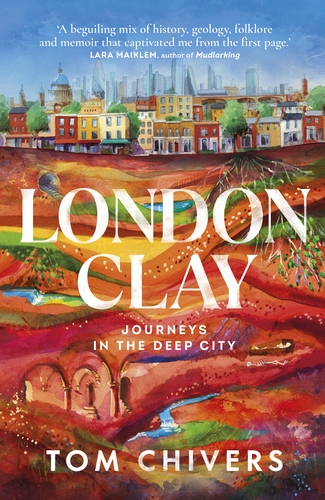
London Clay: Journeys in the Deep City, by Tom Chivers
All my life I have had recurring dreams of paths, of underground tunnels and caves, of the liminal space between land and water. And so I am drawn to explorations in prose of these places, other writers’ experiences. London Clay: Journeys in the Deep City is one of these books.
But it is more than a record of author Tom Chivers’ experiences in exploring what lies beneath the ever-changing city – the layers of history and prehistory exposed by construction, reimagined from old maps, seen in the lines of minor streets. (This too attracted me to the book, landscape history and archeology, as many of you reading this will know, is an avocation of mine.) London Clay chronicles the author’s experiences in the wastegrounds of London – sometimes literally in sewers, sometimes in the abandoned expanses of what was once the industrial docklands, sometimes in the sterility of modern developments, as he searches for traces of the past.
London Clay kept me both entranced and contemplative, thinking of what lies under other cities I know – York, Seattle, my own. History both visible and invisible, traces left from names we know and names we don’t. Throughout the book, Chivers returns to holes: entrance places into the underground pushed up by geology or dug down by humans through the London Clay of the title. Like Orpheus, he goes down into the dark, returning with only shards and shadows and stories to tell – both of London and himself. In his own words:
London is enchanted ground…a glorious hyperreality: a hundred million possible Londons, present and past, imagined, intended, forgotten and reborn. Time is all around us….
I had set out, armed with a tattered map, to discover what lies beneath the streets. But I have found myself descending deeper into the layers of my own life than I had expected…
As I embark on a modest project on the history of the city on which I live – not a book, simply a collection of articles for our community newsletter, only some of which I will write – I cannot help but think Chivers’ book will influence it. Mine is a much smaller city, and much younger, its visible history easier to find. An intended city, imagined on paper, planned. But it too has the past hidden below what is seen today, and I can’t look at it the same way as I would have before reading London Clay.
In no order, here are the fifteen books out of all I’ve read this year that have truly stuck in my mind, one way or another.
Fiction
Karen Heenan: A Wider World. Tudor historical fiction, but not about the royals. A nuanced portrait of a man caught up in the politics and intrigues of the Tudor Court.
Gregory Norminton. The Devil’s Highway. One landscape. Past, present, future. Spare and challenging.
Jonathan Nevair: The Wind Tide trilogy. Space opera at its finest: three interconnected books, with underlying ancient themes of ethics and morality and belonging.
Julie Bozza: Writ in Blood. A retelling of the story of the Earps, Doc Holliday, and Johnny Ringo – but above all about loneliness, love and acceptance.
Laury Silvers: The Jealous. The second of Silvers’ trilogy of Sufi mysteries, this – and the first (The Lover) as well – brought 12th C Baghdad, and the lives of working men and women, alive.
Anne Louise Avery: Reynard the Fox. Beautifully written retelling of the medieval western European story cycle.
Non-fiction read for pleasure:
Helen MacDonald, Vesper Flights. A collection of observational and philosophical essays on nature, with an underlying sense of both wonder and sorrow.
Charles Foster, The Screaming Sky. Science and philosophy, once again, this time centred around swifts and their place in the world – and what the way we see them says about us.
Tom Chivers: London Clay: Journeys in the Deep City. Investigations into the lost landscapes of London. Layers of history and ecology and meaning. An urban, non-fiction companion to The Devil’s Highway.
Robert MacFarlane and Jackie Morris: The Lost Spells. Beautifully illustrated collection of – poems? incantations? – about the natural world.
Non-fiction read for research and pleasure:
Matthew Gabriele and David M. Perry: The Bright Ages: A New History of Medieval Europe. A survey of early-medieval Europe, discussing change, connection, and continuity, and the contributions of often historically marginalized individuals and events.
Guy de la Bédoyère: Praetorian, Gladius, and Domina. All three books have been highly readable yet still scholarly works informing me about the Praetorian guard, the Roman army, and the women who helped shape Rome and Roman politics.
L.J. Trafford: Sex and Sexuality in Ancient Rome. How could I not include this? Both funny and informative, it’s a great resource for writers looking to accurately reflect Roman attitudes, or for anyone who just wants to know what Cicero had to say about sex.










You must be logged in to post a comment.